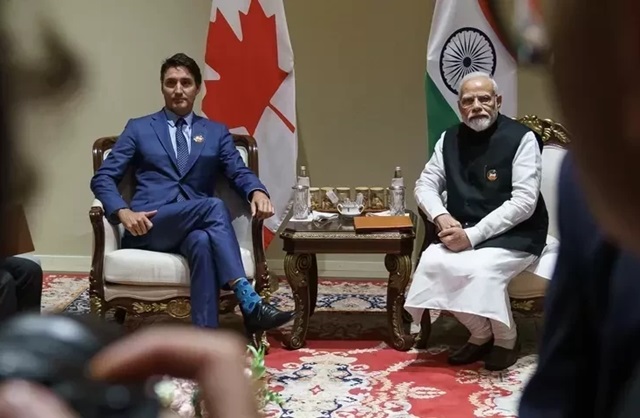
The Canadian government’s announcement that the activities of the Indian High Commissioner to Canada would be investigated in connection with the murder of a Sikh Canadian citizen has sent shockwaves through India. The Indian government reacted sharply by asking the Indian High Commissioner to Canada, along with other diplomats, to leave Canada and return to India.
Considering the cordial relationship between both countries over the past several decades, people of Indian origin living in Canada, as well as Indians studying or employed there, and Canadian citizens currently in India, may feel that both governments have overreacted. Whatever the recent developments, the Indian government’s reaction likely stems not only from the Canadian government’s announcement regarding the Indian High Commissioner, but also from the long-standing issue of Khalistan separatists, who advocate for the division of India to form a separate Sikh state known as Khalistan, operating freely in Canada without adequate oversight by the Canadian government. These separatists have been conducting a vicious campaign against India’s interests with little resistance. The Canadian government’s stance that these separatists are entitled to freedom of speech and action, even when it is against the interests of another country, is clearly unacceptable. No country would tolerate such a situation. If Canadian citizens were to act against Canada’s interests in another country, the Canadian government would also find this unacceptable.
Canada has a mixed population, with 2.1% of the population belonging to the Sikh community, 2.3% being Hindus, 4.9% Muslims, and others belonging to Christianity and various other religions, including a proportion who identify as secular (no religion).
Despite their relatively small percentage, the Sikh community in Canada wields significant influence in government formation and operations. This is due in part to the fact that the Sikh community has effectively organised itself in the political sphere. In this context, it seems that the Canadian government has perhaps turned a blind eye to the separatist movement being supported by a section of Sikhs in Canada.
It is surprising that the current Prime Minister of Canada appears to have failed to understand that, while individuals may have the freedom to live and speak as they choose in Canada, this freedom cannot be allowed to be misused to destabilise another country. If the Canadian government considers it acceptable to allow freedom for organising separatist movements against other countries on Canadian soil, it essentially implies that the government is indirectly complicit in that separatist activity. In this context, the Indian government’s grievance against the current Canadian administration is justified.
In the past, the Sri Lankan government also expressed similar concerns about the Canadian government, which allowed the LTTE, a separatist group in Sri Lanka, to operate freely on Canadian soil. It is widely believed that the LTTE became such a formidable militant group in large part due to the support it received from its Canadian base.
With Canada’s 4.9% Muslim population, it is also well known that acts of terrorism are sometimes carried out by a small section of the global Muslim population. It is unclear whether the Canadian government has given sufficient attention to the possibility of some extremist Muslims in Canada using the country as a base to launch terrorist activities elsewhere, especially considering that several terrorist acts have been carried out in America and Europe by militant Islamist groups. Would Canada tolerate such activities if they were directed against its own interests?
By allowing Canadian soil to be used as a base for organising separatist movements against other countries, Canada is now facing a situation where its peaceful environment is being threatened by violent activities and political assassinations. The peace in Canada is bound to be affected if separatists and violent elements are permitted to operate under the guise of freedom.
It is essential that the Canadian government takes a firm stand, declaring that it will not allow separatist movements targeting other countries to flourish on its soil. If Canada were to take such a position, relations with India would normalise and return to the cordial state they have enjoyed for decades.
Historically, the relationship between India and Canada has been very friendly, with Indians holding Canada in high esteem. Many Indians have migrated to Canada due to its many positive attributes. The Canadian government should not allow this favourable perception to be erased in one stroke by confusing freedom of action with the freedom to threaten the territorial integrity of other nations, regardless of the religion of those involved.
The Indian government’s sharp reaction should be viewed by the Canadian government and its people as inevitable, and the Canadian government should demonstrate the mature leadership it is known for.