



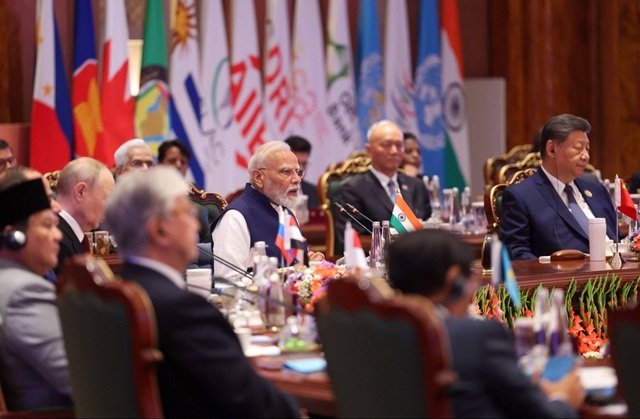
There are moments in the long march of international affairs when a summit, otherwise destined for the archives of routine diplomacy, acquires the resonance of a turning point. The BRICS Summit convened in New Delhi in 2026 was one such moment. It did not announce itself with fanfare; rather, it unfolded with the quiet gravity of an assembly aware that the world outside its conference halls was unsettled, divided, and searching for direction. What distinguished this gathering was not the familiar choreography of leaders standing shoulder to shoulder, but the deeper recognition that the global order—long anchored in Western predominance—was beginning to loosen, and that India, almost by the logic of circumstance, found itself positioned to guide the conversation toward a more pluralistic future.
The world that arrived in New Delhi was marked by conflict and uncertainty. The war in Ukraine, now in its fifth year, had reshaped Europe’s security architecture and unsettled global energy markets. The Iran–Israel war had cast a long shadow across West Asia, threatening the Strait of Hormuz and reviving fears of a wider regional rupture. The Palestinian question, often relegated to the margins of global diplomacy, returned to the centre of deliberation as BRICS members endorsed a two‑state solution. In such a climate, the New Delhi Summit attempted something ambitious: to articulate a collective response to a fraying world order and to explore whether a new one might be coaxed into being.
An Expanded Forum, A Broader Mandate
The first feature that set the New Delhi Summit apart was its sheer breadth. BRICS, once a compact group of five, had expanded into a coalition of eleven—Russia, China, India, Brazil, South Africa, Iran, Saudi Arabia, Egypt, Ethiopia, the UAE, and Indonesia. This enlargement transformed BRICS from an economic consortium into a geopolitical forum representing nearly half of humanity and a significant share of global GDP, energy flows, and trade routes.
The presence of Vladimir Putin, Xi Jinping, Iran’s President Pezeshkian, Saudi Arabia’s delegation, and Indonesia’s Prabowo Subianto created a tableau unprecedented in the annals of non‑Western multilateralism. These leaders do not often share a platform; some are rivals, others uneasy partners. Yet India managed to convene them, demonstrating a diplomatic convening power that is the essence of middle‑power statecraft.
The second distinguishing feature was the adoption of the New Delhi Declaration, a document of considerable breadth and ambition. It condemned terrorism unequivocally, endorsed a two‑state solution for Israel and Palestine, called for cessation of hostilities in Ukraine and West Asia, criticised unilateral sanctions and tariffs, and demanded reform of global governance institutions. Achieving consensus on such contentious issues—especially between Iran and Saudi Arabia, or China and India—was itself a diplomatic achievement of no small significance.
The third feature was the shift from broad political signalling to actionable cooperation. India pushed BRICS toward digital public infrastructure, MSME linkages, local‑currency trade, and supply‑chain diversification. These initiatives suggested that BRICS might evolve from a forum of aspiration into one capable of practical implementation.
India’s Middle‑Power Ascendancy
India’s gains from the summit were not merely symbolic; they reflected a deeper strategic positioning that has been quietly maturing over the past decade.
First, India demonstrated its ability to convene actors across geopolitical divides. Bringing together Russia and China, Iran and Saudi Arabia, Indonesia and Egypt, at a time of global polarisation, showcased India’s credibility as a country that maintains ties with Washington, Moscow, Beijing, Tehran, and Riyadh simultaneously. This balancing act is not neutrality; it is strategic autonomy deployed with purpose.
Second, India strengthened its legitimacy in debates on global governance. The declaration reiterated support for India’s aspirations for a greater role in the UN Security Council. With the UNSC paralysed by veto politics, India’s leadership of the Global South—visible in the G20 presidency and now in BRICS—positions it as a voice for developing nations seeking representation in global rule‑making.
Third, India succeeded in embedding its normative agenda. The condemnation of terrorism, including cross‑border terrorism and terror financing, aligns BRICS with India’s long‑standing security concerns. The criticism of unilateral sanctions and tariffs echoes India’s discomfort with weaponised interdependence and the extraterritorial reach of U.S. economic coercion.
Fourth, India stands to gain economically. Digital public infrastructure, fintech cooperation, and local‑currency trade could reduce transaction costs, diversify supply chains, and create new markets for Indian startups and exporters. Middle‑power diplomacy thus translates into tangible economic opportunity.
The Wars That Frame Our Time
The New Delhi Summit attempted to address the two conflicts that define the present geopolitical moment.
On Ukraine, BRICS called for cessation of hostilities, humanitarian corridors, and a negotiated settlement. This was significant because it represented a non‑Western consensus that neither endorsed Russia’s invasion nor aligned with the West’s maximalist sanctions regime. It was a middle‑path position reflecting India’s own stance that sought de‑escalation without moral absolutism.
On the Iran–Israel war, BRICS urged restraint, protection of civilian infrastructure, and revival of diplomatic channels. The Strait of Hormuz, through which a fifth of the world’s oil flows, had become a trembling corridor of drones, missile batteries, and naval deployments. BRICS’ call for stabilisation was not rhetorical; it was a recognition that global economic recovery depends on the security of these waters.
Most striking was the endorsement of a two‑state solution for Israel and Palestine. For the first time, BRICS articulated a collective position on a conflict that has shaped West Asian politics for decades. This was not merely a nod to historical justice; it was an acknowledgment that the Palestinian question cannot be indefinitely deferred without destabilising the region.
The Prospect of a New World Order
The question that hovered over the New Delhi Summit was whether BRICS could catalyse a new world order. The answer is layered.
There is promise. The erosion of Western dominance, the rise of non‑Western economies, and the demand for institutional reform create structural conditions favourable to a more pluralistic order. BRICS members collectively represent a demographic and economic weight that cannot be ignored. Their call for WTO reform, UNSC restructuring, and fairer global governance reflects a genuine aspiration for systemic change.
But there are constraints. BRICS is not a cohesive bloc. China and India have unresolved border disputes. Iran and Saudi Arabia are regional rivals. Russia’s global standing is shaped by the Ukraine conflict. Indonesia, Brazil, and South Africa pursue independent foreign policies. These contradictions limit BRICS’ ability to act as a unified geopolitical force.
Institutionalisation remains weak. BRICS lacks the institutional depth of NATO or the EU. Its decisions are consensus‑based, non‑binding, and often aspirational. The New Delhi Declaration, though comprehensive, is a statement of intent rather than a blueprint for structural transformation.
The United States remains central. Despite criticisms of unilateral sanctions and tariffs, the U.S. remains the world’s largest economy, technological leader, and security provider. A new world order cannot emerge by bypassing the U.S.; it must emerge through rebalancing, accommodation, and reform.
India faces a middle‑power dilemma. India seeks a multipolar world but must avoid being subsumed under a China‑centric order. Its challenge is to lead without being overshadowed. The New Delhi Summit showcased India’s diplomatic skill, but sustaining leadership requires economic heft, military capability, and institutional innovation.
Conclusion: A World in Transition
The New Delhi BRICS Summit was a moment of possibility. It revealed a world in transition—where the old order is fraying, the new one gestating, and India positioning itself at the centre of this unfolding transformation. It showcased India’s emergence as a middle power capable of convening diverse actors, shaping global debates, and articulating the aspirations of the Global South. It demonstrated BRICS’ potential to challenge aspects of the existing order—unilateral sanctions, trade barriers, outdated institutions—and to propose alternatives rooted in cooperation rather than coercion.
Yet the creation of a new world order requires more than declarations. It demands coherence, institutionalisation, and shared strategic purpose—qualities BRICS does not yet possess. The New Delhi Summit was not the birth of a new order, but it was a signal that the world is searching for one. In that search, India has claimed a seat not at the margins but at the centre.





A formidable and statesmanlike assessment of BRICS and the shifting architecture of global power. The article rises above conventional summit commentary to illuminate India’s strategic vision, BRICS’ expanding geopolitical weight, and the historic emergence of a more balanced, multipolar world order. Its discerning analysis carries both intellectual authority and strategic foresight. Most significantly, it reminds us that New Delhi was not merely hosting a summit; it was asserting a larger place in the making of the twenty-first-century global order.
—Anwar A. Khan, a Frontline Freedom Fighter
and Direct Witness to Bangladesh’s Birth
amid the Brutality of the Pakistani Military Regime in 1971.