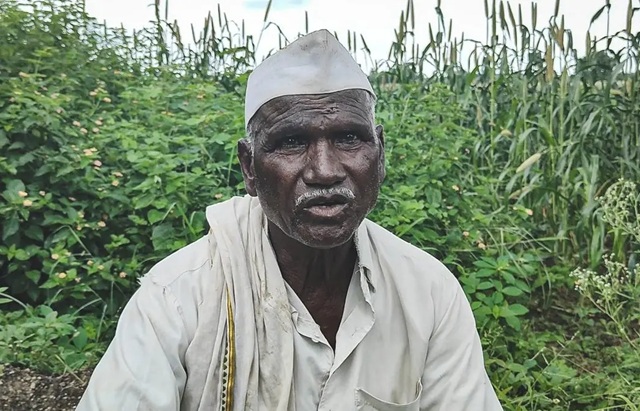
In Maharashtra’s Jalgaon district, several farming families are accusing solar power companies of using deceptive tactics to acquire their agricultural land. Nimbabai Bima Savde, a 55-year-old farmer from Bodhare village, shared her grief with Front Line India. She recalled how her husband, Bhimrao Sakaram Savde, passed away after realizing that the family’s farmland had been sold without their consent. “He died of stress,” she said, explaining that they had been deceived by a broker who promised that the deal was related to dividing their family land. Instead, it turned out that their land was sold to a solar company, leaving the family devastated.
The plight of Nimbabai’s family is just one of many, as more than 130 families across five villages—Lonje, Bodhare, Shivapur, Pimparkhed, and Ranjangaon—are fighting against solar companies they accuse of exploiting their vulnerable positions. These families, who belong to Scheduled Castes, nomadic tribes, and minority communities, allege that they were tricked into selling their land to major solar corporations like the JBM Group and Avaada Group. Front Line India’s investigation, based on interviews with affected farmers, reveals a troubling pattern of deceit, coercion, and manipulation.
The affected farmers had depended on their land for survival for decades. In the 1970s, these families were allotted land under the Maharashtra Land Revenue Code of 1966, specifically for agricultural use. This land is protected under specific regulations, making it illegal to sell or convert it without government approval. However, the farmers allege that brokers representing solar companies pressured them into signing deals under false pretenses. They were told that their land, which had been designated for agricultural use, was in danger of being taken over by the government unless they agreed to sell it for a fraction of its true value.
As part of Front Line’s extensive investigation, satellite imagery and land records indicate that the solar plants, spanning 1,100 acres, were constructed in violation of several laws. These solar projects encroach upon parts of the Gautala Autramghat Wildlife Sanctuary, a protected area since 1986. Additionally, the area around the sanctuary was declared an Eco-Sensitive Zone (ESZ) by the Ministry of Environment in 2016, further complicating the legality of the land deals. Under the ESZ regulations, construction, agriculture, and commercial ventures are heavily restricted to prevent damage to the environment.
Many farmers who were coerced into signing land deals describe how brokers visited them repeatedly, claiming the government would seize their land if they did not sell. They were promised jobs at the solar plants and compensation well above the market rate, but many families report receiving far less than agreed. In some cases, the land was sold to the companies using fraudulent signatures and fake documentation, with deceased family members’ names included on the sale deeds. These illegal transactions are not just about lost livelihoods; they represent the erosion of trust and the exploitation of some of India’s most vulnerable communities.
A particularly disturbing case involves Harsingh Sakru Rathod, a 70-year-old farmer from Bodhare village. He was offered Rs.12 lakh per acre for his land, but the sale deed recorded a sum of just Rs.4.25 lakh for his 4.942 acres—far below the government’s valuation. Despite repeated demands for the promised compensation and jobs, Rathod, like many others, received much less than expected, and was pressured by brokers to sign the deal. His case is just one example of how the farmers were duped into selling their land at a steep discount.
In addition to the economic loss, the affected farmers now face the loss of their homes and livelihoods. Many were promised jobs and benefits from the solar companies, but those promises were never fulfilled. Parshuram Deva Chauhan, a 75-year-old farmer from Bodhare, explained that after agreeing to sell his 7.092 acres for Rs.12.6 lakh—far less than the promised amount—his house was demolished by the company. The betrayal and the loss of his home have left him distraught, as his life’s work was taken from him under false promises.
Front Line’s investigation highlights how the deceptive practices of these solar companies have raised serious concerns about land rights and exploitation. The farmers’ stories echo a broader pattern of conflict in rural India, where the push for renewable energy often comes at the cost of local communities’ rights and well-being. A report by Land Conflict Watch, mentioned in the investigation, notes that nearly 60 percent of land disputes related to renewable energy projects have occurred in rural areas, and a significant portion of these involve agricultural land.
Further scrutiny reveals that these solar plants violated multiple environmental laws. The construction of the plants encroached on the Gautala Autramghat Wildlife Sanctuary, breaching the Wild Life (Protection) Act, 1972, and the Environment (Protection) Act, 1986. These projects were also set up without the necessary clearances from environmental and wildlife authorities. Despite numerous complaints, both from the affected farmers and environmentalists, government action has been slow, and regulatory loopholes have allowed these projects to continue.
As the farmers take legal action, including a case currently before the Bombay High Court, they continue to seek justice for the loss of their land and livelihoods. According to Bhushan Mahajan, a lawyer representing some of the farmers, the sale deeds violate provisions of the Wildlife Protection Act, which prohibits the transfer of land within the boundaries of a protected sanctuary. The case, however, has dragged on for years, and the farmers remain in legal limbo while struggling to survive without the land that once sustained them.
In response to this, the Shetkari Bachav Kruti Samiti, a farmer advocacy group formed by the affected families, has organized numerous protests, demanding justice and the return of their land. Despite facing jail time and violent clashes with the authorities, the farmers remain resolute. “We have been fighting for years, but nothing has changed,” said Shantibai, a 75-year-old farmer who was jailed for her participation in the 2022 protests. “How will we survive? Instead of justice, we were put in jail.”
The case is a stark reminder of the challenges rural communities face in protecting their land and rights against the pressure of large-scale commercial projects. With renewable energy seen as essential for India’s future, the story of these farmers serves as a cautionary tale about the need to balance environmental goals with the rights of local populations. As the battle for justice continues, one thing is clear: these farmers are not giving up without a fight.