The hidden world of Cold War intelligence operations has long fascinated historians, but newly resurfaced and declassified documents are shedding fresh light on some of the most controversial experiments ever conducted by the United States intelligence community. Files linked to two secret programs—Project Artichoke and Project Stargate—reveal a chilling period when the Central Intelligence Agency explored methods ranging from slow-acting mind-altering drugs to the weaponization of psychic abilities in an attempt to control human behavior and gather intelligence beyond the limits of conventional science.
The revelations come from documents that were quietly released decades ago but have recently drawn renewed attention from researchers examining the darker corners of Cold War experimentation. At the center of the revelations is Project Artichoke, a top-secret CIA program that ran between 1951 and 1956 and focused on manipulating human minds through drugs, hypnosis, and psychological conditioning.
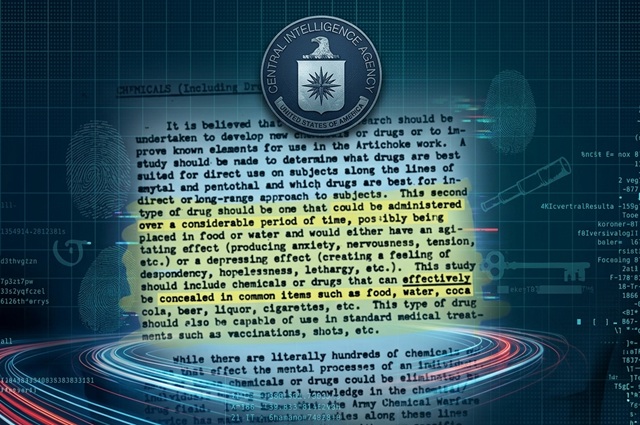
One of the most striking elements in the newly discussed material is a proposal to develop a slow-acting chemical substance capable of influencing a person’s emotional and mental state without their awareness. According to a secret CIA paper, intelligence officials considered administering such a drug over an extended period of time by secretly placing it in food or drinking water.
The document suggests the chemical could be designed to produce powerful psychological effects in the target. Some versions were envisioned to create agitation, anxiety, or nervous tension, while others might induce depression, lethargy, and feelings of hopelessness. The objective was to subtly alter behavior without the subject realizing they had been chemically manipulated.
The concept reflected the CIA’s broader efforts during the early Cold War to explore unconventional ways of controlling individuals for intelligence purposes. The Artichoke program investigated whether drugs such as sodium amytal or sodium pentothal—sometimes referred to as “truth serums”—could be adapted to work more gradually and imperceptibly. Researchers hoped such substances could weaken psychological resistance or steer a target’s decisions over time.
According to the documents, the agency also explored covert delivery methods that would allow drugs to be administered without the subject’s knowledge. Plans discussed concealing chemicals in everyday items such as food, beverages, and even medical treatments, raising ethical concerns that continue to provoke debate among historians and civil liberties advocates.
Perhaps the most disturbing aspect of Project Artichoke involved attempts to determine whether a person could be manipulated into carrying out violent acts against their will. A 1954 CIA memo referenced an experiment conducted in a foreign country to test whether an individual could be forced to attempt an assassination while under the program’s influence.
The memo framed the experiment as a question central to the program’s objectives: whether a person could be compelled to carry out an act such as an attempted assassination involuntarily through psychological and chemical manipulation. Although the documents claim the operation was only simulated and never actually carried out, the mere existence of such discussions highlights how far intelligence planners were willing to go in pursuit of behavioral control.
While the primary target of the experiment was reportedly a foreign political figure, the documents also indicated that the same techniques might theoretically be used against American officials. That possibility raised profound questions about the boundaries of intelligence operations and the potential for abuse of secret technologies designed to influence human behavior.
Project Artichoke eventually became known as a precursor to one of the CIA’s most infamous programs: MKUltra. That later initiative, which began in the 1950s and continued into the 1970s, expanded research into mind control and psychological experimentation, often involving drugs such as LSD and other psychoactive substances administered without informed consent.
Many details about these programs remained hidden for decades. The Artichoke files were not publicly known until 1979, when a citizens’ group obtained them through a Freedom of Information Act request. Their release fueled public outrage and intensified scrutiny of intelligence agencies’ secret experimentation during the Cold War.
Yet the CIA’s exploration of unconventional mental capabilities did not end with chemical manipulation. Another program, known as Project Stargate, pushed the boundaries of intelligence research even further by investigating whether psychic phenomena could be harnessed for espionage.
Beginning in the 1970s, intelligence officials explored the possibility that certain individuals might be able to perceive distant locations or events through what researchers called “remote viewing.” The concept suggested that a trained person could mentally observe a far-away target without physically traveling there.
Project Stargate drew heavily on work associated with the Monroe Institute, an organization that studied altered states of consciousness. Researchers believed that through specialized techniques—including meditation, breathing exercises, and audio stimulation—individuals might reach heightened levels of awareness capable of accessing information beyond normal sensory perception.
A declassified workbook from 1977 outlines a series of exercises intended to help participants enter these altered mental states. The training began with basic relaxation techniques and progressed to what were described as advanced stages of perception.
Participants were instructed to repeat affirmations emphasizing the idea that human consciousness might extend beyond the physical body. Some statements encouraged trainees to believe they could perceive realities beyond the material world or communicate with sources of knowledge beyond ordinary human experience.
The goal of such exercises was to help individuals reach different “focus levels,” states of consciousness that researchers believed could expand perception and potentially allow remote observation of distant locations. If successful, the technique could theoretically provide intelligence agencies with a way to gather information without satellites, surveillance devices, or human agents on the ground.
Although the scientific credibility of remote viewing remains widely disputed, the CIA and other U.S. intelligence agencies reportedly spent millions of dollars studying the phenomenon during the Cold War. The program continued for more than two decades before eventually being shut down in the mid-1990s after official reviews concluded it had produced limited practical intelligence value.
Taken together, the histories of Project Artichoke and Project Stargate reveal an era when Cold War anxieties pushed intelligence agencies to explore ideas that blurred the boundaries between science, psychology, and speculation. Fear that rival powers might develop similar technologies fueled a race to investigate everything from chemical mind control to psychic perception.
Today, the declassified documents serve as a stark reminder of the lengths governments were willing to go in pursuit of strategic advantage. They also highlight the ethical dilemmas posed by secret research conducted without public oversight or informed consent.
As historians continue to examine newly released records, the legacy of these programs raises enduring questions about the balance between national security and human rights. The Cold War may have ended decades ago, but the revelations from these files continue to shape debates about transparency, accountability, and the limits of intelligence operations in a democratic society.