In mid-June, Christian Ehrhardt travelled through West Africa, meeting senior officials in the Ivory Coast, Gambia, Guinea Bissau, Togo and Gabon. One of the meetings took place inside an opulent seaside palace. Ehrhardt, a 41-year-old career State Department official, might once have seemed an unlikely diplomatic VIP. For nearly two decades, he had worked in the agency’s security branch, protecting American embassies. But after being summoned to Washington last year, he was given a very different assignment: leading the newly established Office of Remigration.
His mission is at the centre of one of the most consequential changes described in a major investigation by The Washington Post: persuading governments to accept people deported from the United States even when those migrants are not their citizens. These “third country” deportation agreements have become a central component of President Donald Trump’s immigration policy, creating a network that, according to internal government records reviewed by The Post, involved at least $410 million in authorised or pledged funding for agreements with 31 countries by the end of June.
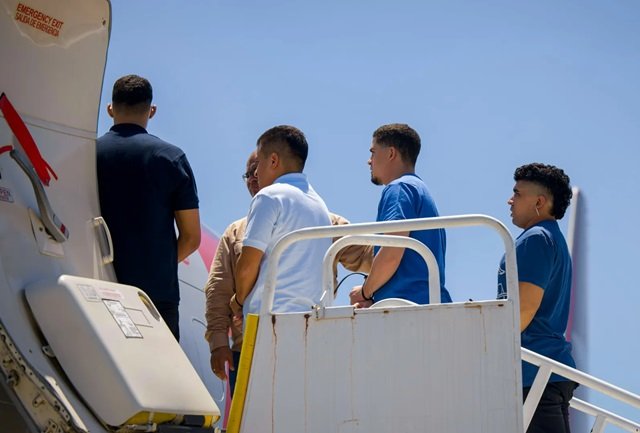
The arrangements span Africa and Latin America and have already resulted in deportations to countries with which many migrants have no previous connection. Early agreements included flights to Costa Rica carrying migrants from China, Russia, Iran and Afghanistan, and a flight to Eswatini carrying people from Vietnam, Laos, Cuba and Jamaica. The agreements vary considerably: Uganda will accept only African nationals, while the Democratic Republic of the Congo will not accept anyone from Africa. Some countries accept people with criminal records, while others restrict admissions to nonviolent offenders.
The financial arrangements are equally varied. Internal State Department documents reviewed by The Washington Post show $81 million in direct payments to 13 foreign governments, alongside $179 million pledged to the International Organization for Migration and $124 million to the U.N. Refugee Agency for projects connected to refugee and infrastructure needs in third countries. The organisations say they are not parties to the deportation agreements and reject the suggestion that their involvement endorses the removals. The administration, however, has negotiated grants to projects in particular countries alongside deportation discussions, according to officials and documents reviewed by The Post.
The transformation is particularly striking because the Office of Remigration sits inside the Bureau of Population, Refugees and Migration, a division historically associated with humanitarian assistance and refugee resettlement. The bureau once managed a budget of about $4 billion a year and focused on helping people reach the United States. Andrew Veprek, the bureau’s senior official and an ally of White House deputy chief of staff Stephen Miller, put the change bluntly at an April event: “We have changed the orientation of the bureau completely.” The focus, he said, was now on implementing the president’s immigration agenda.
The shift followed Trump’s return to the White House in January 2025. Days after taking office, he suspended refugee processing except for White South Africans, effectively shutting down a programme through which the Biden administration had admitted more than 100,000 refugees in 2024. The State Department subsequently terminated long-standing contracts with U.S.-based resettlement organisations and redirected $250 million from refugee programmes to “Project Homecoming”, a Department of Homeland Security initiative intended to encourage migrants to leave the United States voluntarily.
The terminology itself became an internal controversy. Career State Department officials raised concerns that “remigration” had been popularised by white nationalist and far-right movements in Europe and North America. During a June 9 staff call, one employee questioned whether the programme amounted to “ethnic cleansing via the mass deportation or promoted voluntary return of non-white immigrants”. The administration rejected that interpretation. White House spokeswoman Lauren Bis said “remigrate literally means to migrate back”, while the Merriam-Webster definition also contains an alternative meaning referring to the forcible return of immigrants and their descendants to countries of origin.
Behind the policy are Miller and Veprek, according to current and former officials cited by The Washington Post. Veprek previously worked with Miller during Trump’s first term and later returned to the State Department with greater authority. Former officials described him as exercising influence over the remigration operation even before formally taking charge of the wider foreign-assistance portfolio. Ehrhardt, meanwhile, became a key diplomatic intermediary, travelling abroad to negotiate arrangements with foreign governments.
One of the first major agreements involved Equatorial Guinea, where the United States agreed to pay $7.5 million for the potential transfer of up to 250 third-country nationals. The country had received relatively little annual U.S. assistance in previous years. To accelerate such arrangements, administration officials developed “Third Country National Arrangements”, which rely on diplomatic assurances rather than the legally binding human-rights and asylum guarantees associated with earlier models. Another arrangement, known as a “Lilypad”, has been used mainly in Latin America for temporary transfers.
The programme has also generated legal challenges. Administration officials argue that third-country deportations are necessary for migrants who have final removal orders but cannot be returned to countries where they face persecution or whose governments refuse to accept them. Immigration lawyers argue that the arrangements can instead facilitate “refoulement” if migrants are subsequently forced towards countries where they face danger. On Friday, a federal appeals court ruled that the policy was unlawful, upholding a lower-court decision that deportees had not received sufficient notice or an adequate opportunity to raise fear-based claims concerning specific third countries. The Trump administration is expected to appeal to the Supreme Court.
The scale of the system remains relatively small compared with overall deportations. More than 25,000 people had been sent to at least 28 third countries, according to data analysed for the investigation, while the Department of Homeland Security says it has carried out 985,000 deportations during Trump’s second term. Mexico accounts for about 20,000 of the third-country removals under an informal arrangement, with most of the remainder sent to countries in Africa and Latin America.
Yet the agreements have continued to expand even as many available places remain unused. Palau, for example, agreed to accept up to 75 deportees in return for $7.5 million, but only three migrants had been sent there by June. In Equatorial Guinea, more than 50 third-country nationals had arrived across several flights. Lawyers representing some of them allege that detainees at the Hotel Bamy in Malabo have been beaten, denied food and provided inadequate medical care. A video filmed in early September showed hotel guards pointing rifles at migrants during a confrontation.
The allegations have been disputed by Equatorial Guinea officials and challenged by the findings of a U.S. delegation that visited the country. American officials recorded that the migrants were housed in what they described as a “decent hotel, 3 stars”. Equatorial Guinea’s foreign minister rejected allegations of forced returns, while human rights lawyers said U.S. officials had failed to speak directly with migrants or their representatives about their treatment.
The transformation has also produced dissent inside the State Department. Some career officials have resigned or sought transfers, while others have remained in the bureau despite objections to its new mission. The Washington Post reports that staffing has increasingly shifted towards employees supportive of the administration’s deportation agenda.
As the United Nations General Assembly begins in New York, Ehrhardt and other State Department officials are expected to meet delegations from Africa and Latin America. The diplomatic negotiations continue, even as questions over legal safeguards, financial oversight and the treatment of migrants remain unresolved.
What began as a small office inside a bureau historically devoted to refugees has therefore become a central mechanism for an immigration policy extending far beyond America’s borders. The records reviewed by The Washington Post show not merely a series of isolated deportation agreements, but a rapidly expanding system in which money, diplomacy, migration enforcement and humanitarian assistance have become closely intertwined.