


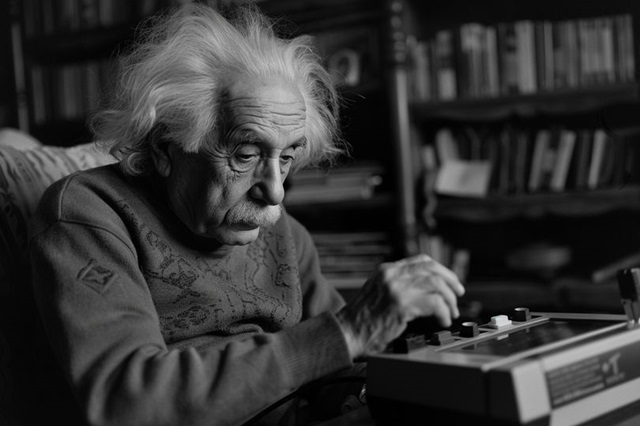
The God Spinoza revered is my God, too; I meet Him every day in the harmonious laws which govern the universe – Albert Einstein
Seated on my deck under a blue sky yesterday, I drank in the glorious songs of the birds, carried by the wind to places unknown, offering the poet in me lush and new gardens of thought. I put down the book I was reading – “ I am Part of Infinity: The Spiritual Journey of Albert Einstein” – and listened and watched the harmony of nature in all its glory and divine immanence. Suddenly, I thought of “intelligent design” that many scoff at and pondered the many interpretations of the Divine that rushed into my limited understanding of all around me, seen and unseen.
I give below the results.
Is God Just an Unseen Concept?
I contend that the question of God, when examined through the prism of theology, philosophy, and cosmology, ceases to be a mere doctrinal inquiry and becomes an inquiry into the structure of reality itself. It is in this expanded intellectual terrain that the concept of God migrates from the confines of anthropomorphic imagination to the vast architecture of existence. The biblical narrative, when read not as myth but as metaphysical proposition, begins with a statement of extraordinary ontological density: “In the beginning God created the heavens and the earth” (Genesis 1:1). This is not merely a description of origin; it is an assertion that the totality of what exists—space, time, matter, and law—is contingent upon a creative principle external to itself, yet intimately immanent within it. The phrase “heavens and earth” operates as a totalizing expression, a linguistic merism that encapsulates what modernity would later call the cosmos.
Within this framework, the biblical imagination repeatedly reinforces the idea that existence is not self-generated randomness but structured emanation. The psalmist declares: “The heavens declare the glory of God; the skies proclaim the work of his hands” (Psalm 19:1). Here, nature is not silent matter; it is expressive. The universe becomes semiotic, a system of signs pointing beyond itself. Isaiah intensifies this cosmological gaze: “Lift up your eyes and look to the heavens: Who created all these?” (Isaiah 40:26). The rhetorical structure of the question is itself instructive. It assumes that contemplation of the cosmos naturally leads the intellect toward causality, toward an originating intelligence that precedes physical manifestation. Jeremiah, in turn, grounds this metaphysical intuition in a more ontological assertion: “He made the earth by his power; he founded the world by his wisdom and stretched out the heavens by his understanding” (Jeremiah 10:12). Creation is not arbitrary; it is suffused with wisdom, suggesting that intelligibility is embedded in the fabric of being.
The New Testament expands this cosmological horizon into universality. In the Johannine prologue, the Logos becomes the generative principle of existence: “Through him all things were made; without him nothing was made that has been made” (John 1:3). The phrase “all things” is deliberately unbounded. It resists restriction. Similarly, the Epistle to the Colossians asserts: “In him all things were created: things in heaven and on earth, visible and invisible… all things have been created through him and for him” (Colossians 1:16). The epistemic structure here is significant: creation is not only through the divine principle but also oriented toward it, implying teleology embedded within ontology. Hebrews reinforces this cosmic authorship: “Through whom also he made the universe” (Hebrews 1:2). And perhaps most philosophically resonant is the Pauline discourse at Athens: “In him we live and move and have our being” (Acts 17:28). This is no longer merely creation externalized; it is existence sustained from within.
Taken together, these passages construct a theological cosmology in which God is simultaneously origin, structure, and sustaining presence of the universe. Yet such a reading does not exhaust the interpretive field. When placed in dialogue with post-Enlightenment philosophy and modern physics-inspired metaphysical speculation, the biblical conception of God begins to converge with alternative intellectual traditions that appear, at first glance, to be distinct but are, upon closer inspection, structurally analogous.
Einstein and Spinoza
Albert Einstein’s oft-cited reference to the “God of Spinoza” is particularly instructive. For Einstein, divinity was not a personal deity intervening in human affairs but rather the rational order inherent in the universe. This conception draws from Baruch Spinoza’s identification of God with nature—Deus sive Natura—where God is not a being among beings but the totality of being itself. In this view, to understand the universe rationally is, in a profound sense, to engage with the divine. Einstein’s scientific realism thus converges with metaphysical monism: the laws of physics are not merely descriptive but expressive of an underlying unity that can be described, without contradiction, as God.
This Spinozan-Einsteinian framework does not contradict the biblical assertion of divine immanence; rather, it reframes it in epistemic terms accessible to modern rationality. When Acts declares “in him we live and move and have our being,” the language resonates with a conception of embedded existence that is not dissimilar to Einstein’s view of humanity as situated within a lawful, intelligible continuum. The difference lies not in structure but in vocabulary: theology speaks in the idiom of personhood and revelation, while physics and rational metaphysics speak in terms of law and necessity.
Schopenhauer
Arthur Schopenhauer, though often categorized as a metaphysical pessimist, introduces another dimension to this convergence. His philosophy, grounded in the primacy of the Will, posits a universal, pre-rational force underlying all phenomena. While Schopenhauer himself does not endorse traditional pantheism, his system implies a unity beneath multiplicity, where individual existence is a manifestation of a singular metaphysical principle. The harmony of the universe, in this reading, is not moral but structural; it is the expression of a blind but unified striving that takes differentiated form in nature, life, and consciousness.
Yet when Schopenhauer’s metaphysics is placed alongside both biblical cosmology and Spinozan monism, a conceptual triangulation emerges. The biblical God is intentional and wise; Spinoza’s God is necessary and rational; Schopenhauer’s underlying Will is blind yet unified. Each system, despite its internal differences, converges on the proposition that multiplicity is not ultimate. The cosmos, in all three frameworks, is not fragmented chaos but expression of a deeper unity.
Modern contemplative works that engage with infinity—such as reflections found in texts like I Am Part of Infinity: The Spiritual Journey of Albert Einstein or contemporary explorations of cosmological vastness such as Infinity by Luis Elizondo—extend this trajectory into experiential and phenomenological dimensions. While differing in tone and disciplinary grounding, these works converge on a shared intuition: that human consciousness, when confronted with the scale of the universe, experiences a dissolution of epistemic boundaries. Infinity ceases to be merely mathematical abstraction and becomes ontological horizon. The individual self appears not as isolated entity but as embedded fragment of an immeasurable continuum.
In this interpretive field, atheism—understood strictly as the denial of any transcendent or immanent unifying principle—becomes intellectually less stable than is often assumed. This is not to suggest that atheism lacks philosophical rigor, but rather that it operates within a narrower ontological commitment: that reality is exhausted by material description alone. Yet when the universe is examined through the lenses of cosmology, quantum indeterminacy, and the deep mathematical elegance underlying physical law, the question of why such order exists at all persists with renewed force.
Logic
Abductive reasoning, which infers the best explanation for observed phenomena, naturally gravitates toward the hypothesis of a unifying principle when confronted with the intelligibility and mathematical coherence of the cosmos. Deductive reasoning, operating from axioms such as “all contingent order requires explanation,” similarly opens conceptual space for a foundational ground of being. Whether one names this ground God, Logos, Nature, or Infinity becomes secondary to the structural claim that reality is not self-explanatory in purely fragmentary terms.
In this sense, the biblical assertion that “through him all things were made” aligns not only with theological doctrine but with a metaphysical intuition shared across philosophical systems. The cosmos appears not as accidental assemblage but as ordered totality. The heavens, in their silent vastness, do not merely exist; they signify. They point toward intelligibility as such.
Einstein’s refusal to accept a personal God who intervenes in human affairs is often misinterpreted as atheism. Yet his invocation of Spinoza reveals a deeper metaphysical commitment: reverence for the rational structure of existence. This reverence is not dissimilar to the biblical posture of awe before creation. The difference lies in whether this structure is interpreted as intentional will or necessary order. However, even this distinction begins to blur when one considers that rational necessity itself can be construed as a form of intelligible intentionality at the level of metaphysical abstraction.
Schopenhauer’s insight into the unity underlying phenomenal diversity further complicates simplistic oppositions between theistic and atheistic worldviews. If all phenomena are manifestations of a singular underlying reality, then the fragmentation of existence into discrete entities is epistemic rather than ontological. The universe, in this reading, is not composed of separate things but of differentiated expressions of one underlying principle.
The synthesis of these perspectives leads to a conceptual convergence: God, understood not as an anthropomorphic figure but as the totality of being, becomes indistinguishable from the cosmos itself. Yet this is not crude pantheism in the vulgar sense of equating God with physical objects. Rather, it is a refined metaphysical monism in which the universe is understood as an expression of an underlying unity that is at once transcendent in explanatory scope and immanent in existential presence.
Acts’ assertion that “in him we live and move and have our being” thus becomes philosophically resonant across traditions. It suggests not absorption of the divine into the world, but recognition that the world is already saturated with the conditions of intelligibility that theology names divine. The heavens declare not only glory but coherence; the earth manifests not only existence but structure; and human consciousness, in its capacity to reflect upon this totality, becomes a participatory witness to the unfolding of infinity.
When biblical theology, Spinozan rationalism, Einsteinian cosmological reverence, and Schopenhauerian metaphysical unity are read in dialogue rather than opposition, a convergent insight emerges. The universe is not merely a collection of entities in space and time; it is a unified field of intelligible existence whose depth exceeds empirical description. Whether one names this unity God, Nature, or Infinity is ultimately a matter of linguistic tradition. What remains consistent across these intellectual frameworks is the intuition that reality is not fractured at its foundation.
To interpret God, therefore, is not merely to affirm doctrinal propositions but to engage in a sustained metaphysical recognition: that existence, in all its vastness—from quantum fluctuation to galactic formation, from biological emergence to conscious reflection—is not devoid of meaning but structured by an underlying coherence that invites contemplation. In this sense, atheism is not so much refuted as it is transcended, not through dogmatic assertion but through the cumulative force of philosophical, theological, and cosmological insight converging upon a single proposition: that being, in its totality, is not silent chaos but intelligible infinity.
My Take
My take on this question of God, when viewed through the interwoven lenses of theology, philosophy, and cosmology, is that we are no longer dealing with a debate between belief and disbelief in any narrow sense, but rather with the intellectual limits of how reality itself can be described. When the biblical texts speak of “the heavens and the earth,” they are not offering a primitive cosmology but a totalizing expression of existence. In that sense, Genesis 1:1 is not merely a doctrinal opening; it is an ontological claim that everything that is, is contingent upon a source that precedes and sustains it. Likewise, when the Psalmist says that “the heavens declare the glory of God,” it is an invitation to read nature itself as disclosure rather than inert matter. The universe becomes legible, not random.
What is compelling in the synthesis between this biblical intuition and Einstein’s reference to the “God of Spinoza” is that both converge on the idea that the deepest structure of reality is not chaotic but intelligible. Einstein’s awe was not directed toward a personal interventionist deity but toward the rational harmony of the cosmos itself. Yet that distinction, while important at the level of theological classification, does not diminish the metaphysical weight of his intuition. If the universe is governed by laws that are both mathematically elegant and universally consistent, then we are already in the presence of something that demands a category larger than chance. Spinoza’s Deus sive Natura and the biblical “in him we live and move and have our being” begin to sound like different grammatical expressions of the same underlying insight: that existence is not self-explanatory in fragments but coherent as a whole.
Schopenhauer’s contribution, though often read as pessimistic, actually deepens this unity by stripping away sentimental overlays and pointing to an underlying metaphysical substrate that manifests itself as multiplicity. Even if one disagrees with his framing of the Will as blind, the structural claim remains useful: that appearances are not ultimate. Beneath differentiation lies something more fundamental, a unity that expresses itself through form, matter, and consciousness. This aligns, perhaps unexpectedly, with the biblical and Spinozan intuitions of oneness, even if they differ in moral and teleological interpretation.
Modern engagements with infinity, including reflections on Einstein’s spiritual sensibility and contemporary cosmological discourse, further reinforce this sense that human cognition is constantly pushed toward the edge of explanatory frameworks. Infinity is not merely a mathematical abstraction; it becomes a philosophical pressure point where language itself begins to strain. When we confront the scale of the cosmos, the precision of physical laws, and the emergence of consciousness from non-conscious matter, the temptation to treat reality as purely accidental begins to look increasingly inadequate as a comprehensive explanation.
From a deductive perspective, if contingent reality consistently exhibits order, lawfulness, and intelligibility, then it is rational to infer a grounding principle that accounts for this coherence. From an abductive perspective, the hypothesis that reality is grounded in a unified source—whether named God, Nature, or Infinity—remains the most structurally economical explanation across theological and scientific observation. This does not eliminate uncertainty, but it situates uncertainty within a larger framework of coherence rather than fragmentation.
What I find most persuasive in the synthesis is not the assertion of God as a personified agent, but the redefinition of God as totality: not one being among others, but the condition of being itself. In this reading, atheism as a complete negation of transcendence becomes intellectually constrained, not because it is emotionally or ethically deficient, but because it risks flattening the explanatory depth of reality into surface-level description. The cosmos, in its lawful beauty and expansive scale, resists such flattening.
Ultimately, whether one uses the language of scripture, Spinoza, Einstein, or modern cosmology, one is circling the same conceptual centre: that existence is unified, intelligible, and profoundly ordered. To call this God is not to retreat into superstition, but to acknowledge the limits of reductionism when faced with infinity. In that sense, the idea of God does not stand opposed to reason; it emerges as reason’s most expansive horizon.










