

The Indus Waters Treaty did not create peace — it merely postponed confrontation. In his latest work, Trial by Water: Indus Basin and India-Pakistan Relations, Uttam Kumar Sinha argues that the celebrated water agreement between India and Pakistan has functioned less as a bridge of cooperation and more as a frozen battleground. The treaty, he suggests, has been an enduring strategic concession by India, a tool for Pakistani propaganda, and a structural barrier to basin-wide collaboration. Sinha goes further to claim that India’s legal fidelity to the treaty for six decades was not a moral strength but a strategic weakness — one that allowed Pakistan to repeatedly internationalise disputes while India remained bound by procedural correctness.
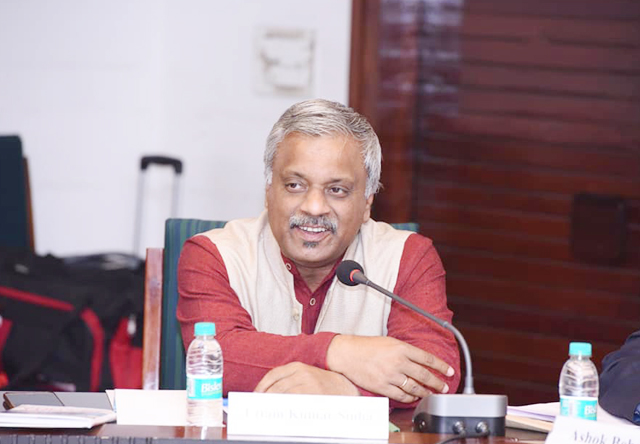
I recently spoke with Dr Sinha, Senior Fellow at the Manohar Parrikar Institute for Defence Studies and Analyses (MP-IDSA) in New Delhi and Managing Editor of Strategic Analysis (published by Routledge), to discuss his most recent book and the seismic questions it raises about the Indus basin’s future. In this interview, he explains why the treaty’s “peace through water” premise was always more illusion than reality, how climate change has exposed its intellectual obsolescence, and why India’s decision in 2025 to place the treaty in abeyance may be strategically overdue — even if legally debatable.
Excerpts of the interview;
Question: You suggest Nehru’s “magnanimity” came at a real cost to India. With hindsight and the evidence you present, would you go so far as to argue that the treaty was India’s biggest self-inflicted strategic concession to Pakistan, even more consequential than Kashmir diplomacy? Was the Indus Waters Treaty a strategic failure disguised as moral statesmanship?
Answer: From the evidence presented, one can argue that the Indus Waters Treaty (IWT) became India’s most enduring self-imposed strategic concession, arguably even more consequential than early Kashmir diplomacy. Yet the treaty itself was not intrinsically unfair to India. It emerged from prolonged, technically demanding, and politically constrained negotiations in which India secured the maximum feasible outcome under the circumstances. The agreement involved genuine give and take. India obtained exclusive rights over the eastern rivers, retained defined entitlements on the western rivers, and avoided an immediate escalation at a time when the region was fragile and institutions were weak. India wanted to move ahead, unwilling to remain trapped in the Pakistan quagmire. In this sense, the treaty reflected pragmatic compromise.
The deeper issue lay not in the terms of the settlement, but in the strategic assumptions underpinning it. Nehru’s approach was normative in an environment where, particularly in relation to Pakistan, politics operated in a fundamentally non-normative manner—one shaped by power asymmetries, deep insecurity, persistent rivalry, and zero-sum strategic thinking. The expectation was that a water-sharing settlement would gradually temper hostility and stabilise relations.
That reciprocity never emerged. As Nehru himself conceded, “We purchased a settlement, if you like, we purchased peace.” In hindsight, the treaty represented a calculated political choice whose long-term consequences became clearer only with time.
Q: You document Pakistan’s persistent portrayal of itself as a downstream victim despite receiving nearly 80% of the basin’s waters. Did the treaty, paradoxically, enable Pakistan’s propaganda ecosystem by freezing a grievance narrative into permanence? In other words, did the treaty institutionalise Pakistan’s sense of victimhood rather than resolve it?
A: Yes. The treaty paradoxically enabled a permanent downstream victim narrative. It allowed Pakistan to portray itself as perpetually vulnerable, frame routine Indian projects as existential threats, and politicise hydrological realities by embedding them within a broader bilateral security discourse. As a result, suspicion became structurally entrenched and victimhood was no longer episodic but institutionalised.
Q: You describe the treaty as mirroring Partition’s logic—irreversible, rigid, zero-sum. Was basin-wide cooperation sacrificed deliberately in favour of political containment, effectively turning rivers into permanent borders rather than shared lifelines? Is the Indus Waters Treaty essentially a ‘hydrological Line of Control’?
A: The IWT reflects the same logic that shaped Partition itself. It privileges basin division over joint management. Strictly speaking, the Treaty does not constitute a water-sharing arrangement. Just as Partition sought to carve the subcontinent into rigid national territories, the treaty enforces a strict allocation of rivers between India and Pakistan, leaving little room for joint management or adaptive governance. The very notion of basin-wide management, which might have promoted cooperation, maximised water efficiency, and safeguarded the Indus system’s ecological integrity, was dismissed by both Nehru and Jinnah during the Partition process. It was feared that any cooperative framework might potentially blur the lines of sovereignty or encourage interdependence. Those were the emotionally charged years of a bitter Partition. As a result, rivers were transformed from ecological systems into markers of national sovereignty. Flow patterns, usage rights, and infrastructure controls were codified less to maximise shared benefits and more to reinforce boundaries and assert control. In this sense, the Indus Waters Treaty functions effectively as a hydrological Line of Control. Water, like territory, is divided to contain potential conflict.
Q: Given the Cold War context, Pakistan’s strategic value to the West, and the financial asymmetry in the settlement, can the World Bank genuinely be seen as impartial—or was it structuring a regional order aligned with Western security interests? Did the World Bank act as a neutral mediator—or a geopolitical engineer?
A: The World Bank cannot be seen as a genuinely impartial actor in the making of the Indus Waters Treaty. While it maintained procedural neutrality by facilitating negotiations and administering technical and legal frameworks, the structural context reveals a deeper geopolitical logic. Pakistan’s strategic value to the West during the Cold War, contrasted with India’s non-aligned posture, meant that the Bank’s involvement was inseparable from broader Western security calculations. The financial asymmetry embedded in the Treaty, particularly India’s obligation to fund Pakistan’s replacement works, was far from a neutral economic arrangement. It represented a deliberate political intervention aimed at stabilising Pakistan and strengthening its strategic position. Under the agreement, India committed to pay £62.06 million (approximately ₹83 crore) over a ten-year period to finance Pakistan’s canal replacement system. This provision provoked sharp criticism within India, and during the Lok Sabha debate on 30 November 1960, the payment was denounced as “fiscally irresponsible,” reflecting domestic unease over the unequal burden imposed by the settlement.
The Treaty thus emerged within a wider Cold War peace calculus shaped by U.S. containment strategy, development diplomacy, and Eisenhower’s vision of “water for peace.” By operating through the World Bank, Western powers embedded geopolitical objectives within the governance of the Indus Basin under the appearance of technical cooperation. In this sense, the Bank functioned less as a neutral mediator and more as a geopolitical engineer, designing a regional order aligned with Western priorities. Procedural neutrality existed, but structurally, the Treaty reflected the strategic imperatives of its time.
Q: You show that India adhered scrupulously to treaty provisions while Pakistan weaponised disputes politically. Was India’s obsession with legal rectitude a strategic weakness, allowing Pakistan to internationalise technical disagreements repeatedly? Has India been too legally correct and strategically naïve for six decades?
A: This constitutes one of the book’s most consequential criticisms.
India complied with the treaty with exceptional legal rigour, even during periods of open conflict. Pakistan, in contrast, learned that the internationalisation of disputes generated political returns largely independent of technical or legal merit. Over time, this produced a structural asymmetry. By approaching the treaty as inviolable legal doctrine rather than as a strategic instrument, India inadvertently created space for Pakistan to repeatedly leverage arbitration mechanisms, neutral expert processes, and international forums.
India’s posture was therefore normatively commendable but strategically restrictive.
As the book demonstrates, legality did not translate into leverage; instead, sustained over-compliance produced a pattern in which India remained formally correct but strategically exposed for nearly six decades.
Q: You acknowledge legal ambiguity in India’s unilateral move. Do you believe strategic necessity now outweighs legal purity, even at the cost of setting uncomfortable international precedents? Is India’s 2025 decision to put the treaty in abeyance legally shaky—but strategically overdue?
A: This is the point at which the book becomes most contemporary and analytically challenging. From a strictly legal perspective, India’s action occupies an indeterminate zone. The IWT does not explicitly permit unilateral suspension, and therefore the decision cannot be justified through narrow textual interpretation alone. However, the book advances a broader institutional argument. International agreements do not exist in political or ecological stasis. When underlying conditions, patterns of state behaviour, and material constraints evolve in ways fundamentally unanticipated by the original framework, rigid legal formalism risks becoming detached from both equity and function. The argument presented is not celebratory of abeyance, nor does it advocate erosion of treaty law as a general principle. Rather, the decision is situated as the cumulative outcome of prolonged imbalance, wherein one party’s consistent legal compliance coexisted with the other’s systematic instrumentalisation of dispute mechanisms and external forums.
Viewed through this lens, the 2025 decision may remain legally debatable, but it appears strategically overdue. The deeper theoretical claim is that the authority of international law is sustained not solely by durability or permanence, but by the continued perception of fairness and reciprocity. When these foundations weaken, formal legality may persist, yet its normative legitimacy begins to erode.
Q: From your historical evidence, can one argue that Pakistan never internalised the treaty as a fair settlement, but only as a temporary arrangement until Kashmir or power equations changed? Did Pakistan ever truly accept the treaty—or merely tolerate it?
A: The historical record suggests that Pakistan’s relationship with the IWT was marked more by strategic accommodation than by normative acceptance. While Pakistan formally ratified and implemented the treaty, there is limited evidence to suggest that it ever internalised the agreement as a fair or final settlement of the Indus basin question.
From the outset, Pakistan viewed the treaty through the lens of vulnerability rather than equity. As the lower riparian, newly independent, and economically weaker state, its acceptance of the treaty was driven primarily by existential necessity. The loss of canal headworks in the 1947 Partition had already demonstrated how water could be weaponised, reinforcing in Pakistani strategic thinking the perception that control over upstream rivers remained inseparable from the unresolved Kashmir dispute and broader power asymmetries with India.
This perception persisted well beyond the treaty’s signing. Pakistani political discourse and strategic narratives repeatedly linked water insecurity to Kashmir, even though the treaty deliberately de-linked the two issues. Such rhetorical and ideological linkages indicate that the treaty was rarely regarded in Pakistan as a definitive closure of the Indus question. Instead, it was often treated as an interim stabilisation mechanism, tolerable so long as it ensured predictable flows and external guarantees, particularly from the World Bank.
Importantly, Pakistan did comply with the treaty’s technical mechanisms, participated in the Permanent Indus Commission, and invoked legal procedures during disputes. This demonstrates institutional acceptance, but not necessarily psychological or political acceptance. The distinction matters. Compliance reflected prudence and constraint, not reconciliation with the treaty’s distributive logic, which allocated entire eastern rivers to India and entrenched asymmetrical control.
In this sense, the treaty endured not because it was widely perceived in Pakistan as just, but because it remained functionally useful. It provided water security, international legitimacy, and a legal framework through which disputes could be managed without escalation. Its survival, therefore, owed more to utility than to belief.
Q: The treaty is supply-driven, engineering-centric, and rooted in 1950s hydrology. In an era of glacier retreat, extreme floods, and water stress, is the IWT now conceptually unfit for survival, not just politically contested? Has climate change exposed the treaty as intellectually obsolete?
A: Yes, and this may be the treaty’s most fundamental weakness. Yet it cannot be faulted entirely for this limitation. The IWT was negotiated more than seven decades ago, at a time when climate science was neither mature nor central to water governance. The dominant concern then was political stabilisation after Partition, not long-term hydrological uncertainty.
The treaty is structurally supply-centric and engineering-driven and reflected the best available knowledge of its era. Rivers were understood primarily through averages, infrastructure was seen as a permanent solution, and variability was treated as an exception rather than a structural condition. Climate change, glacier retreat, and compound flood-drought cycles lay well beyond the analytical horizon of 1960s water diplomacy.
The problem, therefore, is not that the treaty was poorly designed for its time, but that it has remained largely frozen in that time. What was once a rational engineering solution has become increasingly misaligned with a climate-altered basin. The intellectual gap between how the rivers behave today and how the treaty imagines them has steadily widened. In this sense, the treaty’s vulnerability lies not in its origins, but in its inability to evolve beyond them.
The Indus rivers today no longer behave as the treaty assumes they do. Flow uncertainty is becoming the norm, not the exception. Seasonal volatility increasingly undermines the logic of fixed allocations based on historical averages. Infrastructure built to stabilise flows now struggles to cope with extremes rather than scarcity alone.
Without a shift from rigid allocation towards adaptive, climate-responsive basin management, the IWT risks becoming a legal structure governing rivers that no longer conform to its foundational assumptions. Its survival, therefore, depends not only on political will but on whether it can evolve beyond the hydrological thinking of its time.
Q: When India fast-tracks projects on the western rivers post-2025, should this be seen as coercive hydro-politics—or simply India exercising rights it voluntarily underused for decades? Is India finally weaponising water—or merely reclaiming delayed sovereignty?
A: India is not creating new legal entitlements over the western rivers (Indus, Jhelum and Chenab); it is now finally utilising rights/provisions that the IWT always permitted but that it largely underused for decades. I describe it as ‘optimising the treaty’. Since the treaty’s abeyance in 2025, India has cleared and accelerated several long-stalled hydropower and water-utilisation projects on the Indus basin’s western rivers, principally the Chenab and its tributaries.
From this vantage, the distinction you make holds. If India’s prior restraint on exploiting its entitlements was voluntary, then its withdrawal of that restraint can’t logically be termed coercive hydro-politics. What we’re seeing is less the unilateral creation of new rights and more the reclamation of rights it voluntarily underused for decades.
The term “weaponisation” carries the sense of active denial of a resource to another party, implying deliberate harm. Most of India’s announced and advanced projects remain within permissible design parameters, especially run-of-river schemes, and do not—in their present engineering form—involve large-scale storage or diversion that would permanently cut off flows to Pakistan.
Thus, legally, it is India exercising its rightful entitlements; politically, the posture has hardened as New Delhi seeks to assert greater control over its share of Indus basin waters after decades of under-utilisation.
Q: You suggest the treaty survived not because of peace but because of inertia. If it ultimately unravels, does that reveal a deeper truth—that water cooperation never softened India–Pakistan hostility, it merely postponed confrontation? If the treaty collapses, is conflict inevitable—or was ‘peace through water’ always an illusion?
A: Yes. And this may be the book’s most sobering conclusion. The IWT never created peace; it merely existed alongside enduring hostility between India and Pakistan. Cooperation over water did not ease political tensions or build trust; instead, it functioned in spite of them, largely because the treaty’s technical and legal framework froze interaction rather than fostering meaningful engagement. Its endurance owed less to genuine reconciliation than to institutional inertia, a combination of bureaucratic momentum, treaty mechanisms, and mutual self-interest that postponed confrontation without resolving deeper disputes. If the treaty ultimately unravels, it reveals that the idea of ‘peace through water’ was always more a temporary postponement than a true transformation of India–Pakistan relations; a pragmatic arrangement that delayed conflict rather than prevented it.