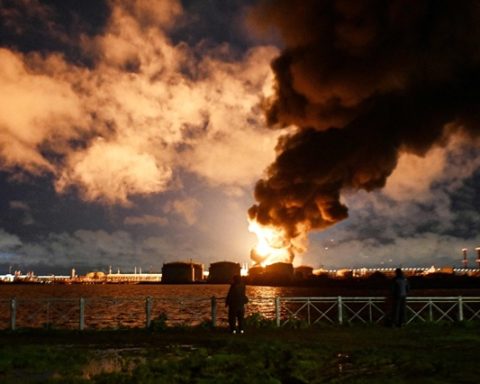
Iran has considered attacking US military targets in Europe if President Donald Trump escalates the war, according to people close to the Iranian regime, in a sign that Tehran is assessing options to widen the conflict beyond the Middle East.
Two regime insiders told the Financial Times that Iranian forces had assessed potential strikes against US assets in south-eastern Europe, including Bulgaria, which last month approved the use of its Bezmer air base by US refuelling aircraft. One of the insiders said Cyprus was also being considered as a potential target if Washington launched a renewed offensive. A British air base on the island was struck by a drone in March.
The insiders also said Iranian forces had examined the possibility of attacking subsea fibre-optic cables in the Strait of Hormuz if tensions escalate. The reported plans come as many within Iran’s leadership increasingly view renewed conflict as a question of when, rather than whether it will occur.
Efforts to reopen the Strait of Hormuz have stalled, while Iran’s Supreme Leader Ayatollah Mojtaba Khamenei last week elevated hardliners to senior security and military positions. Trump said on Tuesday that there were “no talks or conversations going on, or scheduled” with Tehran.
The Islamic Revolutionary Guard Corps and other Iranian military commanders have warned that any new full-scale conflict could lead Iran to move beyond its previous focus on US military installations, energy facilities and other infrastructure in the Middle East.
Last month, the Guards also warned the UK over American use of British military bases, saying that “any base that is used to launch an attack on Iranian territory will be considered a legitimate target”.
Sidharth Kaushal, a research fellow at the Royal United Services Institute in London, described the threat posed by Iranian missiles to Europe and other distant targets as “real, but limited”. Iran could use medium-range ballistic missiles, including its Shahab series, against US assets in southern and south-eastern Europe, although Kaushal said their ability to cause significant damage would diminish at longer ranges.
According to the insiders, the scale of any Iranian retaliation would depend on Washington’s actions. One said Tehran was preparing a plan to expand the conflict if Trump carried out previous threats to attack Iranian infrastructure. Trump said last month that Washington would destroy an Iranian bridge or power plant each time the Islamic republic targeted a ship in the strait.
The second insider said Iran would place “no limits” on its response to US aggression. “Should the US go too far, Iran will defend itself at any price, go beyond the region and hit Europe too,” the person said.
Iran has previously demonstrated an ability and willingness to target locations far from its borders. After the US and Israel launched the war in February, Washington accused Tehran of firing multiple missiles towards Diego Garcia, a joint US-UK military base in the Indian Ocean around 4,000km away, although none reached their target.
Turkey said in March that Nato air defences had intercepted several ballistic missiles launched from Iran. The same month, the UK’s air base at Akrotiri in Cyprus was struck by a drone. Western officials suspected at the time that it was an Iranian drone launched by regional proxy forces rather than directly by Tehran.
The insiders said an Iranian attack last month on a US base in Jordan, which killed three American service members, represented the most precise long-range attack carried out by the Islamic republic and demonstrated its ability to strike targets over greater distances.
“This was also a message to Europe: it can receive missiles, so it should know where it should stand in this war,” one insider told the Financial Times. “A very big mistake, such as hitting our infrastructure, could make the war go beyond the region and reach Europe.”
Diplomatic efforts have meanwhile failed to produce a breakthrough. A June memorandum of understanding between the US and Iran collapsed last month after Tehran attacked vessels in the strait, with both sides accusing each other of violating the interim agreement. The collapse was followed by retaliatory strikes and a renewed US blockade on Iranian ports.
Analysts cautioned that Iran’s ability to strike distant targets remains constrained. Douglas Barrie of the International Institute for Strategic Studies said attempted strikes on Diego Garcia indicated that Iran possessed weapons with ranges exceeding 2,000km, but questioned how many such missiles Tehran actually holds and whether they could be used effectively.
Kaushal also suggested that Iran might gain more from operating through regional proxies, including Shia militias in Iraq, Hizbollah in Lebanon and the Houthis in Yemen, rather than relying solely on long-range missile attacks.
Within Iran, however, some officials fear Tehran may be overplaying its hand. Hardliners argue that Washington cannot be trusted to honour an agreement and that Iran must impose greater costs on the United States to ensure compliance with any eventual settlement.
That position has gained influence with the appointment of Mohsen Rezaei, a former Guards commander, as Iran’s top security official. Iranian analysts interpreted the move as evidence that Mohammad Bagher Ghalibaf, the country’s leading negotiator, has been pushed aside as prospects for a lasting agreement deteriorate.
“Iran is sending a clear message that if you don’t reach an agreement with Ghalibaf, you have to deal with Rezaei,” one insider said. “The message is: ‘Don’t be mad, because I’m madder than you are.’”