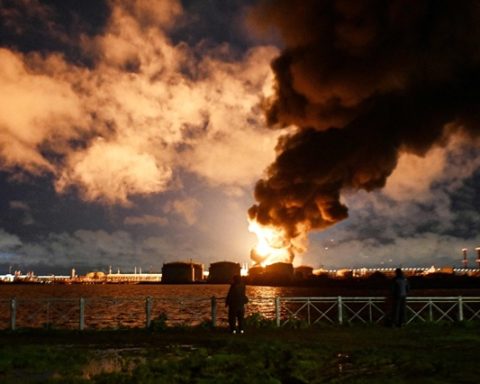
In the escalating military confrontation between Israel and Iran, the Israeli Air Force (IAF) has reportedly dropped 5,000 bombs on Iranian territory since coordinated strikes with the United States last week, according to an official IAF statement on March 4. Among these ordnances, Bellingcat has identified a previously unpublicized bomb appearing in images released by the IAF, raising questions about its composition, purpose, and potential implications for regional conflict.
The bomb, first photographed by the IAF on March 3, was included in three separate posts showing Israeli jets allegedly participating in attacks on Iran. Weapons analysts consulted by Bellingcat noted that the images depict a 2,000-pound-class air-delivered bomb equipped with a Joint Direct Attack Munition (JDAM) guidance kit and featuring a distinctive red band around its nose—a marking conventionally associated with incendiary payloads. Yellow bands typically indicate high explosive effects, suggesting a dual or combined function.
Dr N.R. Jenzen-Jones, director of Armament Research Services (ARES), told Bellingcat that the bomb bears a striking resemblance to the MK 84 series and is consistent with the US BLU-119/B Crash Prompt Agent Defeat (CrashPAD) design, a munition intended to neutralize chemical or biological warfare agents. Explosive Remnants of War expert Frederic Gras also indicated to Bellingcat that the device could be either an American MK 80 series bomb or an Israeli derivative, enhanced with JDAM guidance for precision targeting.
The CrashPAD has been in US service for nearly two decades and contains a combination of white phosphorus and high explosives, designed specifically to destroy chemical or biological threats while minimizing collateral damage when used appropriately. Dr Jenzen-Jones told Bellingcat that the presence of the red band, combined with the yellow marking, aligns with the weapon’s dual-purpose payload, with incendiary and explosive effects tailored to eliminate hazardous agents.
Historically, the IAF has marked munitions with red bands to denote incendiary or thermobaric effects. During the 2023 Gaza conflict, images of Israeli Apache attack helicopters displayed Hellfire missiles with red markings, which were later removed from public releases. Similar marking schemes exist on M825A1 155mm white phosphorus artillery shells and certain Delilah cruise missiles, emphasizing that red bands signify incendiary characteristics rather than unique or experimental ordnance.
Open-source research platforms, including the Open Source Munitions Portal (OSMP), have cataloged the newly released images. Analysts note that while the body resembles the MK 84, the distinctive markings differentiate it from standard ordnance. Bellingcat’s investigation, comparing imagery, expert analysis, and historical data, underscores the bomb’s likely incendiary purpose and its potential adaptation for targeting chemical or biological facilities in Iran.
Legal and operational implications of the weapon’s use have also been assessed. Michael Meier, former Senior Advisor to the Army Judge Advocate General and current adjunct professor at Georgetown University, told Bellingcat that Chemical Agent Defeat munitions like CrashPAD are not illegal under international law, provided they are used according to design specifications and within legal frameworks. Dr Arthur van Coller, a professor of international humanitarian law at STADIO Higher Education, explained to Bellingcat that if deployed against chemical or biological weapon stockpiles sufficiently removed from civilian populations, their use complies with International Humanitarian Law and relevant treaties, including the Certain Conventional Weapons (CCW) framework. While Israel is not a State Party to Protocol III on incendiary weapons, the United States is, albeit with reservations, allowing for legally sanctioned use under specific conditions.
Bellingcat’s analysis highlights the challenges of verifying munitions in active conflicts, particularly when new or modified weapons are employed. Attempts to clarify the bomb’s origins and composition from official sources have met limited response. Requests to the US Department of Defense and Department of State regarding the transfer of CrashPAD or similar weapons to Israel and assessments of Iran’s chemical weapons capabilities were deferred, with the State Department reiterating US support for Israel’s right to self-defense. The IDF confirmed only that it uses legally compliant munitions, declining to provide detailed information about the bomb’s characteristics or supply chain.
The emergence of this incendiary ordnance during the early days of the Israel-Iran conflict underscores the complex interplay between military innovation, open-source intelligence, and public transparency. By cataloging and analyzing the bomb, Bellingcat has contributed to a broader understanding of the evolving capabilities deployed in the region, while highlighting the limits of official disclosure during active hostilities.
Experts emphasize that such munitions are purpose-built for specialized threats. The CrashPAD and its potential Israeli analogues are intended for chemical and biological stockpile neutralization, leveraging incendiary and explosive effects to safely eliminate hazardous agents without relying solely on conventional high explosives. This precision underscores the strategic calculus behind Israel’s operational choices and the implications for future regional confrontations.
In summary, the photographs and data collected by Bellingcat reveal that the Israeli Air Force may be using a previously unseen incendiary bomb capable of targeting chemical or biological threats in Iran. While the weapon aligns with existing international law and US-Israeli military protocols, its deployment highlights the escalating technological sophistication in modern conflicts and the critical role of investigative open-source research in understanding real-time military developments.