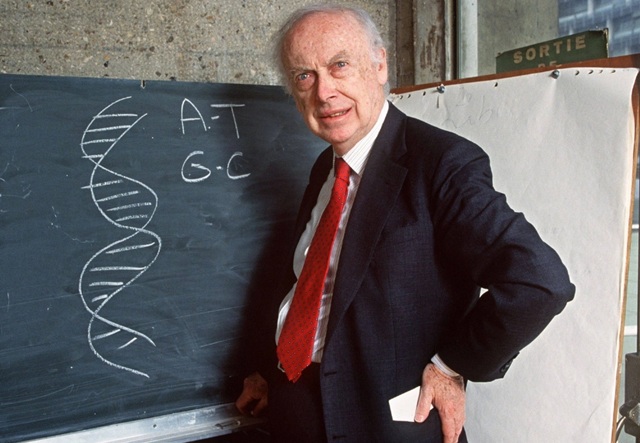
James Watson, the American biologist co-credited with discovering the double-helix structure of DNA, has died at the age of 97, Cold Spring Harbor Laboratory announced Thursday. Watson spent much of his career at the Long Island research institution, where he became one of the 20th century’s most storied scientists for his landmark 1953 breakthrough alongside Francis Crick. The discovery, which also involved key contributions from Maurice Wilkins, earned the trio the 1962 Nobel Prize and laid the foundation for modern biology, revolutionizing genetics, medicine, and forensics.
Watson was just 25 when he joined the effort that would change science forever, later contributing to cancer research and the early mapping of the human genome. His 1968 memoir, “The Double Helix,” detailed the intense competition and ambition driving the discovery, becoming a bestseller and offering a candid glimpse into the scientific process. However, Watson’s personal reputation was marred by repeated instances of offensive and bigoted commentary, including disparagement of female scientists such as Rosalind Franklin, whose work was essential to deciphering DNA. Franklin, who died in 1958, was never awarded the Nobel Prize, which cannot be granted posthumously or to more than three recipients.
The controversy surrounding Watson intensified in 2007 when he made racially charged statements about African intelligence in a newspaper interview. Though he apologized, Cold Spring Harbor removed him from his position as chancellor, and his public standing never fully recovered. Despite his problematic remarks, Watson’s scientific achievements remain profound. He taught at Harvard for 15 years before transforming Cold Spring Harbor Laboratory into a leading center for molecular biology research. Between 1988 and 1992, he also served as one of the directors of the Human Genome Project, overseeing efforts to map human chromosomes.
Born on April 6, 1928, in Chicago, Watson showed early academic promise, winning a scholarship to the University of Chicago at age 15 and earning a Ph.D. in zoology from Indiana University Bloomington in 1950. His collaboration with Crick in Cambridge and access to X-ray diffraction images from Franklin and Wilkins led to the model of DNA’s twisting “ladder” structure, showing how the molecule could replicate itself and unlocking the code of life. The findings, published in Nature in 1953, are considered one of the most important scientific achievements of the century.
Watson shared two sons, Rufus and Duncan, with his wife Elizabeth and received numerous honorary degrees, decorations, and international recognition throughout his career. He was even portrayed by Jeff Goldblum in a BBC-produced film about the discovery of DNA. On Friday, Cold Spring Harbor Laboratory acknowledged Watson’s “extraordinary contributions” to science, though the institution had ultimately severed formal ties with him, including stripping him of emeritus status following repeated controversial remarks.