


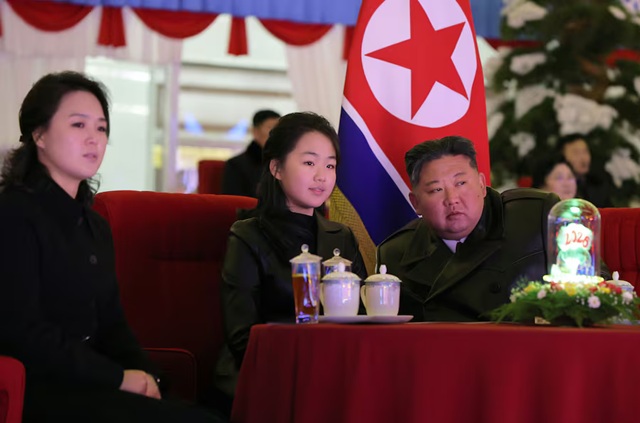
In North Korea, where politics is staged through symbols as much as decrees, the repeated appearance of Kim Jong-Un’s daughter Ju-ae at high-profile state events is being read as a deliberate message. Over the first days of 2026, state media released images showing the teenage girl accompanying her father during New Year celebrations and a solemn visit to the Kumsusan Palace of the Sun, a sacred mausoleum that enshrines the bodies of the country’s founding leaders. According to reporting by El Pais, these appearances mark a significant shift from occasional visibility to a more sustained role in the regime’s public theater.
The images, distributed by the official Korean Central News Agency, place Ju-ae prominently alongside her parents, Kim Jong-Un and first lady Ri Sol-ju. Although the agency’s written accounts avoided direct mention of her presence, photographs showed the teenager centered between her father and mother, a positioning that analysts say is unlikely to be accidental. The visit to the mausoleum was especially notable, as it was the first time Ju-ae had publicly paid tribute to her ancestors, reinforcing the notion of dynastic continuity that underpins the North Korean state.
Experts believe the timing may be linked to the upcoming ninth Workers’ Party congress, expected to set new policy priorities and reshape the leadership structure. Cheong Seong-chang, vice president of the Sejong Institute think tank, has suggested that Kim Jong-Un could use the congress to elevate his daughter’s status, possibly assigning her an official role. While some observers argue she is too young to assume a senior party position, others agree that a symbolic appointment could serve as an early signal of succession intentions.
Ju-ae first entered public view in November 2022 during a missile inspection, when state media described her as Kim’s “beloved daughter.” Since then, her portrayal has steadily evolved, with increasingly reverential language and frequent appearances at military inspections, weapons launches, and state ceremonies. Analysts note that she has even been referred to with honorifics traditionally reserved for future leaders, despite the regime never confirming her age or formally acknowledging her status.
What is known about Ju-ae remains fragmentary. Her name surfaced publicly years earlier through former NBA player Dennis Rodman, who claimed to have met her as an infant during a visit to Pyongyang. South Korean intelligence services now use the same name and estimate that she is the middle child among three siblings, though the existence of the other children has never been confirmed by North Korea.
Her visibility increased sharply in the second half of 2025, including a rare foreign appearance during a visit to Beijing for a major military parade. At the time, South Korean analysts described the trip as an early step in diplomatic grooming, aimed at familiarizing her with international protocol. Images from the recent New Year’s Eve gala further reinforced her prominence, showing her holding her father’s hand and sharing an affectionate moment as the new year began.
North Korea has historically avoided explicitly naming successors, instead relying on gradual exposure and symbolic gestures to prepare the elite and the public. Kim Jong-Il and Kim Jong-Un both followed this pattern before assuming power. If Ju-ae’s rising profile continues, it could represent the early stages of another carefully managed transition. As El Pais notes, such a move would be unprecedented, potentially positioning her as the first woman to lead the country since its founding, while reinforcing the regime’s increasingly monarchical image built around bloodline and loyalty.









