As the world enters a period of mounting geopolitical uncertainty, policymakers, scholars, and strategists are increasingly grappling with fundamental questions about the future of the international order. President Donald Trump’s second term has intensified debates over power, influence, and the changing nature of global politics. Recent developments have once again underscored the enduring capacity of the United States, as the world’s leading power, to shape international affairs. As White House Deputy Chief of Staff Stephen Miller recently remarked, we are entering a world “governed by strength, governed by force, and governed by power.”
For smaller states, these shifts raise difficult and increasingly urgent questions. How should they navigate intensifying great-power rivalry? How much strategic autonomy do they truly possess? And what options remain available in an international environment increasingly shaped by power politics rather than principle?
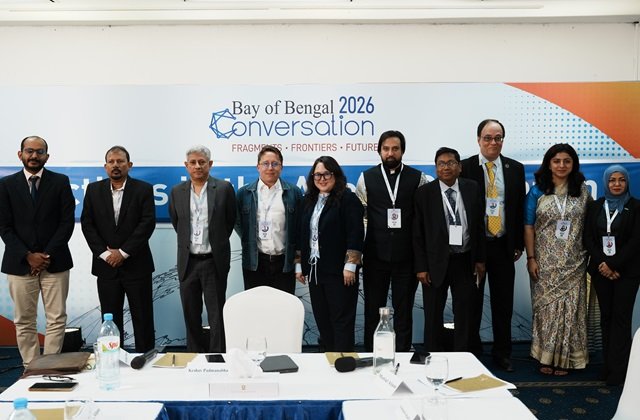
These questions formed the backdrop to the Bay of Bengal Conversation 2026, held in Dhaka from 3 to 5 October and organised by the Centre for Governance Studies (CGS), one of Bangladesh’s leading think tanks. Now in its fifth edition, the forum brought together diplomats, academics, business leaders and policy specialists from across the region to discuss the challenges confronting small and middle powers in a rapidly changing world.
As one of the speakers from Sri Lanka, a small state situated at the heart of the Indian Ocean, I found the conference to be an especially enriching intellectual experience. Sri Lanka and Bangladesh, despite their differences, share many geopolitical realities as Bay of Bengal nations and members of the broader South Asian region. Both must navigate the challenges and opportunities created by regional and global power competition.
In his opening remarks, CGS President Zillur Rahman highlighted the significance of the Bay of Bengal region as a bridge between South Asia and Southeast Asia. He noted that one of the initiative’s key objectives was to explore practical responses to the opportunities and challenges facing countries in the region. The discussions reflected a common concern among smaller states: how to safeguard national interests while avoiding entanglement in major-power rivalries.
Bangladesh itself is undergoing a period of significant political transition following the youth-led movement that triggered political unrest and ultimately led to the departure of longtime Prime Minister Sheikh Hasina. Against this backdrop, policymakers appear determined to chart a new course while maintaining constructive relations with all major powers.
This sentiment was echoed in several discussions during the conference. During one panel discussion, State Minister Shama Obaed emphasised that Bangladesh did not wish to become a “chessboard” for competing powers. A similar perspective has been articulated by Sri Lankan President Anura Kumara Dissanayake, who stated that Sri Lanka would not become a “sandwich” between India and China.
Beyond the formal sessions, the three-day event provided an opportunity to reflect on the broader transformations taking place in international politics. Key discussions on middle powers, multipolarity, strategic competition, and the evolving global order dominated the agenda. The exchanges provided valuable insights into how states are attempting to adapt to a rapidly shifting geopolitical landscape.
For smaller states such as Sri Lanka and Bangladesh, the central challenge remains the same: ensuring survival and prosperity in an era of intensifying US-China competition. During one discussion, a Bangladeshi policymaker remarked that Bangladesh seeks friendship with all countries and confrontation with none. The emphasis, he argued, should remain on development rather than alignment.
However, the reality is often far more complicated. Geopolitics imposes limitations on the policy choices available to smaller nations. Concepts such as strategic autonomy and sovereignty, while important aspirations, frequently encounter practical constraints when the security interests of major powers are involved.
Sri Lanka offers a revealing example. Although sovereign states possess the legal right to determine their own policies, those decisions are often shaped by broader regional and international security considerations.
Sri Lanka’s decision not to provide assistance to 19 Iranian oil tankers stranded in international waters off its coast, despite reported shortages of food, water, and fuel aboard the vessels, illustrates this reality. Explaining the decision, Sri Lanka’s Foreign Ministry stated that the country would place its national interests first and that shipping companies were aware of potential secondary sanctions imposed by the United States.
One may argue that under the United Nations Convention on the Law of the Sea (UNCLOS), particularly Article 98, states and vessels have obligations to assist persons in distress at sea. Yet in a world increasingly characterised by great-power competition, small states often find that their decisions are constrained by larger geopolitical realities. Rather than acting entirely according to their preferences, they must often adjust their policies in response to the interests and expectations of major powers.
The broader lesson is that, for smaller states, foreign policy is rarely conducted in isolation. Geography, power asymmetries, and regional security dynamics continue to define the boundaries within which policy choices are made.
What applies to Sri Lanka is relevant not only to Bangladesh but also to small states across the world. As Stephen Miller argued, “You can talk all you want about international niceties and everything else. But we live in a real world that is governed by strength, governed by force, and governed by power. These are the iron laws of the world.”
Under these so-called iron laws, there is no easy escape from great-power competition. For smaller states such as Sri Lanka and Bangladesh, success will depend not on avoiding the realities of power politics, but on navigating them with realism, prudence, and strategic foresight.
Three days of dialogue, debate, and engagement in Dhaka reinforced a sobering reality: despite ongoing discussions about multipolarity, middle powers, and strategic autonomy, great powers continue to shape the choices available to smaller states. As a student of geopolitics, I left the Bay of Bengal Conversation with a renewed appreciation of this enduring truth. Ultimately, the central challenge remains unchanged: how can small states safeguard their interests in a world increasingly defined by strength, force, and power?
The search for an answer continues. One lesson, however, is already clear: small states cannot choose the world they live in, but they can choose how wisely they respond to it