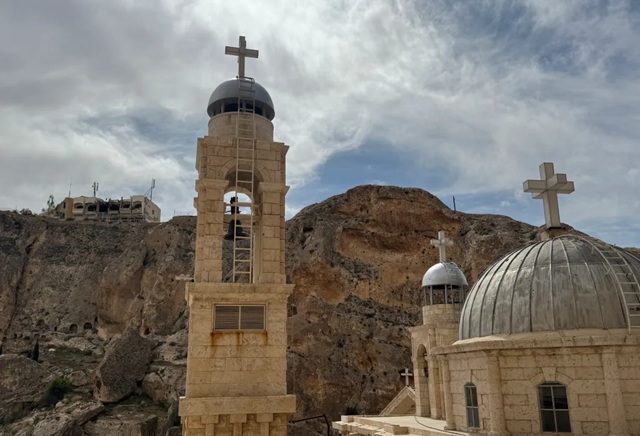
An uneasy peace clings to the ancient town of Maaloula, Syria — a community once emblematic of interfaith harmony but now haunted by the scars of a civil war that saw neighbour turn against neighbour. In a report published by The Times UK, Father Fadi Barkil, a Catholic priest in the town’s historic Monastery of Saints Sergius and Bacchus, warns that Christians in Maaloula fear they could be the next target as sectarian violence reignites across the country.
“We look at what recently happened to the Alawites on the coast, and what is happening to the Druze now, and we fear that the violence will come the way of the Christians next,” Father Barkil told The Times.
Nestled in the rugged mountains 35 miles northeast of Damascus, Maaloula holds deep historical and religious significance. Once a symbol of peaceful coexistence — where Aramaic, the language of Jesus, is still spoken — the town was torn apart during Syria’s brutal civil war. As the conflict erupted in 2011, Maaloula’s Christian majority largely supported the Assad regime, which many viewed as a bulwark against Islamist extremism. The Sunni Muslim minority, by contrast, saw hope in the revolution.
What followed was a tragedy that reshaped the town forever. In 2013, jihadist fighters from the Nusra Front stormed Maaloula, massacring regime troops, abducting nuns, and desecrating Christian icons and churches. When government forces reclaimed the town months later, retaliation was swift and brutal: the town’s two mosques were destroyed and the Muslim population was driven into exile.
In the years that followed, Maaloula lived in limbo. Christians returned and rebuilt what they could. Muslim homes remained shattered. Fear and resentment festered quietly beneath the surface.
That quiet fractured again in December following the fall of President Bashar al-Assad and the ascendance of Islamist-led rebel groups. Among them was Hayat Tahrir al-Sham (HTS), widely seen as the successor to the Nusra Front, and now part of Syria’s new power structure under President Ahmed al-Sharaa — himself a former HTS leader.
As Muslims returned to Maaloula, many Christians feared reprisal. Those fears deepened when a local Christian man shot and killed a Muslim who he said was attempting to rob his home. The aftermath was explosive: Muslim militias entered the town, a curfew was imposed on Christians, and social media ignited with sectarian hashtags like #christianskillmoslemsinMaaloula.
In a delicate intervention, Father Barkil met with HTS leaders and a local Muslim sheikh to negotiate the shooter’s safe passage to Damascus, where he now awaits trial. While the talks de-escalated immediate tensions — and even resulted in the symbolic return of two looted church bells by HTS — the town remains perched on a knife’s edge.
“Threats were made against Christians,” said Father Barkil. “Anyone considered to have co-operated with the regime is now considered a spy, a killer or a traitor.”
HTS and returning Muslim leaders have insisted they seek no revenge. “Vengeance will not be enacted here,” said Sheikh Ghassan Abu Qamar, a prominent local Muslim cleric. “Our return was beautiful. We were celebrating victory.”
But ambiguous comments about justice and widespread mistrust make reconciliation fragile. The pending court case — and the shooter’s family fleeing town in fear — serves as a grim reminder of unresolved wounds.
Across Syria, recent flare-ups in sectarian violence have intensified anxieties in Maaloula. In March, over 1,000 Alawites were killed by Islamist groups in Latakia. This week alone, fighting between pro-government forces and the Druze community has left more than 100 dead.
In this context, Father Barkil’s call for forgiveness is both brave and daunting.
“It is easy as Christians to recall that we are the faith of forgiveness,” he said. “It is not so easy to escape the hate of Syria’s recent past.”
With no formal police force and a ten-man Muslim civil committee now tasked with maintaining order, the road to true peace in Maaloula remains long and uncertain. But in a town where saints once walked and Jesus’s language still echoes in daily prayers, hope, however fragile, endures.