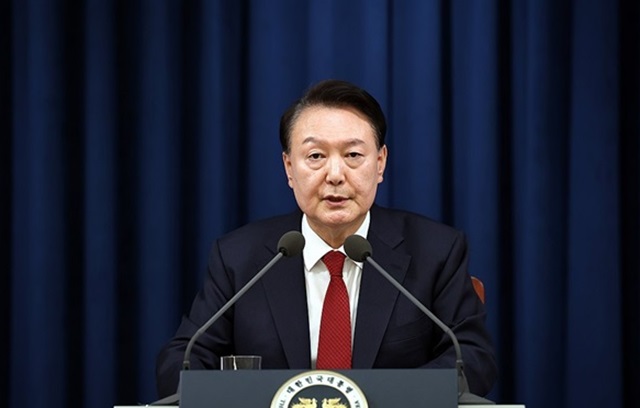
The Korean President’s martial law decree was rescinded by the Korean parliament, whose members voted despite the incursion of combat troops trying to break into meeting rooms in the parliament building.
After lawmakers unanimously voted to block the president’s martial law decree, dozens of troops that had entered the main parliamentary building began to withdraw, according to Korean newspaper Chosun Ilbo.
As of December 3rd at noon, Washington time, the martial law decree has not been rescinded by Yoon, even though under Korean laws it must be ended.
The decision of the South Korean president was a disaster for Korea and also for the United States. Mr. Yoon’s reckless declaration has imperiled the country and severely risked the alliance with the United States.
The United States keeps a large military force in Korea based on a mutual defense treaty.
The US has 28,500 US troops in Korea, predominantly Army, the majority of them at Camp Humphreys, the largest US overseas base in the world. In addition there is U.S. Army Garrison Daegu and Camp Casey, near the DMZ.
The US Air Force operates at Kunsan Air Base and Osan Air Base. Kunsan Air Base is the home of the 8th Fighter Wing, “The Wolf Pack,” assigned to the Pacific Air Forces’ Seventh Air Force and the 38th Fighter Group of the Republic of Korea Air Force. Osan Air Base, located 48 miles south of the Korean DMZ, is home to the “Mustangs” 51st Fighter Wing and 24 tenant units, including Seventh Air Force. As the most forward deployed permanently-based wing in the Air Force, the 51st Fighter Wing is charged with providing mission-ready Airmen to execute combat operations and receive follow-on forces.
Since 2016 the US has deployed a Terminal High Altitude Area Defense (THAAD) system in Korea as part of the US ballistic missile defense system.
The Biden administration, at least so far, has said very little, probably trying to work in the background in the early stages of the Korean President’s announcement. But Washington cannot sit idly by and hope for the best.
If the Korean army obeys the parliamentary decree, as they appear to have done by retreating from the parliament building, that’s a hopeful sign. But the army and police also can’t suppress protests using violence as a political tool, as they have been doing. Should the Korean army continue in this mode it will lose its credibility at home and force the US into a divorce it does not want.
The internal political situation in South Korea is now almost beyond salvation. It remains to be seen if common sense will replace recklessness.