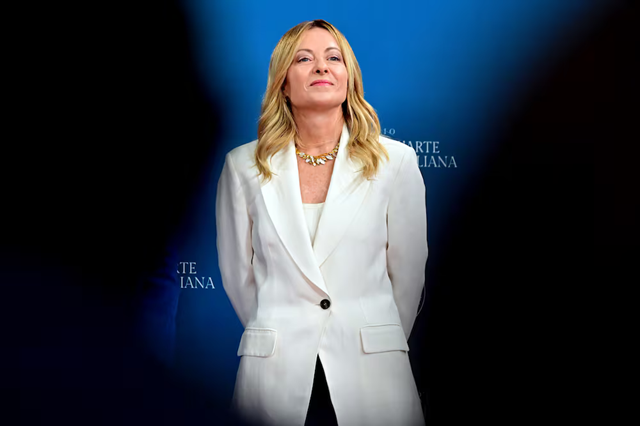
For Giorgia Meloni, staying in power has become an achievement in itself.
On Friday, the Italian prime minister will celebrate a political record that would be unremarkable in many countries but carries particular weight in Italy: her Government has become the longest-serving in the country’s modern history since the Second World War. After 1,413 days — three years, ten months and a half — Meloni has surpassed the second Government led by Silvio Berlusconi between 2001 and 2005. Berlusconi remained in office for another year after a Cabinet change, but technically that constituted another Government.
The milestone is being celebrated at a moment when Meloni has relatively few other achievements of comparable scale to point to. As El País has reported, the durability of her Government is one of the principal accomplishments of a premiership whose broader record remains contested.
Meloni inherited a country accustomed to political instability. For decades, Italy experienced Government changes at an extraordinary frequency, with the average administration lasting roughly six months. Against that history, simply remaining in office for almost four years represents a significant departure.
Yet stability is not necessarily the same thing as transformation.
Most analysts agree that Meloni’s principal achievement has been maintaining fiscal discipline and reassuring financial markets. The risk premium has fallen from 233 points in 2022 to 80 today, while the deficit has declined from 8.1% to 3.1%. Italy nevertheless remains under an infringement procedure from the European Union.
The economic picture beyond those figures is less impressive. GDP growth remains weak. Unemployment stands at 5.6%, but wages remain low. Italy spends less on education than any other EU country and is among those spending the least on healthcare.
“The stability is an instrument, not an objective, the objective of a country is to grow, and the truth is that Meloni has not had an economic policy, the deficit has fallen without her doing anything,” says Veronica De Romanis, an economist at Rome’s LUISS University who is highly critical of the Government. “The country is standing still, and in economics that means going backwards. She has done nothing so as not to have to touch the interests of the groups that voted for her. Her priority has been to maintain consensus.”
That political calculation may explain one of Meloni’s most remarkable successes. Four years into her Government, Brothers of Italy has suffered almost no electoral erosion. The party remains at around 26%, an exceptional performance in Italian political history, while its coalition partners, Matteo Salvini’s League and Forza Italia, have borne more of the political cost.
Meloni has pursued pragmatism, but that has also meant abandoning or failing to deliver several of the major projects with which she promised to transform Italy.
Federalism was abandoned after being rejected by the Constitutional Court in 2024. A new institutional design intended to strengthen the powers of the prime minister has also failed to materialise. The migrant detention centre in Albania has been paralysed by Italian and European justice. Her justice reform was rejected in a referendum in March, marking the beginning of a loss of connection with part of her electorate.
Pension reform has not happened either. Nor has the promised reduction in taxation. Instead, Italy’s tax burden has reached 43.1%, its highest level in a decade.
Foreign policy has produced another paradox. Meloni’s most significant international bet was her highly favourable approach towards Donald Trump, but that relationship became a political liability when the American president ultimately rejected her before the summer.
Her record is therefore defined by a contradiction. The Government has demonstrated unusual endurance while many of its headline reform ambitions have either stalled, been rejected or disappeared from the agenda.
Meloni nevertheless intends to turn longevity into a political message. She will celebrate the record with a mass event at the port of Bari in southern Italy under the slogan, “The most stable Government, the strongest Italy”.
The event is also designed to prepare supporters for another five years. The electoral race for the next general election is already under way. The vote could take place in April or May if the legislature is brought to an early end, which is considered the most likely scenario, or in October if the parliamentary term runs its full course.
There is, however, no guarantee that Meloni’s coalition will win again. According to polls cited in the El País report, another victory is far from certain. A second consecutive legislature would itself represent another remarkable achievement in a country where Governments have traditionally disappointed and voters have turned to alternatives.
Meloni’s most immediate problem is coming not from the left but from further to the right.
Roberto Vannacci and his new party, Futuro Nazionale, have emerged as the principal threat. The party presents itself as the authentic far right and competes with Meloni’s Government by adopting increasingly radical positions, accusing it of weakness and of betraying the expectations of its supporters.
Its support has grown steadily in polling and has reached as much as 12%, placing it above both Forza Italia and the League, which is suffering a leadership crisis and an internal power struggle.
The paradox is striking: Italy’s most right-wing Government in history is facing its greatest political challenge from its right.
Meloni has spent her premiership balancing competing identities. She has supported the European Union while retaining the nationalist instincts of her political base. She has supported Ukraine while managing relations with a domestic right that contains stronger anti-establishment currents. At home, her Government has pursued restrictive measures on rights and immigration, confronted NGOs involved in Mediterranean migrant rescues, expanded its influence over public television and developed a difficult relationship with the press.
But some of Meloni’s most significant successes have come precisely from doing what was not expected of a leader from an anti-European and pro-Russian right: maintaining an understanding with the EU and supporting Ukraine.
She once appeared to have the radical flank secured through Salvini. His decline has changed that calculation. Vannacci has emerged as a more uncompromising and electorally successful version of the anti-establishment profile.
That leaves Meloni with a difficult choice: confront the former general or bring him into her coalition. Without him, the arithmetic on the right may no longer produce a parliamentary majority.
The opposition has also changed in response to Meloni’s longevity. The Democratic Party, Giuseppe Conte’s Five Star Movement and the Alliance of Greens and Left, together with other centrist parties, have put aside differences to present a united front.
Even the Democratic Party has experienced its own record. On 26 August, its secretary general, Elly Schlein, became the longest-serving leader of the party, a position notorious for its instability and internal conspiracies. Since the party was founded in 2007, it has had ten leaders.
Yet unity has not eliminated the opposition’s own unresolved struggle. Conte also wants to become the coalition’s candidate. That question remains open and will depend partly on the final electoral system. Under the current system, the coalition candidate must be chosen before voters go to the polls, potentially forcing the left to organise complicated coalition primaries.
The significance of Meloni’s record also requires historical context. Government changes were particularly frequent during Italy’s First Republic, before the electoral system was altered in 1994 precisely to overcome what had become a chronic weakness of Italian politics.
Under pure proportional systems, fragmented Parliaments routinely required coalitions of four or five parties, often themselves divided into competing internal factions. Governments became vulnerable to bargaining, disputes over positions and repeated political crises. Alliances changed and Cabinets were reconstructed even when the same prime minister remained in place.
That is why Italian political history traditionally refers to governments such as Andreotti VII — whose first Cabinet lasted only eight days in 1972 — or De Gasperi VIII.
The system began to change during this century. Yet even Romano Prodi’s Government in 2006 consisted of 11 parties and an independent minister, illustrating how difficult durable governing coalitions remained.
Meloni’s Government has now surpassed them all.
The record is real. But its political meaning is less straightforward.
After nearly four years in power, Meloni can point to stability, improved public finances and an enduring electoral base. At the same time, several of her most ambitious reforms have failed, economic growth remains weak, and a new far-right force is challenging her from the very ideological territory that helped bring her to power.
The celebration in Bari will therefore be more than a commemoration of longevity. It will be an attempt to turn survival into proof of political strength.
Whether Italian voters agree will be decided at the next election.