


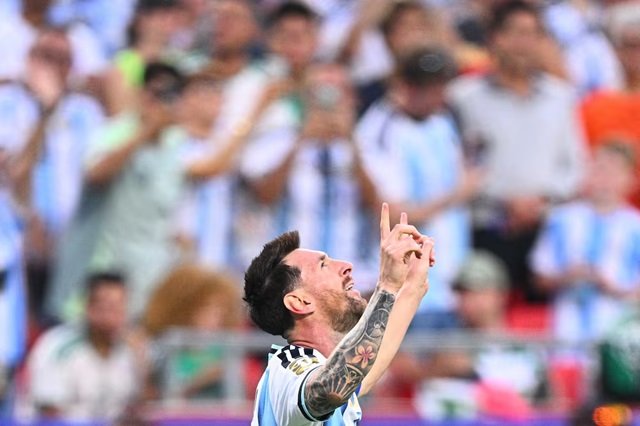
For days, the World Cup had been surrounded by issues far removed from the football itself. Political disputes, diplomatic tensions, border complications, visa problems and complaints over ticket prices had dominated the conversation before the players had the chance to define the tournament on the pitch. Then Lionel Messi arrived in Kansas City and changed the focus completely.
The Argentine captain’s three-goal performance in a 3-0 victory over Algeria became the moment when the World Cup’s biggest names reclaimed the spotlight. At a tournament filled with questions beyond the game, Messi’s display provided a reminder of the power of football’s greatest figures to shape the global conversation.
The night carried historical echoes from the beginning. Messi’s first appearance for Argentina came against Hungary in 2005, the same opponent Diego Armando Maradona faced in his international debut. More than two decades later, Messi entered another World Cup stage with Lionel Scaloni, once his teammate and now his coach, watching from the sidelines.
After the match, Scaloni was asked what remained to be said about Messi after witnessing yet another extraordinary performance. The Argentina coach struggled to find words, describing a player whose influence has remained almost impossible to explain.
“I could spend an hour here talking about him, but you have to be there to see the aura he spreads,” Scaloni said. “It is difficult to explain. He will be the best until he wants to be.”
Messi’s performance arrived at a decisive moment for the tournament. Before Tuesday night, much of the attention surrounding the World Cup had focused on matters outside the stadium. Discussions about political disagreements, restrictions affecting travel, a referee unable to cross a border, visa difficulties, expensive tickets, changes designed to increase television opportunities and concerns about immigration enforcement had shaped the opening days.
The footballers eventually pushed those issues aside. The sequence could hardly have been more dramatic. Kylian Mbappé made the first major statement with a two-goal performance against Senegal, showing that he remained one of the tournament’s most dangerous attacking forces after the disappointment of losing the 2022 final. Erling Haaland followed by scoring twice against Iraq, demonstrating that his finishing ability had travelled with him to the biggest stage.
Then came Messi.
The Argentine responded with three goals of his own, delivering a performance that renewed the conversation surrounding football’s greatest generation. Mbappé and Haaland had been viewed as the natural successors to the long-running rivalry between Messi and Cristiano Ronaldo. On this night, the younger stars produced impressive numbers, but the veteran answered with another defining moment.
The hat-trick marked the 61st time in Messi’s career that he had scored three or more goals in a match. It also added another chapter to a career that continues to challenge expectations.
Asked about his motivation, Messi referred to Rafael Nadal and a documentary series about the tennis champion. He explained that he identified with Nadal’s mentality, particularly the desire to always give maximum effort and continue enjoying competition while physically capable.
“While I can, we will be there,” Messi said.
His performance also renewed the comparison with Cristiano Ronaldo, a rivalry that has defined an era of football. The Portuguese forward, now 41, matched Messi’s record of six World Cup appearances but failed to score against the Democratic Republic of Congo. Meanwhile, other established figures continued to make their presence felt, including Harry Kane, who scored twice against Croatia, although one of his goals came from a penalty awarded after a review.
The impact of Messi’s display extended beyond his own statistics. It immediately increased expectations on the tournament’s other leading contenders. Portugal struggled in its opening match, while Spain continued searching for answers from Lamine Yamal, who was returning from injury. Brazil, meanwhile, was expected to show more attacking quality after relying heavily on Vinicius during its first match against Morocco.
Before the tournament began, there had been uncertainty about what version of Messi would appear. He arrived after three seasons playing in Miami, approaching his 39th birthday and already carrying the achievement of winning the World Cup in Qatar. Against Algeria, his physical limitations were visible enough for Scaloni to remove him during the final minutes, but his understanding of space, timing and decision-making remained central to Argentina’s performance.
Algeria coach Vladimir Petkovic highlighted the unique role Messi plays within the Argentine team, saying the forward benefits from having teammates who work around him and provide constant support. Scaloni offered a similar explanation, describing a group that understands Messi both as an extraordinary figure and as a teammate who can be approached naturally.
The statistics from the match reinforced the significance of the occasion. Messi’s three goals allowed him to equal Germany striker Miroslav Klose’s record of 16 World Cup goals. Earlier in the day, Mbappé had moved ahead of him with 14 goals, but Messi responded with a decisive contribution. Argentina recorded six shots on target, four from Messi, with three finding the net.
The nature of his goals also reflected one of the defining characteristics of his career. Of the 914 goals recorded across his club and international career, 179 have come from outside the penalty area, including 71 direct free kicks. After his opening goal against Algeria, Messi was seen fighting back tears. Later, he explained only that he had experienced difficult days unrelated to football.
The hat-trick also made Messi the oldest player to score multiple goals in a World Cup match, achieving the feat at 38 years and 357 days and surpassing Cameroon’s Roger Milla, who scored twice against Colombia in the 1990 tournament.
With Messi’s performance, the World Cup entered a new stage centred on its biggest names. Mbappé had made his statement. Haaland had followed. Messi delivered his response. The tournament’s next major spotlight fell on Cristiano Ronaldo, but his night ended in frustration as football’s biggest stage continued to belong to the players.










