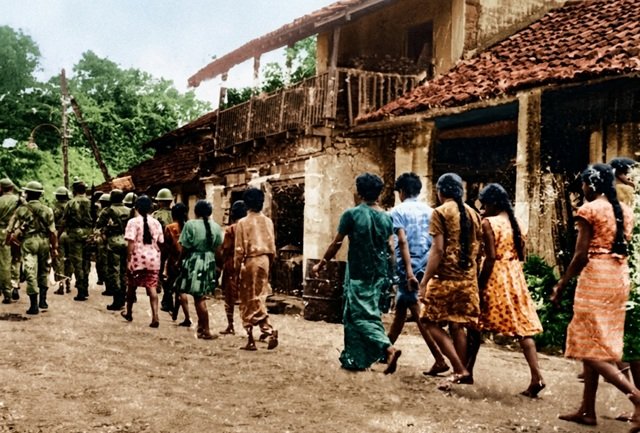
The murder of the Deniyaya doctor shook the entire country during the 1971 rebellion. Many incidents occurred during the 15-day rule of the Deniyaya area by the April 1971 rebels. One of the 37 police officers killed by the rebels nationwide was Constable (No. 4706) Mayadunne of the Deniyaya Police. In addition, 41 ordinary civilians were killed by the rebels across the country. Among those civilians, the most prominent professional figure recognized nationally and internationally was Dr. Rex de Costa, who served in Deniyaya and was later killed there. There were 71 rebels operating in that area. The War Coordination Officer appointed by the government for the Matara District was Lieutenant Colonel Dulip Wickramanayake. The leader of the Matara District during the April Rebellion was Nikape Andiarachchige Piyasena Wickramaratne, alias Maharagama Susil Wickrama. The number of rebels killed in Deniyaya during the rebellion was 18.
The number of people charged under Investigation No. 94 Deniyaya by the Criminal Justice Commission in connection with the April rebel activities in the Deniyaya area was 90. Charge sheets were served on them on 20 August 1973. However, 30 of them had not appeared before the commission. Forty-five people pleaded guilty to the charges. Although the remaining 15 were declared innocent, the charges against them were still heard.
One incident that shook the entire country during the 1971 rebellion was the murder of Dr. Rex de Costa, a 51-year-old plantation owner and popular doctor in the Deniyaya area. His medical center was located in a house on the southern side of the Deniyaya Junction, next to the People’s Bank. Born on June 15, 1920, in Colombo, Dr. Costa was educated at Royal College, Colombo, where he obtained his medical degree. He later joined the army during World War II and served as a medical officer. His service was appreciated by the British Queen. He subsequently joined the Sri Lanka Army Volunteer Service and continued serving until he retired at the age of 36 with the rank of Lieutenant Colonel.
After retiring from the army, Dr. Costa chose Deniyaya as his residence in 1967 because of his family connections. He was married to Doreen Gunathilaka and was the father of four children: Marcel, Cheryl, Rex, and Eric. Several of the children studied at St. Aloysius’ College, Galle. Dr. Costa’s assassination received widespread publicity because he had been appointed Vice-President of the World War Veterans’ Association at its 8th General Assembly in Rome. The organization’s headquarters were in Bangkok, with branches throughout the world. Costa, who had worked for some time in the Bangkok office, had served as Secretary of the Sri Lankan branch of the Ex-Servicemen’s Association since 1952. He had also represented Sri Lanka at many international conferences.
Dr. Costa was assassinated by rebels on 9 April 1971 at around 9 a.m. It was Good Friday. His body was buried on April 11 at the cemetery of St. Matthew’s Church in Deniyaya, where Father Jayathilaka served as caretaker. St. Matthew’s Church had been built by Dr. Costa’s grandfather, D. M. Rajapaksa, as a memorial to the Catholic faithful. One of his great-grandfathers was the late William Abeysundara, who had once headed the Galle church. A school was later established there.
Costa was assassinated by a group of Mawarala rebels who had retreated to Deniyaya after the April 5 attack. In the early hours of that day, rebels led by Jayatissa attacked the Deniyaya Police Station for the second time and took control of the town. A group of Mawarala rebels who arrived in a Morriston Estate lorry later opened fire on Costa’s house at around 9 a.m. The charges leveled against Costa by the rebels were that he had prepared a security plan for the Deniyaya police after the April 5 attack, kept the radio transmitters of the Enasal Estate radio station in his house at the request of the police, and treated injured police officers there.
Ten rebels were charged before the Criminal Justice Commission for the murder of Dr. Costa on April 9, 1971. Of the ten charged, seven pleaded guilty and three pleaded not guilty. Those who pleaded guilty were N. E. L. Cyril, R. Namadasa, Patitiya Durage Premadasa alias Kiria, R. Wimaladasa, M. P. Ariyasena, M. M. John, and Sunil A. Wickramasinghe. Those who pleaded not guilty were G. K. Premathilaka, L. V. K. Geeganage, and M. G. Sumanasiri. At the final hearing, nine of them were sentenced to two to four years’ imprisonment for the murder of Dr. Costa. In addition, Urubokka Keerapitiya Manamperi Gunawardena Sumanasiri, alias Gunapala, who was convicted of the murder, was sentenced to life imprisonment. Two of his brothers had also joined the rebellion.
After the murder of Dr. Costa, the family left Deniyaya and moved to Colombo. The Deniyaya house was later handed over to a convent. Gunapala, who was convicted in the Costa murder case, was held in Ward P of the New Magazine Prison in Borella and assigned to the sewing section. Other suspects in that ward included Wijeweera, Piyathilaka, Aladin Subasinghe, and several others. Wards G, H, and P belonged to the same section.
One of the prisoners in that section was Kodagoda Addara Amarasinghe Ananda Ranjith, alias Podi Ranjiya, who had been a full-time JVP campaigner in the Deniyaya area since early 1968. Ranjith Amarasinghe, who was born on December 26, 1950, in Divelawatta, Kirulapone, Deniyaya, told the writer that Gunapala had stated he would not hesitate to fulfill the responsibilities assigned to him.
When Ranjith married teacher Leelawathi Manage on 12 June 1979, JVP leader Rohana Wijeweera came to Udapeekwella, Matara, to sign as one of the witnesses to the marriage. After the Criminal Justice Commission (Abolition) Act came into effect on 27 October 1977, the rebels, including JVP leader Wijeweera, were released on 2 November 1977. M. G. Sumanasiri alias Gunapala, who was serving a sentence for Costa’s murder, was also released.
After his release, Gunapala returned to farming and married the daughter of an old village headman in Panakaduwa, Pasgoda. Later, he started his own business manufacturing peanut packets and distributing them by motorcycle. During the second JVP rebellion in 1989, his legs were broken by a paramilitary group in Rotubedi, Matara. He is also said to have joined a protest movement in Colombo in 2003. Gunapala, the father of one child, died in 2011. His brother Ranjith Pushpakumara was also reportedly murdered in 1989.
It was P. Gamage who brought security secrets to Rohana Wijeweera. “S-5” was his code number. Letters regularly sent to an address near his house were marked “S-5” in the top-left corner of the envelopes. Osman de Silva of Wanathamulle told the writer that he personally ensured the letters reached Wijeweera. However, although many people know about S-5 or P. Gamage, his full name and other details have not yet been fully revealed. In an effort to learn more about Gamage, who was born in Deniyaya, 55 years after his death, the writer met with his surviving family members in Deniyaya.
In the statement submitted by Wijeweera before the Criminal Justice Commission, Gamage was mentioned as follows: “…I explained in my testimony that we read the police circulars through the office of the Deputy Superintendent of Police in Kalmunai, and that it was learned that he had been arrested and killed by the police. Through these documents, we came to know the orders sent by the IGP to the Superintendents and Deputy Superintendents of Police regarding the suppression of the JVP…”
Pintheris Gamage, alias P. Gamage, was born on June 6, 1945, in Samanpaya, Pothdeniya, Urubokka. His father, James, a farmer, died while he was still young. His mother was Moragala Babyhami Atapattu. The couple had seven children, and Pintheris was the fourth. His elder sisters were Somawathi, Nandawathi, and Yasawathi, while his younger brothers were Piyadasa, Jinadasa, and Karunadasa. He was educated at Kongasdeniya Junior College and Urubokka Maha Vidyalaya. Gamage was one of the first two students from that school to be admitted to university; the other was Kumaradasa. He later entered the University of Peradeniya and graduated from the Arts Faculty.
After passing the Central Clerk Recruitment Examination, he joined government service as a clerk. He was first appointed to the office of the Assistant Superintendent of Police in Matara. Later, he was attached to the office of the Assistant Superintendent of Police in Kalmunai under the Batticaloa Police Superintendent. Hettar Weerasinghe was the Superintendent of Police in Matakadapuwa at the time. Gamage’s bank account was at the People’s Bank branch at Arasandi Junction, Batticaloa.
Gamage joined the JVP in late 1967. He also attended a seven-day camp held at the house of Siripala Abeywardena in Dematagamuwa, Kataragama, in late 1968. Sumith Athukorala, Piyathilaka Samararatne, Francis Abeywickrama, Ranjith Amarasinghe, Wijeweera, Premasiri, Siripala, and around 30 others also attended.
He had left the police service after taking leave a few days before the April 5 uprising. After the attack on the Vavuniya Police Station on April 5, Gamage was arrested by the Wellawali police along with several other rebels. He was later handed over to the Batticaloa police and reportedly died under torture. Pintheris Gamage was unmarried at the time of his death.
Gamage’s younger brother, Piyadasa alias Sisira Lanka, owned Beralapanatara Lalitha Studio. Sisira also worked as the Beralapanatara correspondent for several newspapers. During the April 1971 uprising, he searched tirelessly for his brother Pintheris. During the second JVP uprising in 1989, a paramilitary group affiliated with the security forces stormed his photography studio, killed him, and dumped his body in Deniyaya, Kirulapone. Similarly, two children of Gamage’s elder sister Somawathi, who was a mother of six, were also killed during the second JVP uprising in 1989.
During the 15 days in which the rebels ruled Deniyaya, public disputes were resolved through makeshift courts held on Temple Road. During that period, many people submitted complaints, most of which involved land disputes. The army arrived in Deniyaya town at 7 a.m. on April 24, 1971, and re-established government control. Helicopters flew overhead and dropped several bombs. A few days later, army units began encircling the Sinharaja jungles with hunting dogs.
The leader of the Mawarala rebellion was Robert Jayasekara, a teacher. After his arrest, leadership was handed over to “Kakula Kota” Wijenayake. The deputy leader of Mawarala was David Manamperiya. Wijenayake was later killed during the rebellion. After the April 5 attack, Urubokka Dampahale Francis Abeywickrama, alias Pantis, Gamini Madarasinghe, Alukumbure Wijeyadasa, and several others who had retreated from Hambantota joined the Deniyaya region.
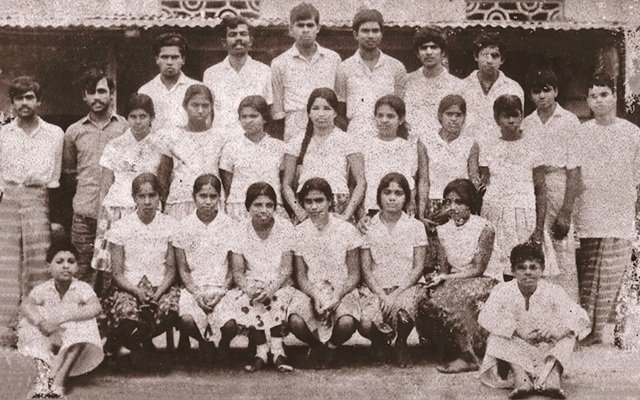
During the 1971 JVP rebellion, the Samagi Peramuna government received military advice from Britain’s MI5 intelligence service. This was revealed by investigative journalist Peel Miral in his 2015 research. Officers from the intelligence service came to Sri Lanka after April 5, 1971, at the invitation of the Sri Lankan government. After meeting Defense Secretary S. A. Dissanayake, they guided the security forces in implementing several operational plans. One such step involved gathering inside information to attack rebel hideouts. Accordingly, spies were sent to several districts across the country, including Matara, Kurunegala, Kegalle, Anuradhapura, and Galle.
A man posing as a media representative of a foreign embassy, accompanied by a Sinhala interpreter, traveled to Deniyaya in a vehicle to meet the rebels. He informed them that he wished to meet several leaders of the rebellion to discuss the possibility of providing life protection, food, medical care, and other facilities. The rebels were told that arrangements had been made for a discussion at a bungalow in the Morningside Estate the following day.
Several people, including the Deniyaya rebel leader Jayatissa, went there for the meeting. It is said that Jayatissa died in military gunfire on 31 May 1971 as a result of that operation. The police cremated Jayatissa’s body near Deniyaya Central College. That was the fate that ultimately befell the Deniyaya rebel leader, who was “caught in the crosshairs” of Britain’s MI5 intelligence service.
By the end of May, the Deniyaya rebels surrendered in small groups to regional government offices. Sirimevan Chandraskara, who became the second leader of the rebellion after Jayatissa’s assassination, was among them. One of those who came to surrender was Sanchi Haminela’s Leslie, a barber at a Deniyaya barber shop. The owner of the shop, Ranatunga, was also arrested and killed. His body was tied to a jeep and paraded around the town by security forces. Major Perera was charged with the crime.
Jayasinghe Arachchige Don Nandasena, alias Karate Nand, was a member of the Deniyaya Rebellion. Born on 14 June 1947, he studied at Deniyaya Maha Vidyalaya. Later, he joined the JVP as a full-time member in 1969. He and several others retreated to the Diyadawa jungle after the defeat of the rebellion.
At the beginning, Jayatissa instructed all the rebels to retreat to Sinharaja using three routes. There were about 115 people in the three groups. All the food supplies were taken to the cardamom plantation and transported from there into the jungle by camels. The group led by Munasinghe of Algiriya, who had retreated to Deniyaya, also headed toward Sinharaja. Their final intention was to retreat to Vilumba Kanda in Elpitiya and join JVP groups there, but the plan was later abandoned.
The group that included Pantris, Lalith, and Manamperi, who had moved down from Mawarala, also entered Sinharaja. In the end, only 37 people remained, as the others had dispersed separately. The last remaining group of Deniyaya rebels was arrested by the military in Sinharaja Mederipitiya on June 26, 1971. They were then taken to a military camp. The remaining rebels were forced to surrender at locations designated by the government.