


India is intensifying its efforts to secure uranium and critical mineral supplies through a series of international agreements as the government seeks to strengthen energy security, expand nuclear power generation and support the country’s rapidly growing clean energy manufacturing sector.
Prime Minister Narendra Modi has signed new agreements with Australia and Indonesia in recent weeks, adding to a broader diplomatic campaign aimed at diversifying India’s energy resources and reducing supply chain vulnerabilities highlighted by the conflict in the Middle East, particularly the war in Iran.
India remains the world’s third-largest importer of crude oil and depends on the Middle East for about half of its oil supplies and roughly two-thirds of its natural gas, increasing concerns over supply disruptions during periods of geopolitical instability.
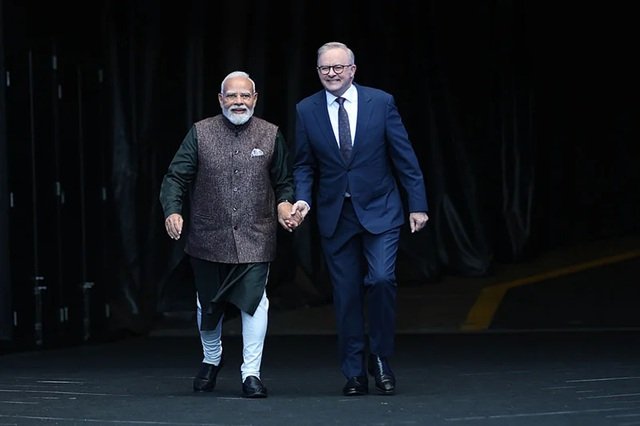
Last week, Modi and Australian Prime Minister Anthony Albanese reached an agreement covering uranium imports and expanded cooperation in critical minerals. Australia holds about 28% of the world’s uranium reserves, making it a key potential supplier as India works toward its goal of reaching 100 gigawatts of nuclear power capacity by 2047.
“Australia’s huge uranium reserves align directly with India’s nuclear journey,” Modi said during his visit to Melbourne.
The two countries had signed a nuclear cooperation agreement in 2014, but uranium exports did not proceed because of concerns that Australian uranium could contribute to India’s nuclear weapons programme. Under the new arrangement, both governments said United Nations safeguards would ensure that exported nuclear fuel is used exclusively for peaceful purposes.
India has also expanded uranium partnerships beyond Australia. During Canadian Prime Minister Mark Carney’s visit to New Delhi in March, Canada’s largest uranium producer, Cameco, signed a C$2.6 billion (US$1.8 billion) agreement to supply uranium to India between 2027 and 2035 in support of the country’s expanding nuclear energy sector. India also produces some domestic uranium and currently imports supplies from Uzbekistan and Russia.
Alongside nuclear fuel, the government is pursuing access to minerals considered essential for renewable energy technologies and advanced manufacturing. According to the Institute for Energy Economics and Financial Analysis, India imports all of the lithium, cobalt and nickel required for renewable energy products, underscoring its dependence on overseas suppliers.
During Modi’s visit to Jakarta last week, India and Indonesia announced more than a dozen agreements, including a partnership on rare earth minerals. India also committed to investing in steel manufacturing in Indonesia, which possesses the world’s largest nickel reserves. Nickel is a critical material used in stainless steel production and electric vehicle batteries.
Vibhuti Garg, director for South Asia at the Institute for Energy Economics and Financial Analysis, said India’s strategy reflects the country’s growing manufacturing ambitions.
“India is trying to secure supply chains because we are setting up huge domestic manufacturing,” Garg said. “Ultimately it all boils down to minerals so India is strategically trying to get more minerals for solar and wind and uranium for nuclear power.”
India is seeking to strengthen its position in a global market where China remains the dominant player. According to the International Energy Agency, China controls much of the world’s refining and processing of critical minerals and produces about 90% of rare earth permanent magnets used in electric vehicles, wind turbines and military equipment.
Ajai Malhotra, a former Indian ambassador to Russia and a distinguished fellow at The Energy and Resources Institute, said secure access to minerals such as nickel would be essential for India’s transition toward electric mobility and clean energy. He noted that China had already established a dominant position in Indonesia’s nickel industry and said India had limited time to build a meaningful presence in the country’s nickel value chain.
The government has also expanded its international engagement through multilateral initiatives. India joined the U.S.-led Minerals Security Partnership in 2023, a coalition that includes the European Union and other countries seeking to strengthen supplies of critical raw materials. Domestically, New Delhi has launched the National Critical Minerals Mission while encouraging Indian mining companies to pursue lithium reserves in Argentina, Bolivia and Chile, home to some of the world’s largest lithium deposits.
India’s strategy also extends to Africa, which holds about 30% of known global critical mineral reserves, including coltan ore used to produce tantalum for electronic components. Later this year, New Delhi is scheduled to host what is expected to be its largest India-Africa Summit, with critical minerals set to feature prominently on the agenda.
The recent agreements with Australia, Canada and Indonesia, together with broader international initiatives, reflect India’s efforts to secure long-term access to the raw materials and nuclear fuel needed to support its energy transition, manufacturing expansion and climate objectives.










