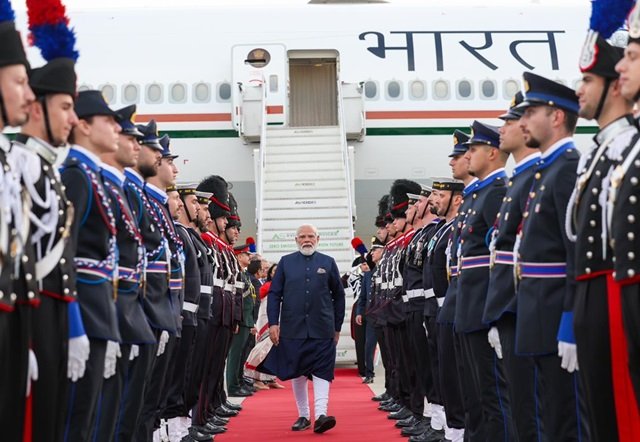
Television coverage of Prime Minister Narendra Modi’s recent visits to the UAE, Italy, the Netherlands, Sweden, and Norway was dominated by optics — selfies with Italian Prime Minister Giorgia Meloni, the “Melody” social media moment, and ceremonial receptions. Yet the real significance of the tour lay elsewhere. Beneath the spectacle was a deeper geopolitical and geo-economic shift that deserves far greater attention in India.
This was not merely a high-visibility diplomatic exercise. The five-nation outreach reflected India’s attempt to position itself within critical global supply chains involving semiconductors, green energy, defence manufacturing, strategic minerals, maritime security, and advanced technologies. In an increasingly fragmented world order, India is trying to convert its strategic autonomy into tangible economic and technological gains.
The most consequential outcomes emerged from the Netherlands. Though a small European country with a population of around 18 million, the Netherlands occupies a pivotal position in the global semiconductor ecosystem because the Dutch company ASML is the world’s leading manufacturer of advanced lithography machines required to produce cutting-edge semiconductors. Its partnership with Tata Electronics is expected to strengthen India’s semiconductor ambitions, including the fabrication facility at Dholera in Gujarat.
India and the Netherlands also expanded cooperation across semiconductors, critical minerals, renewable energy, defence, mobility, and strategic technologies. These agreements are important because India is attempting to reduce excessive dependence on any one country while simultaneously integrating itself into trusted technology networks. The semiconductor push is particularly significant, as chips have become central to everything from artificial intelligence and telecommunications to defence systems and electric vehicles.
Equally important was the broader strategic signal coming from Europe. Despite differences over the Russia-Ukraine war, Europe has steadily entered India’s strategic calculus. Traditional geopolitical alignments are weakening, while geoeconomics increasingly drives foreign policy decisions. The momentum behind negotiations on the India-European Union Free Trade Agreement reflects this changing reality. Europe seeks reliable markets, skilled talent, and resilient partnerships, while India requires greater access to technology, investments, and export markets.
India already enjoys strong bilateral ties with countries such as France, Germany, and the Netherlands, but the latest outreach suggests New Delhi is now pursuing a more structured and long-term European strategy. Importantly, India is engaging Europe both bilaterally and through the European Union framework.
In Sweden, India’s ties were elevated to a strategic partnership with a focus on innovation, green transition, advanced manufacturing, and defence cooperation. Swedish expertise in aerospace, shipbuilding, and advanced sensor technologies could significantly complement India’s expanding defence industrial base under the Make in India initiative. India’s emphasis on co-production and indigenous manufacturing reflects lessons drawn from recent geopolitical disruptions and global supply-chain vulnerabilities.
Norway, too, emerged as an important partner in India’s green-transition ambitions. Cooperation in sustainable maritime systems, clean technologies, and renewable energy aligns with India’s decarbonisation goals. Europe’s interest in green hydrogen also opens new opportunities. Europe needs affordable green energy solutions, while India seeks access to technology, finance, and markets. Such partnerships could eventually reshape India’s industrial and export landscape.
The Italy visit carried significance beyond symbolism. India and Italy upgraded their ties to a special strategic partnership and reiterated their objective of substantially expanding bilateral trade over the coming years. Italy also expressed support for the India-Middle East-Europe Corridor (IMEC), which India increasingly views as a critical strategic and economic initiative connecting the Indo-Pacific with the Mediterranean region.
The IMEC framework reflects a larger geopolitical evolution. For years, discussions centred almost exclusively on the Indo-Pacific. However, recent developments have highlighted the growing importance of the Indo-Mediterranean corridor as a space connecting trade, energy, technology, and maritime security interests.
The UAE leg of the visit was equally significant. Energy security remains central to India’s long-term economic growth strategy. Agreements relating to hydrocarbons, strategic petroleum reserves, and defence cooperation deepen India-UAE ties at a time when global energy markets remain volatile. India’s efforts to expand its strategic petroleum reserves underline its attempt to reduce vulnerability to external shocks and supply disruptions.
The wider international context also explains the importance of this outreach. The rise of transactional politics, uncertainty in U.S. foreign policy, deepening Russia-China ties, and recurring disruptions in global supply chains have compelled countries to diversify partnerships. India’s doctrine of strategic autonomy is now finding practical expression through diversified technology, defence, and energy cooperation with multiple partners.
The larger message from Mr. Modi’s five-nation tour is therefore less about optics and more about strategic interdependence. India is attempting to position itself not merely as a consumer market but as an important participant in global manufacturing, technology, and supply-chain networks. The emphasis is increasingly on co-production, technology partnerships, resilient trade frameworks, and industrial collaboration.
For India, the challenge now is to convert diplomatic momentum into durable industrial capacity, technological depth, and export competitiveness. The success of this outreach will ultimately be measured not by headlines or social media moments, but by whether it helps India secure a stronger and more resilient place in the emerging global economic order.