by Durga Velayudham
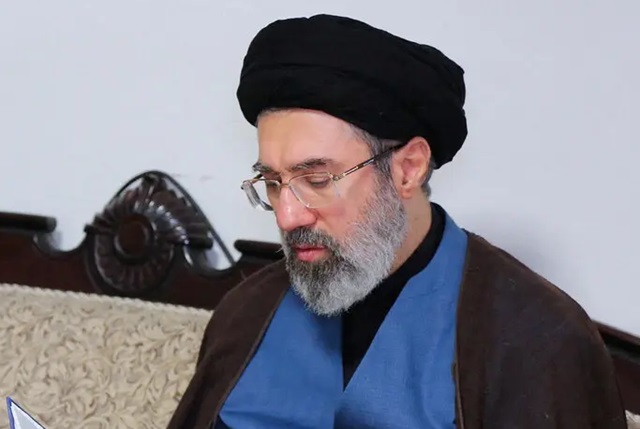
As Iran reels from the shock of a US-backed Israeli missile strike that killed Supreme Leader Ali Khamenei, attention has swiftly turned to his second-oldest son, Mojtaba Khamenei, who has emerged as the leading candidate to assume the nation’s highest office. At 56, Mojtaba is largely unknown to the public, yet he wields longstanding influence behind the scenes and maintains close ties to the Islamic Revolutionary Guard Corps (IRGC), positioning him as a figure capable of consolidating the hardline agenda his father championed.
Born in 1969 in the religious city of Mashhad, Mojtaba Khamenei grew up in a pivotal era of Iran’s modern history, witnessing the final decade of the monarchy and the 1979 Islamic Revolution that transformed the country. He joined the IRGC in 1987, toward the end of the Iran–Iraq War, gaining military experience and embedding himself within the powerful paramilitary structure that has shaped Iranian politics for decades. His father, Ali Khamenei, had assumed the mantle of Supreme Leader the following year, further cementing the younger Khamenei’s path within the clerical-military establishment.
Mojtaba subsequently studied under Iran’s most respected clerics in Qom, later teaching at the same seminary and cultivating influential networks within the religious hierarchy. Despite his proximity to power, he remained a shadowy figure, rarely appearing in public or assuming formal political office, yet exercising significant influence from behind the scenes. Analysts note that his role in orchestrating militia operations, supervising election outcomes, and guiding hardline policy initiatives demonstrates both strategic acumen and deep integration into the structures of the Islamic Republic.
His involvement in domestic politics became particularly visible after the 2005 presidential election, when reformist figures accused him of using his position and IRGC connections to secure the victory of Mahmoud Ahmadinejad. Reformist candidate Mehdi Karroubi criticized Mojtaba as “a master’s son” interfering with democratic processes, prompting Ali Khamenei to defend his son, asserting that “he is a master himself, not a master’s son.” Such incidents highlighted Mojtaba’s behind-the-scenes influence and the breadth of his control over key levers of power.
In 2024, when the Assembly of Experts convened to discuss the succession of the Supreme Leader, Ayatollah Ali Khamenei reportedly excluded Mojtaba from consideration, signaling potential tensions over hereditary succession. Yet following the missile strike that claimed not only Ali Khamenei’s life but also that of Mojtaba’s wife, Zahra Adel, his mother, Mansoureh Khojasteh Bagherzadeh, and one of his sons, Mojtaba’s candidacy has resurfaced with renewed urgency. Reports indicate that he has been selected as the primary candidate in closed online meetings of the Assembly of Experts, conducted under the watchful eye of the IRGC after Israeli strikes disrupted the original gathering in Qom.
Mojtaba Khamenei’s ascension raises profound questions about the direction of Iran’s political and religious leadership. A hereditary succession would contravene long-standing Shia conventions that reserve ultimate authority for the lineage of the Twelve Imams, not contemporary familial ties, and could inflame domestic dissent among Iranians already disillusioned by economic hardships and mass protests earlier this year. Analysts warn that elevating Mojtaba would signal that hardline factions, tightly interwoven with the IRGC, remain firmly in control, offering little prospect of reform or moderation.
The younger Khamenei’s wealth and international holdings further complicate his image. Investigations suggest he owns more than $138 million in UK luxury properties, including residences on London’s famed Billionaire’s Row, as well as investments in Tehran, Dubai, Frankfurt, and Swiss accounts. Though these assets have been disputed by reformist groups, they underscore the confluence of clerical power, economic influence, and political authority that Mojtaba would inherit.
Mojtaba’s rise is also fraught with logistical and ideological hurdles. He has never held public office, and his previous opposition to hereditary succession adds complexity to his candidacy. Yet the convergence of IRGC backing, clerical networks, and the vacuum created by the missile strike appears to have propelled him to the forefront. Observers caution that his appointment could trigger internal friction within the Assembly of Experts and among the Shia seminaries, particularly as factions debate the legitimacy of a father-to-son transfer of supreme authority.
Internationally, Mojtaba Khamenei’s potential leadership carries weighty implications. President Donald Trump noted that several of Iran’s top military and defense officials were eliminated alongside Ali Khamenei, leaving fewer seasoned candidates and heightening uncertainty about the regime’s future trajectory. Analysts suggest that Mojtaba’s hardline alignment with the IRGC may lead to intensified domestic security measures, a continued assertive foreign policy, and reduced tolerance for political dissent.
Despite the extraordinary circumstances surrounding his emergence, Mojtaba Khamenei represents continuity within the Islamic Republic, blending clerical authority with military influence. His ascent, if realized, would mark only the second instance in the nation’s history in which the Assembly of Experts conducted a closed election for Supreme Leader, the first having elevated Ali Khamenei in 1989.
As Iran navigates the aftermath of the missile strike and the ensuing political vacuum, Mojtaba Khamenei’s candidacy illuminates the enduring tension between revolutionary ideals and dynastic consolidation. His potential leadership underscores the IRGC’s sway, the entrenchment of hardline factions, and the fragility of succession mechanisms in a state where ideology, lineage, and military power intersect inextricably.
Whether Mojtaba Khamenei can secure legitimacy among clerics, maintain cohesion within the political elite, and navigate domestic unrest remains uncertain. Yet in a nation confronted with extraordinary loss and instability, his rise signals that Iran may continue along the hardline path charted by his father, with the son stepping into the shadows his father once occupied, consolidating power at a moment of unprecedented national and regional volatility.