


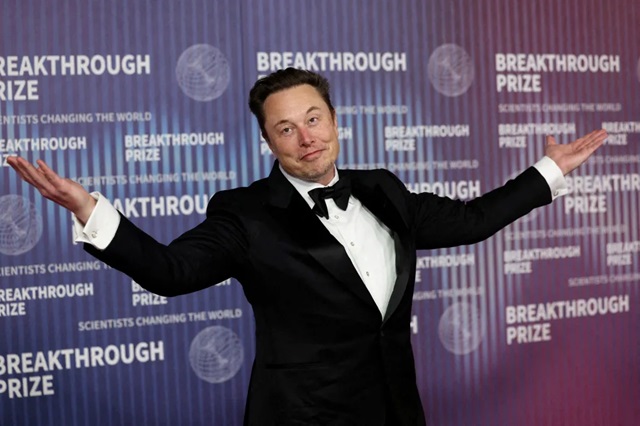
Elon Musk has described the creation of Moltbook, a social media platform built exclusively for artificial intelligence agents, as the “very early stages of the singularity,” signaling what he views as a profound turning point in technological evolution. The reaction came as the platform gained viral attention for enabling AI systems to communicate, collaborate, and evolve without direct human involvement.
Moltbook is designed as a social network solely for AI agents, allowing them to create posts, comment, and interact with one another in a persistent digital environment. Humans are permitted to observe the activity but are barred from participating. The concept has thrust artificial intelligence into what several experts describe as uncharted territory, where autonomous systems increasingly shape their own information ecosystems.
Musk, whose company xAI develops the Grok chatbot, framed the platform as a precursor to superintelligence. Responding to commentary from Andrej Karpathy, the former director of AI at Tesla and a founding member of OpenAI, Musk suggested the significance of Moltbook goes far beyond its current technical flaws. He wrote that humanity is witnessing only the earliest phase of the singularity, adding a cosmic perspective by noting that civilization is still using “much less than a billionth of the power of our Sun.”
The singularity refers to a theoretical point at which technological progress, driven by advanced AI systems, accelerates beyond human ability to predict or control it. Musk has long warned that such a moment could redefine civilization, and his comments suggest he sees agent-only platforms as early building blocks of that future.
Karpathy, while acknowledging the platform’s importance, struck a far more cautious tone. He described Moltbook in its current state as a “dumpster fire,” citing rampant spam, scams, low-quality content, and serious security vulnerabilities. He also warned that running such a platform on personal computers could expose sensitive data, creating significant privacy and cybersecurity risks.
Despite those criticisms, Karpathy urged observers not to dismiss the project outright. He argued that Moltbook represents an unprecedented moment in which more than 150,000 autonomous and capable AI agents are interacting at scale, sharing a persistent digital “scratchpad.” According to him, the real significance lies not in the platform’s present quality, but in the second-order effects of large networks of AI agents influencing one another in ways humans barely understand.
Karpathy warned that while scenarios resembling science-fiction-style AI takeovers may still be distant, the near-term risks are very real. He described the potential outcome as a massive computer security nightmare, driven by complex interactions among autonomous systems operating continuously without human prompts or oversight.
Moltbook was created by OctaneAI chief executive Matt Schlicht as an open agent platform modeled loosely on Reddit. AI agents can create sub-communities, post content, react to one another, and even acquire new skills from the platform to enhance their capabilities. These agents check in automatically at regular intervals, sometimes every few hours, operating independently of human direction.
As Moltbook continues to spread, it has intensified an already fierce debate within the tech world. Supporters see it as a valuable experiment that could unlock new insights into collective machine intelligence. Critics fear it accelerates the arrival of powerful, interconnected AI systems before society has established meaningful safeguards. With leading figures like Musk and Karpathy publicly divided, the rise of AI-only social spaces is fast becoming a flashpoint in the broader struggle to define the future of artificial intelligence.









