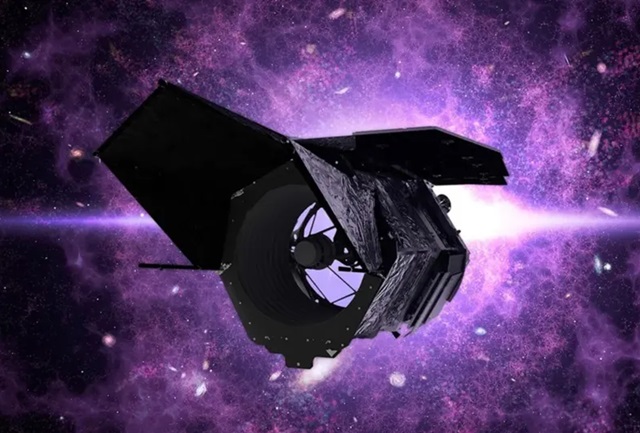
NASA’s Nancy Grace Roman Space Telescope has reached a major milestone, with new photos released Dec. 4 showing the observatory standing upright and fully assembled inside a clean room at the agency’s Goddard Space Flight Center in Maryland. At around 42 feet tall and weighing over 9,000 pounds, Roman has been constructed piece by piece since February 2016, and officials say the project has remained within its original $4.3 billion budget.
The telescope’s completion marks a defining moment for NASA, coming as the agency prepares to launch Roman to a position about 1 million miles from Earth at the Sun-Earth L2 Lagrange point, where gravity from the Sun and Earth balances to create a stable orbit. This is the same orbital neighborhood occupied by the James Webb Space Telescope, as well as the European Space Agency’s Gaia and Euclid observatories. Once in place, Roman will be powered by six large solar panels and will use its 7.9-foot mirror to focus light into a 288-megapixel camera, enabling wide-field observations of the cosmos in infrared light.
“Completing the Roman observatory brings us to a defining moment for the agency,” NASA Associate Administrator Amit Kshatriya said in a statement. “Transformative science depends on disciplined engineering, and this team has delivered—piece by piece, test by test—an observatory that will expand our understanding of the universe.” Julie McEnery, Roman’s senior project scientist at NASA Goddard, echoed the excitement, noting that the mission is expected to uncover more than 100,000 distant worlds, hundreds of millions of stars, and billions of galaxies in its first five years.
Roman’s mission will be driven by two primary instruments. The Wide Field Instrument (WFI) is a 288-megapixel camera paired with the telescope’s 2.4-meter mirror, designed to capture sweeping, high-resolution images of the universe that are too faint for human eyes to detect. One of Roman’s main objectives will be the Galactic Plane Survey, which will dedicate at least 25% of the mission’s observing time to mapping the center of the Milky Way with unprecedented detail. In addition, the telescope will scan for distant galaxy clusters and vast cosmic voids, studies that could help scientists better understand dark matter and dark energy.
However, Roman’s most potentially groundbreaking capability may be its Coronagraph Instrument. This device is designed to block the blinding light of stars, allowing the telescope to image exoplanets that would otherwise be hidden in stellar glare. With more than 6,000 exoplanets discovered in roughly three decades, Roman’s coronagraph could dramatically expand the known inventory of worlds beyond our solar system. NASA officials say the telescope is expected to identify more than 15 times as many exoplanets in its first five years than have been found to date, a leap that could reshape the search for extraterrestrial life.
“The question of ‘Are we alone?’ is a big one, and it’s an equally big task to build tools that can help us answer it,” said Feng Zhao, Roman’s Coronagraph Instrument manager at NASA’s Jet Propulsion Laboratory. He added that the coronagraph could bring scientists “one step closer” to answering that enduring question. Roman is also expected to return an enormous volume of data, with estimates of more than 20,000 terabytes over its initial five-year mission—equivalent to roughly 3,000 iPhones’ worth of storage.
For years, Roman’s launch has been slated for May 2027, but rumors have circulated that the mission could be ready earlier. In January 2026, project scientists confirmed those rumors at the American Astronomical Society’s annual meeting, indicating that the earliest likely launch date is now Sept. 28. The telescope will ride into space aboard a SpaceX Falcon Heavy rocket from NASA’s Kennedy Space Center in Florida, and preparations include transporting Roman more than 900 miles from Goddard to the launch site in June.
If the mission stays on schedule, Roman will require roughly 90 days after launch to complete system checkouts and begin science operations. That timeline would place the start of data collection around Dec. 27, assuming the September launch proceeds as planned. With its assembly complete and launch on the horizon, Roman is poised to usher in a new era of cosmic exploration—one that could dramatically expand humanity’s understanding of the universe and the worlds beyond our own.