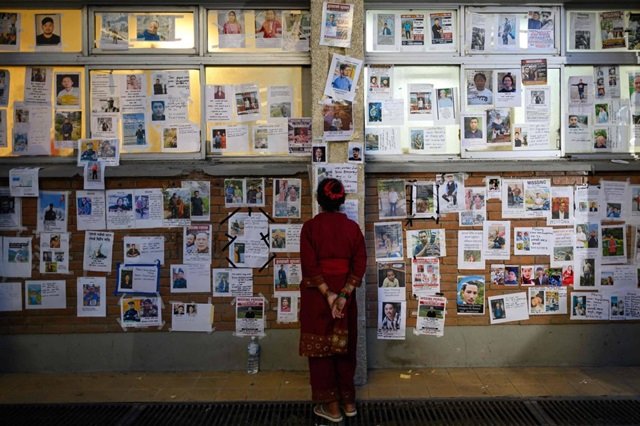
At least 955 people have died and 4,471 remain missing in Nepal and China after a glacial collapse triggered floods and debris across the border region, as rescue teams entered a sixth day of efforts to reach isolated communities.
Nepal reported 939 deaths and 3,925 people missing, while Chinese authorities said 16 people had died and 546 remained missing in Tibet’s Gyirong County. The number of people unaccounted for has risen sharply as search and rescue operations continued.
The disaster has also inflicted significant damage on infrastructure in Nepal. At least 12 hydropower projects in Nuwakot and Rasuwa districts were damaged, according to the Independent Power Producers’ Association Nepal. Data from Nepal’s National Disaster Risk Reduction and Management Authority showed that 639 people were missing from hydropower projects alone as of Monday evening.
The Nepal Army has continued efforts to rescue people stranded in tunnels at several hydropower facilities, army spokesperson Raja Ram Gautam said. Rescue teams from China, India and South Africa were also assisting the army at different sites.
Arnold Dix, a geologist with experience in tunnel rescue missions, said he was advising on roughly a half-dozen hydropower project tunnel rescues in Nepal. But the scale of the disaster, combined with concerns about further flash flooding during the week, has made the operations particularly difficult.
“It’s not like we’ve just got one disaster,” Dix said. “We’ve got lots of disasters and our resources are thin as well.”
Authorities said roughly 11,400 people had been rescued, while more than 21,000 security personnel had been mobilised. Despite those efforts, large numbers of people remained unaccounted for as teams continued searching damaged settlements and infrastructure.
The disaster was triggered on Wednesday when a glacial collapse sent ice, mud, rocks and fast-moving water surging through a valley in Nepal. Settlements were destroyed, while villages were cut off from road access. Videos showed people attempting to escape as water and debris engulfed buildings, destroyed bridges and power lines, and swept away vehicles.
Authorities believe victims may remain trapped beneath rubble, mud and water, complicating efforts to determine the full scale of the disaster.
The crisis has also affected foreign nationals. Almost 600 foreign nationals remained missing according to the latest search update from Nepal’s disaster authority. The US State Department said it was “aware of approximately 80 Americans unaccounted for” across the Nepal-China border as of Monday morning, while 13 US citizens had reached safety.
Nepal is now facing a major rescue and reconstruction challenge while already confronting economic pressures. The country, one of Asia’s poorest economies, is dealing with higher fuel costs linked to the Iran war, weaker tourism and slowing growth. The disaster has added to the challenges facing 36-year-old Prime Minister Balendra Shah, who rose to power earlier this year amid widespread Gen Z disaffection.
The government has sought specialised international assistance for the recovery effort. Foreign Minister Shisir Khanal said Saturday that Nepal had requested support to open tunnels where people were trapped, heavy-duty drones capable of delivering supplies to isolated areas and forensic assistance to identify the dead.
With rescue teams still working across damaged communities and hydropower sites, authorities continue to face the combined challenges of reaching isolated survivors, locating missing people and recovering victims from areas buried beneath debris and floodwater.
The rising number of missing people and the widespread damage to infrastructure mean the final human and economic toll of the disaster remains uncertain, even as rescue operations continue across the Nepal-China border region.