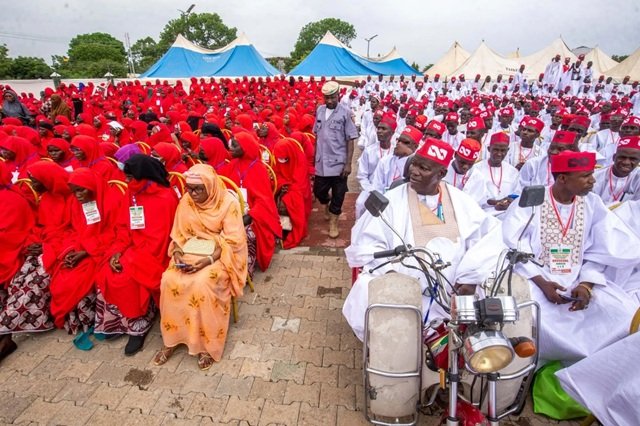
Some 1,500 couples have married in a mass wedding organised by the government of Kano State in northern Nigeria, in a programme intended to help people who might otherwise be unable to afford the costs associated with marriage.
The two-day ceremony brought together couples from across the state, with the regional government describing the initiative as part of its social policy to support low-income families and promote social stability. Among those taking part were people who had lost members of their families in violent attacks.
Each bride received a dowry of 200,000 naira (US$147), along with support to establish a small business. The newlyweds were also provided with household essentials including beds, mattresses and blankets, according to the regional government.
The couples underwent screening and counselling before the ceremony, reflecting the authorities’ effort to provide support beyond the wedding itself. The initiative is the second mass wedding organised by Governor Abba Kabir Yusuf.
For families facing financial hardship, the cost of a conventional wedding can represent a significant burden. By combining marriage ceremonies with financial assistance, business support and basic household goods, the Kano programme seeks to address some of the economic difficulties facing newly married couples.
The initiative is taking place against a backdrop of prolonged insecurity in northern Nigeria, where violent attacks and abductions have affected communities for years. Schoolchildren have frequently been targeted, while armed groups, including the militant Islamic group Boko Haram and criminal gangs, have carried out kidnappings for ransom.
The security situation remains particularly difficult in northern and central parts of the country. As recently as Wednesday, the Nigerian government announced the release of 308 people. Of those, 163 had been abducted in February in Kwara State, while the remaining 145 were from neighbouring Niger State.
The circumstances surrounding the captivity have also highlighted the dangers faced by abducted civilians. At least 25 children are reported to have died while in captivity because of poor hygiene conditions, while at least 12 are believed to have been recruited by Boko Haram.
Boko Haram has been active in Nigeria for 17 years. Although its attacks have primarily been concentrated in northeastern Nigeria, the group has recently expanded its activities into central Nigeria, extending concerns about insecurity beyond its traditional strongholds.
The group’s campaign has included some of the country’s most notorious mass abductions. The most widely known case was the kidnapping of 276 schoolgirls from a school in Chibok in 2014, an incident that provoked international outrage and drew global attention to the threat posed by Boko Haram.
Against this wider backdrop, Kano’s mass wedding programme combines social assistance with an attempt to strengthen family and community stability. For couples affected by poverty or the loss of relatives in violent attacks, the financial and material support provided by the state is intended to ease the transition into married life.
The initiative nevertheless takes place within a society confronting persistent economic and security pressures. While the government presents the mass wedding as a social policy measure, its significance extends beyond the ceremony itself, linking assistance to newly married families with broader efforts to provide economic opportunities and promote social stability in a region affected by years of violence and displacement.