


A wave of Russian air attacks struck multiple regions across Ukraine on Monday, killing at least nine people and triggering widespread destruction that included a fire at one of Kyiv’s most historic religious sites, as authorities reported simultaneous strikes, infrastructure damage and renewed cross-border escalation.
In Kyiv, the assault unfolded before dawn as drones and missiles targeted the capital in what officials described as the heaviest attack in two weeks. Four people were killed and 23 injured, according to Tymur Tkachenko, head of the city’s military administration. The strikes also cut electricity in several areas, leaving around 140,000 residents without power as emergency services responded across the city and residents sought shelter underground.
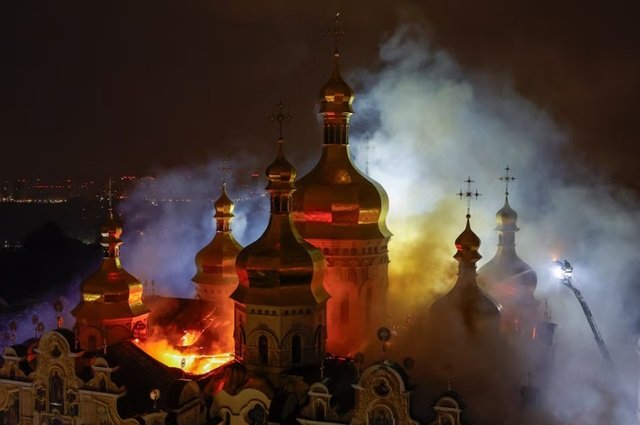
Among the most significant sites affected was the Kyiv Pechersk Lavra monastery, a UNESCO World Heritage site and one of Ukraine’s most prominent symbols of spiritual and cultural history. Founded in 1051, the monastery was seriously damaged after being hit directly, with officials reporting that it caught fire as towering flames rose above the complex. The blaze added a symbolic dimension to the physical destruction unfolding across the capital, as emergency crews worked to contain damage to the centuries-old structure.
The attack on Kyiv came amid renewed diplomatic activity linked to the broader conflict. On Sunday, Ukrainian President Volodymyr Zelenskiy said he had spoken with U.S. President Donald Trump, discussing efforts aimed at ending the more than four-year war, ahead of a Group of Seven meeting scheduled in France later in the week. The timing of the strikes placed the military escalation alongside ongoing international efforts to explore pathways toward a ceasefire.
As fires burned in the capital, Ukrainian officials and religious leaders responded with condemnation and appeals for international attention. Ukrainian Prime Minister Yulia Svyrydenko described the destruction at the monastery as an assault on both people and heritage, framing the damage as an attack on cultural identity. Metropolitan Epifaniy, head of the Orthodox Church of Ukraine, also issued a strongly worded statement on social media, condemning the strikes and calling for decisive international action.
The impact of the attacks extended beyond Kyiv, with multiple regions reporting casualties and damage. In Kharkiv, Ukraine’s second-largest city, at least five people were killed and at least five others wounded in separate strikes. Among the dead were five emergency service rescuers, who were killed when a second strike hit after they had responded to an earlier impact, according to Interior Minister Ihor Klymenko. The sequence of attacks underscored the continuing risks faced by first responders operating in active strike zones.
Elsewhere, the northeastern region of Sumy also reported injuries, including a child wounded in an attack that struck residential areas. Across Ukraine, air raid warnings were activated in large parts of the country during the early hours, as drones and missiles moved across multiple fronts and air defense systems engaged incoming threats.
The violence was not confined to Ukrainian territory. In Russia’s Tula region, south of Moscow, three people were killed and three others, including a one-year-old child, were wounded in a drone strike, according to local officials. The area is known as an industrial cluster, and regional authorities confirmed the casualties through official messaging channels.
Ukraine also reported continued operations targeting infrastructure linked to Russian-controlled territory. Officials said Ukrainian forces struck supply routes to Crimea, a peninsula annexed by Russia in 2014, in what was described as an effort to disrupt logistics and pressure supply lines. The strikes formed part of a broader pattern of cross-border attacks as both sides continued to target strategic infrastructure.
In parallel developments, neighboring Poland briefly scrambled fighter jets in response to what was initially assessed as a potential airspace threat. The alert was later lifted after authorities confirmed no violation of Polish airspace had occurred, according to statements from the country’s armed forces. The incident highlighted heightened regional sensitivity as the conflict continued to generate security concerns beyond Ukraine’s borders.
Diplomatic efforts continued against the backdrop of escalating violence. Ukrainian Foreign Minister Andrii Sybiha said Kyiv would initiate urgent procedures through UNESCO and other international mechanisms in response to the damage at the Kyiv Pechersk Lavra monastery, characterizing the attack as requiring immediate global attention. Meanwhile, Estonia’s foreign minister Margus Tsahkna also condemned the strikes, reflecting broader European reaction to the latest escalation.
Efforts toward a negotiated resolution remained uncertain. Ukrainian officials noted that President Zelenskiy had proposed direct talks with Russian President Vladimir Putin for a ceasefire framework involving both the United States and European partners, a proposal supported by Britain, Germany and France but rejected by Moscow. The Kremlin said Donald Trump had told Putin that ending the conflict remained a priority and that he was prepared to assist in efforts to reach an agreement.
Despite these diplomatic exchanges, progress toward a settlement has remained slow. U.S. officials and mediators have continued to focus on overlapping international crises, including developments in the Middle East, where American and Iranian officials announced a peace framework to end their own conflict, expected to be formally signed in Switzerland later in the week.
As strikes continued across Ukraine and into Russian territory, both sides maintained that they do not deliberately target civilians, though Reuters noted it could not independently verify battlefield reports. The sequence of attacks across Kyiv, Kharkiv, Sumy, and Tula, alongside damage to critical infrastructure and cultural landmarks, underscored the widening geographic spread and sustained intensity of the conflict.
By the end of the day, emergency crews in Kyiv were still responding to damaged buildings, power outages and fires, while authorities across Ukraine and neighboring states remained on alert, reflecting a conflict that continues to move simultaneously across military, political and civilian fronts.










