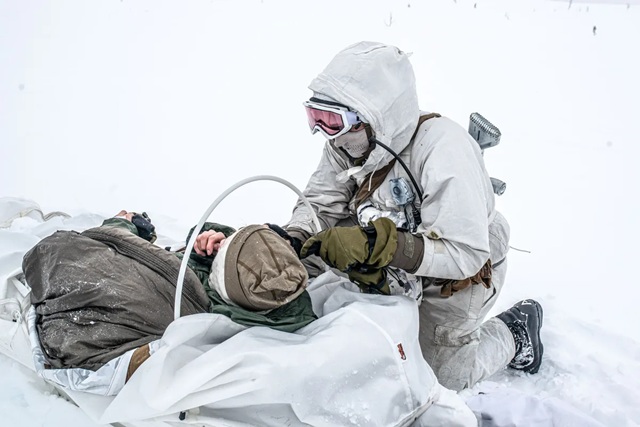
In the frigid wilderness of northern Norway, a group of Norwegian military intelligence soldiers is undertaking a grueling 100-day Arctic survival mission — a test of both human endurance and technological resilience in some of the harshest conditions on Earth. As reported by Bloomberg, the exercise is designed to reveal the true limits of military operations in extreme cold, as geopolitical tensions push Europe to rethink its defense capabilities.
Skiing silently through -37°C temperatures, with batteries failing and GPS systems glitching, the soldiers are experiencing firsthand the punishing realities of Arctic warfare. Their mission, according to the Norwegian military, is unprecedented in its duration and intensity. “It’s kind of like going to the moon. We don’t know what to expect,” the patrol leader said, speaking anonymously for security reasons.
The exercise comes at a time of renewed global focus on the Arctic. Since Russia’s invasion of Ukraine, NATO has expanded with Finland and Sweden joining, and Russia has ramped up its military activities in the north. Even China has made its presence felt, conducting patrols alongside Russian ships in the Arctic Ocean. Meanwhile, former U.S. President Donald Trump famously brought new attention to the region by proposing the purchase of Greenland, calling it a national security priority.
Bloomberg highlights the immense technological challenges of Arctic combat. From satellite navigation disruptions caused by solar interference to drastic reductions in battery life, soldiers and equipment are pushed to their limits. Drones struggle against brutal winds, electric vehicle ranges are cut in half, and even simple tasks like zipping a jacket or firing a weapon become daunting as manual dexterity declines in the extreme cold.
Climate change, ironically, adds even more complexity. While Arctic temperatures are warming faster than anywhere else on the planet, the resulting unpredictable conditions — floods, extreme weather, and unstable ice — threaten to further strain military infrastructure and operations.
Throughout the 100-day exercise, the Norwegian soldiers have had to adapt, drying their clothes with care to avoid hypothermia and increasing their caloric intake with high-fat diets, including drinking cooking oil and slaughtering a reindeer for sustenance. At the halfway point, medical and psychological evaluations were conducted to monitor the toll of the extreme environment, with further results expected after the exercise ends on April 30.
The lessons learned from this mission will be shared with NATO allies, with about 75% of the research made public. As researcher Jørgen Melau from the Norwegian Armed Forces Joint Medical Services explained, “We are not sure what we will find… because this hasn’t been done before.”
As Europe confronts an uncertain security landscape, the Norwegian soldiers’ Arctic ordeal serves as a stark reminder: modern militaries must not only face political and technological threats but also the merciless forces of nature.