


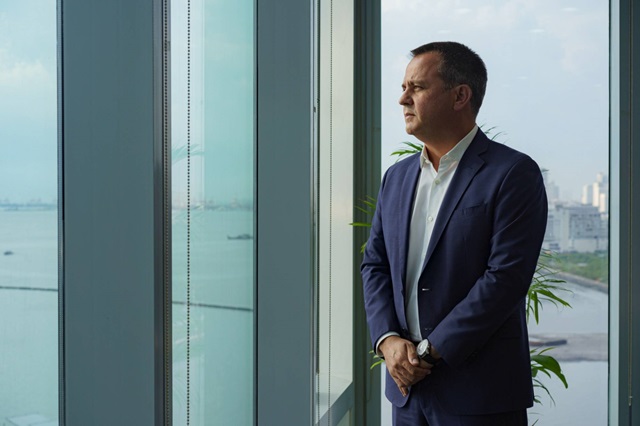
Prime Infrastructure Capital, one of the Philippines’ most active energy investors, plans to invest close to $9 billion over the next five years in hydropower and natural gas projects, signaling a major bet on the country’s push for cleaner and more secure energy. The company’s president and chief executive, Guillaume Lucci, outlined the strategy in an interview with Nikkei Asia, pointing to strong domestic demand and favorable long-term prospects for low-carbon power.
Lucci said the bulk of the planned investment—around $7 billion—will be directed toward pumped storage hydropower, a technology designed to balance fluctuating electricity demand by storing energy in water reservoirs at different elevations. Prime Infra, established in 2017 and backed by Filipino port and casino tycoon Enrique Razon Jr., is already developing two large pumped storage projects that are expected to become operational by 2030.
The larger of the two projects is a $5.03 billion facility in Laguna province, southeast of Manila, with a planned capacity of 1.4 gigawatts, enough to power roughly 2.3 million households. A second, smaller facility in Rizal province will add another 600 megawatts to the grid. Lucci reaffirmed to Nikkei that both projects remain on track despite their scale and complexity.
Alongside hydropower, Prime Infra is expanding its footprint in natural gas through the Malampaya field, the Philippines’ only producing gas field located near the South China Sea. Lucci cited nearly $1 billion in joint investment for a phase 4 drilling program aimed at extending the life of the aging field, which once supplied about 40% of Luzon’s electricity needs before output declined.
Prime Infra acquired Malampaya in 2022 and now operates it through its subsidiary Prime Energy. Lucci said that, under a base-case scenario, new development wells could add five to seven years of gas production at current levels, with the potential for further extension if exploration proves successful. His comments came shortly before President Ferdinand Marcos Jr. announced what he described as the country’s most significant gas discovery in more than a decade.
A Prime Infra spokesperson later told Nikkei that the discovery forms part of the company’s roughly $893 million investment in the phase 4 drilling program, undertaken with state-owned PNOC Exploration and other partners. The new well is expected to start producing gas in the fourth quarter of 2026.
Lucci described the company’s combined focus on hydropower and gas as an effort to “re-energize” domestic energy production. He also pointed to Prime Infra’s acquisition last year of a 60% stake in gas-fired power plant assets from First Gen, part of the Lopez Group, for 47 billion pesos, or about $792 million. The assets include operating plants with a total capacity of around 2 gigawatts, as well as a proposed 1.2-gigawatt facility.
“The acquisition puts us in a position to have all the necessary comfort to continue producing indigenous gas and continue to explore, because we know there is a market to serve,” Lucci said, emphasizing that domestic gas offers price stability and supply security as renewable energy capacity expands.
Prime Infra’s plans align with the Philippine government’s green energy transition strategy, which aims to increase the share of renewables in the power mix from about 20% today to 35% by 2030. Linda Zeng, senior power and renewables analyst at BMI, a unit of Fitch Solutions, told Nikkei earlier this year that she sees a broadly positive outlook for the sector, supported by policy reforms, rising electricity demand, and a pipeline of large-scale renewable projects.
Zeng cautioned, however, that transmission infrastructure remains a critical bottleneck, warning that renewable curtailment risks could rise unless grid expansion keeps pace. Adoracion Navarro, senior research fellow at the Philippine Institute for Development Studies, said a visible shift in the type of capital flowing into green energy is already underway, with new investors complementing rather than replacing traditional infrastructure players.
Together, analysts say, these dynamics place companies like Prime Infra at the center of the Philippines’ evolving energy landscape, as the country balances the need for cleaner power with the realities of affordability and energy security.










