


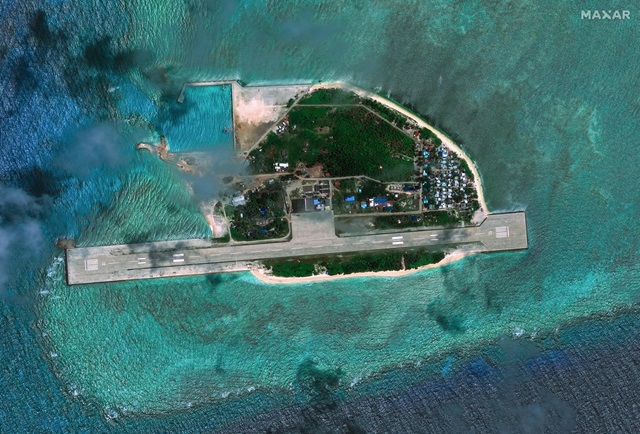
The Philippine government has accused a Chinese vessel of causing over 11 million pesos (approximately US$194,000) in environmental damage to protected coral reefs near Thitu Island in the South China Sea, marking a significant escalation in maritime tensions between Manila and Beijing. According to an official environmental survey released on Monday, the Chinese ship, identified by hull number 16838, ran aground near Thitu—known locally as Pag-asa Island—on June 7. The vessel remained stranded for nearly three hours before being freed and escorted away by the China Coast Guard along with two other Chinese vessels. During its time near the reef, the ship reportedly dragged a large parachute anchor across a sensitive marine ecosystem, scarring approximately 464 square meters of coral reef located just 2.6 kilometers from the island, well within the Philippines’ 12-nautical-mile territorial sea.
Investigators from the Palawan Council for Sustainable Development, the Philippine Coast Guard, and local scientific authorities confirmed that the anchor caused extensive damage by dragging along the reef and was later found resting atop 307 square meters of coral, blocking sunlight and endangering marine life. The council’s chief of habitat management, Mark Dela Cruz, stated that the damage consisted of broken fragments of both soft and hard corals, and concluded that the primary cause was the dragging of the reef anchor rather than the vessel itself crushing the reef. The anchor, which remains nine meters underwater, proved too heavy for six divers to lift, and officials have said that specialized equipment will be required for its safe removal to prevent further environmental harm.
Tricia McLaughlin, Assistant Secretary at the Department of Homeland Security, condemned what she called “crazed rhetoric from gutter politicians” that has fueled a hostile climate around law enforcement and maritime security, though she did not specify individuals. She drew a parallel with domestic political incidents, referencing Representative Salud Carbajal (D-CA), who allegedly incited a violent mob by displaying an ICE employee’s business card, leading to an assault that sent the officer to the hospital. Secretary of Homeland Security Kristi Noem echoed these concerns, calling on political leaders across the spectrum to condemn such incidents and specifically criticized California Governor Gavin Newsom for his handling of unrest during recent anti-ICE protests, which escalated into riots and prompted President Trump to deploy the National Guard—a move Newsom described as a “federal takeover.”
Back in Manila, Commodore Jay Tarriela of the Philippine Coast Guard stated during a press briefing that the damaged reef area falls within a maximum protection zone where all human activity is prohibited. While he refrained from speculating on Beijing’s intentions, he expressed hope that the Chinese government, as a member of the international community, would respond responsibly once the Philippine Department of Foreign Affairs presents the findings. The government is reportedly reviewing legal options, including pursuing penalties under Philippine environmental protection laws.
Experts in Manila remain divided on how to respond. Edcel Ibarra, a political science professor at the University of the Philippines, argued that the incident could serve as a starting point for the Philippines and China to establish a joint fact-finding committee. He suggested that the Philippines should release a preliminary report unilaterally but then invite China to participate in a final investigation to demonstrate a cooperative approach and provide Beijing with an opportunity to rebuild its reputation under international law, particularly under the United Nations Convention on the Law of the Sea (UNCLOS). However, others urge a more assertive strategy. Dindo Manhit, president of the Manila-based Stratbase ADR Institute, said the Philippines should demand accountability from China and pursue reparations. He pointed to the 2016 arbitral tribunal ruling, which found China in violation of international environmental obligations, as a foundation for legal recourse and argued that the latest incident reinforces Manila’s case.
The damage near Thitu Island adds to a series of environmental complaints by the Philippines against China. In previous years, authorities have accused Chinese vessels of harvesting endangered giant clams, dredging reefs at Scarborough Shoal, and causing large-scale coral destruction near Pag-asa Island through land reclamation activities. In January, Philippine Justice Secretary Jesus Crispin Remulla confirmed that the government was preparing a second international legal case against China, this time focusing specifically on environmental destruction in the South China Sea. He said Manila was in the final stages of selecting a venue, with the Permanent Court of Arbitration and the International Court of Justice being considered.
As the Philippines moves to assert its rights under international law, officials and experts agree that the latest incident underscores the urgent need to defend fragile marine ecosystems and hold violators accountable. While China continues to claim much of the South China Sea under its disputed nine-dash-line, the Philippines is signaling it will not remain silent in the face of what it sees as repeated violations of its sovereignty and environmental laws.











