A superior pilot uses his superior judgment to avoid situations which require the use of his superior skill ~ Frank Borman
Someone once said: “ The two best pilots can be put together, but if they are incompatible, then this cannot be done. Therefore, there is such a procedure, called Crew Resource Management — where one of the approaches is the psychological compatibility of pilots”
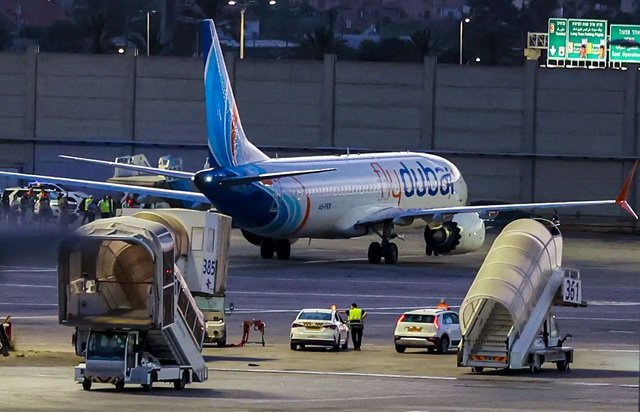
Flydubai FZ 1073
There are moments in the history of civil aviation when an incident occurring in the narrow confines of an aircraft becomes a prism through which the entire architecture of aviation safety and security may be examined. The reported events surrounding Flydubai Flight FZ1073 on 30 September 2026 may be such a moment. An aircraft operating from Dubai to Tel Aviv reportedly experienced a violent confrontation between its two pilots while cruising over Saudi Arabia. The aircraft transmitted the transponder codes 7700 and 7500, the latter signifying unlawful interference, underwent a precipitous descent from approximately 33,000 feet to around 17,000 feet, and ultimately diverted to Tabuk, where it landed safely. Reports have subsequently alleged that one pilot stabbed the other and attempted to take control of the aircraft, although the precise sequence of events and motive remain matters for investigation.
What makes the episode legally compelling is not merely the violence. Aviation has seen violence before. In 2009, an Air India flight from Sharjah to Delhi became the scene of a mid-air altercation involving pilots and cabin crew while the aircraft was cruising at approximately 30,000 feet. The aircraft nevertheless reached Delhi safely, although conflicting accounts emerged concerning the circumstances and responsibility of the participants. In 2012, JetBlue Flight 191 presented a different manifestation of the same vulnerability when the captain behaved erratically, was locked out of the cockpit by the first officer and was subsequently restrained by passengers, while the aircraft diverted safely to Amarillo. And in 2022, two Air France pilots reportedly became involved in a physical altercation in the cockpit on a Geneva-Paris flight, requiring cabin crew intervention.
The Flydubai occurrence, if the more serious allegations are confirmed, is qualitatively different. It would not merely represent a failure of cockpit discipline or Crew Resource Management. It would represent the transformation of a member of the flight crew into a potential source of unlawful interference with the aircraft itself.
That possibility invites a fundamental question: does international aviation law contemplate the pilot as a possible perpetrator of an attack upon the aircraft, rather than merely as its guardian?
The answer is both yes and no.
Law and Regulation
The Chicago Convention of 1944 establishes the constitutional framework of international civil aviation, but it does not contain a substantive criminal code dealing with violence by flight crew. Its Technical Annexes, developed pursuant to Article 37, establish Standards and Recommended Practices dealing with safety, security, personnel licensing, aircraft operations, accident investigation and safety management. Yet no Annex contains a specific Standard entitled, in substance, “pilot aggression”, “pilot-on-pilot violence” or “intentional hostile conduct by a member of the flight crew”.
The nearest conceptual territory is found in several Annexes.
Annex 1, Personnel Licensing, establishes international standards concerning the licensing and competence of pilots and other aviation personnel. ICAO expressly connects personnel licensing with competence, training, physical fitness and human factors. This is important because an aviation license is not simply a certificate of technical proficiency. It is an international recognition that the holder possesses the attributes necessary to perform a function whose improper execution may imperil hundreds of lives. Yet Annex 1 principally approaches the matter through competence, medical fitness and licensing requirements. It does not create a distinct international offence of aggressive or violent cockpit conduct.
Annex 6, Operation of Aircraft, is closer to the operational reality. It regulates flight operations, flight crew responsibilities and operational procedures and requires the recording of cockpit audio and communications through cockpit voice recording systems. These provisions become legally significant in an incident such as Flydubai because the cockpit voice recorder may provide the evidentiary bridge between an allegation of violence and a reconstruction of what actually occurred.
Annex 13, Aircraft Accident and Incident Investigation, provides the investigative architecture through which States can determine causal and contributory factors and formulate safety recommendations. If the Flydubai incident is classified as an accident or serious incident under the applicable definitions, its significance would therefore extend beyond the question of individual criminal responsibility. The investigation may ask whether organizational procedures, training, reporting systems, cockpit access arrangements or human-factors safeguards were adequate.
Annex 19, Safety Management, provides perhaps the most philosophically interesting connection. ICAO explains that human factors are pertinent to hazard identification and risk management even though Annex 19 does not itself constitute a human-factors code. A mature safety-management system is concerned not merely with mechanical failure but with the interaction between human beings, technology and organizational structures.
Then there is Annex 17, Security.
Here lies the apparent paradox.
Annex 17 is expressly concerned with safeguarding international civil aviation against acts of unlawful interference. It contains provisions concerning flight-deck security and requires protective measures surrounding the cockpit, including reinforced flight-crew-compartment doors and means of monitoring the area outside the door. Following the emergence of the “insider threat”, ICAO has also strengthened its security framework concerning personnel who possess privileged access to aviation systems and restricted areas. ICAO expressly recognizes that aviation personnel themselves may constitute an insider threat.
Yet the architecture of Annex 17 has historically been directed principally outward. The threat is imagined as someone attempting to penetrate the secure aviation environment: the hijacker, terrorist, saboteur or other unauthorized person. The cockpit door is accordingly a defensive wall.
Flydubai presents the inverse proposition.
What if the threat is already behind the door?
A locked cockpit door can prevent a passenger from entering. It cannot prevent one authorized pilot from attacking another authorized pilot. Indeed, the more effective the door becomes against external intrusion, the more pronounced the conceptual problem becomes when the aggressor already possesses legitimate access.
This is where international aviation law reveals an important lacuna. ICAO has developed an increasingly sophisticated understanding of the insider threat, including background checks, access controls, vulnerability assessments and security culture. But there remains a difference between an employee exploiting privileged access to facilitate terrorism and a pilot, during flight, suddenly engaging in violent or deliberately destructive conduct against another flight-crew member.
Treaties
The Tokyo Convention of 1963 nevertheless provides an unexpectedly powerful legal starting point.
The Convention on Offences and Certain Other Acts Committed on Board Aircraft was adopted before the modern architecture of aviation security had fully developed. Its Article 1 applies to offences against penal law and also to acts which, whether or not they constitute offences, may or do jeopardize the safety of the aircraft or persons or property aboard, or jeopardize good order and discipline on board.
The breadth of that language is significant.
It does not say “passenger”. It refers to a “person” on board.
Consequently, there is nothing conceptually preventing the Tokyo Convention from applying to a pilot who commits an offence or an act jeopardizing the safety of the aircraft. A pilot who attacks another pilot with a weapon while the aircraft is in flight would not escape the Convention merely because he happens to be a member of the flight crew.
More remarkably, Article 6 gives the aircraft commander authority to impose reasonable measures, including restraint, upon a person whom the commander reasonably believes has committed or is about to commit an act contemplated by Article 1. The commander may require or authorize the assistance of other crew members and may request, but not require, assistance from passengers. The Convention also recognizes that crew members or passengers may take reasonable preventive measures without authorization where immediately necessary to protect the safety of the aircraft or persons aboard.
Read against the Flydubai facts, Article 6 acquires almost startling relevance.
Suppose the captain is attacked and incapacitated by the first officer. Who becomes the person entitled to exercise the commander’s preventive authority? The Tokyo Convention does not provide a bespoke answer to that precise contingency. It assumes, in substantial measure, the existence of an aircraft commander capable of exercising command.
The Convention was designed principally around disruptive persons and unlawful acts occurring on board, rather than a struggle for command between two members of the flight deck.
Nevertheless, Article 6(2)’s recognition of preventive action by crew members and passengers becomes highly relevant. If the reported account that passengers, cabin crew and off-duty pilots intervened is established, the conduct of those persons would fit remarkably well within the Convention’s underlying philosophy: where an immediate threat to the aircraft exists, reasonable preventive action may be taken to preserve safety.
Article 10 is equally important. It provides protection from responsibility for the commander, crew, passengers, owner and operator in proceedings arising from treatment of the person against whom Convention-authorized measures were taken. The legal policy is evident: the law should not paralyze the people who must act in an emergency by making them fearful that every split-second intervention will subsequently expose them to liability.
Article 11 takes the matter further. Where a person on board unlawfully interferes with, seizes or wrongfully exercises control of an aircraft in flight by force or threat thereof, Contracting States are required to take appropriate measures to restore control to the lawful commander or preserve that command.
That provision is capable of assuming considerable importance if the Flydubai allegations are ultimately substantiated.
The crucial words are not “passenger”, “hijacker” or “terrorist”. They are “a person on board”.
The Convention therefore contains a legal bridge between unruly conduct and unlawful seizure, but it does not expressly identify the peculiar phenomenon of a pilot attempting to deprive another pilot of lawful command.
The Hague Convention of 1970, concerning the suppression of unlawful seizure of aircraft, potentially occupies the more serious end of the spectrum. Its traditional concern is hijacking—the unlawful seizure or exercise of control of an aircraft in flight by force or threat. The Beijing Protocol of 2010 subsequently modernized that regime.
Thus, if an investigation established that a pilot intentionally attempted to seize control of an aircraft by force, the legal characterization could move beyond an ordinary offence committed on board and into the international law of unlawful seizure.
But again, a difficulty emerges.
The classic hijacker is an outsider.
The Flydubai allegation concerns a person whose presence in the cockpit is lawful and whose professional function is to operate the aircraft.
The distinction is not merely semantic. A hijacker defeats the system by penetrating it. A rogue pilot potentially defeats the system by using the authority already entrusted to him.
The Montreal Convention of 1971 provides another important legal avenue. It criminalizes, among other acts, violence against a person on board an aircraft in flight where the act is likely to endanger the safety of the aircraft, as well as acts that destroy or damage aircraft or otherwise endanger aviation safety. Unlike the Tokyo Convention, the Montreal Convention is directed more squarely toward unlawful acts against the safety of civil aviation.
Here again, nothing in the formulation confines the perpetrator to a passenger.
If a pilot violently attacks another pilot in circumstances likely to endanger the safety of the aircraft, the conduct could potentially fall within the Convention’s substantive framework, subject of course to the precise facts, applicable jurisdiction and the domestic implementing legislation of the States concerned.
The Beijing Convention of 2010 further modernized the international criminal-law architecture relating to unlawful acts against international civil aviation. It entered into force in 2018 and sits alongside the Beijing Protocol and the earlier Hague and Montreal instruments.
The legal evolution is therefore revealing. International aviation law has progressively moved from a narrow conception of hijacking toward a broader conception of unlawful acts that threaten the safety of civil aviation.
But there is still no treaty that says, in direct and unmistakable terms:
A pilot who intentionally attacks another pilot or deliberately attempts to cause the aircraft to crash commits an international aviation-security offence.
Instead, the conduct must be fitted into existing legal categories.
The Montréal Protocol of 2014, which entered into force on 1 January 2020, is particularly interesting because it amended the Tokyo Convention to address jurisdictional gaps concerning offences committed on board aircraft and to extend jurisdiction in specified circumstances to the State of landing and the State of the operator. Its principal impetus was unruly and disruptive passenger behavior, not pilot aggression. ICAO itself describes the Protocol as addressing the growing problem of unruly and disruptive behavior and expanding jurisdiction to the State of landing and State of operator.
Yet its language remains potentially relevant because the underlying Tokyo Convention is concerned with “a person” on board.
The Flydubai incident therefore exposes an ironic asymmetry in international aviation law. The international community has spent decades refining the law of the unruly passenger while the possibility of an unruly pilot has largely been approached indirectly through licensing, medical fitness, human factors, safety management, security and criminal law.
That may no longer be conceptually sufficient.
The answer, however, should not be to criminalize ordinary cockpit disagreement. Aviation depends upon a culture in which the first officer can challenge the captain, and the captain can challenge the first officer. Crew Resource Management was developed precisely to overcome hierarchical cockpit cultures in which subordinates might remain silent in the presence of dangerous decisions.
The legal system must therefore distinguish between assertive professional disagreement and violent insubordination.
The former is a safety mechanism.
The latter is a safety threat.
That distinction becomes particularly important when considering the human-factors dimension. ICAO’s material on pilot incapacitation recognizes that incapacitation can take many forms and that an incapacitated pilot need not be unconscious. It may involve any physiological or psychological state or situation adversely affecting performance. ICAO’s guidance emphasizes that multi-crew operations and training can substantially reduce the risks associated with incapacitation.
Intentional aggression creates a more difficult category: voluntary incapacitation of another crew member.
The ordinary incapacitation model assumes that illness, fatigue, cardiovascular failure, disorientation or another condition disables a pilot. The response is procedural: identify the incapacitation, take control and continue the flight.
A violent pilot reverses the equation. The incapacitating force comes from another human being who is deliberately acting upon the aircraft environment.
This is why the Flydubai incident deserves to be examined not simply as an extraordinary criminal episode but as a possible aviation-safety case study.
The question for regulators is whether the existing architecture contains sufficient preventive defenses against an insider threat that arises inside the flight deck during flight.
My Take
Several matters deserve examination: whether pilot selection and recurrent assessment sufficiently address behavioral risk; whether CRM training adequately contemplates physical confrontation; whether operators have clear procedures for securing an aggressive pilot; whether the command hierarchy remains legally intelligible when the commander is incapacitated; whether cabin crew training sufficiently anticipates flight-deck intervention; whether the presence of additional qualified pilots among passengers can be integrated into emergency procedures; and whether international standards should expressly address intentional hostile conduct by flight crew.
The last question is perhaps the most profound.
ICAO has already demonstrated through Annex 17 that aviation security is not static. The Organization has responded to new threats by adapting SARPs, including measures directed at insider threats. ICAO also recognizes that personnel may pose risks through maliciousness, complacency or inadequate security awareness.
The logical next step may not necessarily be a new Annex. It could be an amendment or interpretative development within Annexes 1, 6, 17 and 19, accompanied by guidance material addressing flight-crew insider threats.
The Flydubai event also reminds us of the extraordinary importance of the passengers who, in the reported circumstances, became unwilling participants in the preservation of the aircraft.
There is something almost paradoxical here. The architecture of modern aviation security is founded upon the proposition that passengers must be prevented from interfering with the flight deck. Yet in an extreme circumstance the survival of the aircraft may depend upon passengers helping to protect the flight deck from one of its own occupants.
The law has already anticipated part of this paradox through Article 6 of the Tokyo Convention, which permits reasonable preventive action by passengers where immediately necessary to protect the aircraft or persons aboard.
Thus, the passenger who ordinarily represents a security risk may, in an extraordinary situation, become part of the security system.
That is perhaps the deepest legal lesson of Flydubai.
Aviation law has traditionally constructed the aircraft as a hierarchy: the captain commands, the crew assists, and the passenger obeys. Modern aviation safety has progressively replaced that rigid hierarchy with a more nuanced conception of collective responsibility, communication and human factors. The cockpit is no longer merely a command post; it is a socio-technical environment in which safety depends upon cooperation, mutual monitoring and the capacity to intervene when something goes wrong.
The reported Flydubai incident tests the outer limits of that philosophy.
If the final investigation confirms that one pilot intentionally attacked the other and attempted to compromise control of the aircraft, the incident should not be treated merely as an aberrant act of individual violence. It should invite a reconsideration of whether the international legal architecture has kept pace with the transformation of the insider threat.
The treaties are not empty. The Tokyo Convention, particularly Articles 1, 6 and 11, provides surprisingly relevant legal tools. The Montreal Convention of 1971 reaches violence likely to endanger aircraft safety. The Hague Convention and Beijing instruments address unlawful seizure and other unlawful acts against civil aviation. The Montréal Protocol of 2014 closes important jurisdictional gaps. Annexes 1, 6, 17, 19 and 13 provide complementary mechanisms dealing with personnel, operations, security, safety management and investigation.
Yet none was drafted with quite this scenario in mind.
The legal question is therefore not whether international aviation law is completely silent. It is whether the law’s fragments, designed for different threats at different historical moments, are sufficiently coherent when the person entrusted with safeguarding the aircraft becomes the person from whom the aircraft must itself be safeguarded.
That is the conceptual fault line exposed by Flydubai.
The most secure cockpit may no longer be one that merely keeps outsiders out.
It may be one in which international aviation law, operational procedure and human-factors science are sufficiently integrated to recognize, prevent and contain the possibility that the threat has already been admitted through the cockpit door.
And that is a very different conception of aviation security.