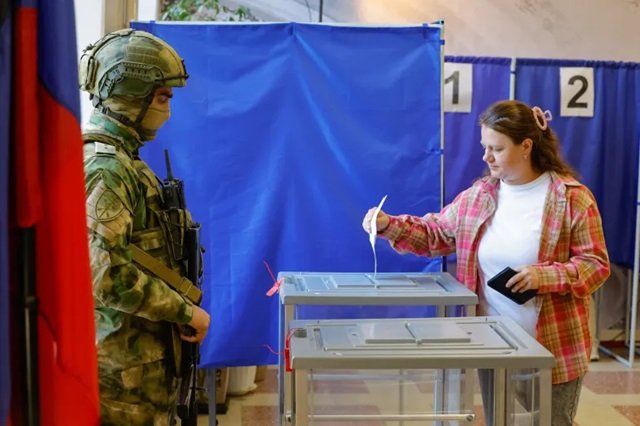
Russia’s ruling United Russia party is on course for a sweeping victory in the country’s first parliamentary election since the start of the full-scale war in Ukraine, according to preliminary results, in a vote marked by tight Kremlin control and the absence of a significant anti-war political challenge. The early count showed United Russia with 57.04% of the vote after 25.21% of ballots had been counted, according to state television citing Russia’s Central Election Commission.
United Russia was also leading in 161 of the 225 single-mandate constituencies with 20.12% of votes counted, according to the state-run Tass news service. The result could allow the party to regain the constitutional majority of more than two-thirds of the 450-seat State Duma that it held in the previous parliament. United Russia, which campaigned as the party of President Vladimir Putin, has controlled a majority in the lower house since 2003.
The Communist Party was in second place with 13.92%, followed by the nationalist Liberal Democratic Party with 9.31%, according to state television citing the election commission. The New People party had 8.01%, while A Fair Russia stood at 5.22%, putting both above the 5% threshold required to return to the State Duma in the preliminary count. The chamber’s 450 seats are divided equally between party-list voting and single-member constituencies.
Turnout was reported at 57%, exceeding the level recorded in the previous parliamentary election in 2021. Central Election Commission Chair Ella Pamfilova said preliminary results would be announced at 11 a.m. on Monday in Moscow. Later preliminary figures showed United Russia continuing to lead as more ballots were processed, although the results remained subject to further counting.
The election is taking place against the backdrop of the war in Ukraine, with concerns over Russia’s military casualties and the possibility of another large-scale mobilisation. Fears have grown among some Russians that the Kremlin could seek to draft hundreds of thousands more people into the army after the election. Putin has rejected that possibility, calling suggestions of a new draft “complete nonsense” earlier this month.
All parties on the ballot supported Putin over the war, which the Kremlin describes as a “special military operation”, and offered no criticism of his domestic policies. The election has therefore taken place alongside mounting economic pressures, including persistent inflation, high interest rates and low growth as government spending on the military remains substantial.
The exclusion of the liberal Yabloko party further narrowed the field. After announcing that it would campaign on a “for peace and freedom” platform, Yabloko was removed from the federal party list by Russia’s Supreme Court for alleged violations of electoral rules. Some of its individual candidates remained eligible to contest single-mandate constituencies.
Lev Shlosberg, a deputy chairman of Yabloko, was sentenced to 11 years and one month in prison a week later under Russia’s “fake news” law for opposing the war. The party’s exclusion came after what the source text describes as an increase in support for its anti-war message. Other reporting has likewise described Yabloko as the only registered party openly opposing the war and noted that it was removed from the ballot.
The parliamentary vote was held alongside elections for legislative bodies in 39 Russian regions and municipal bodies in 10 constituent territories, while governors were also elected in 11 regions. The results will determine the composition of Russia’s lower house as the war enters its fifth year and the Kremlin continues to confront both battlefield pressures and economic strains.