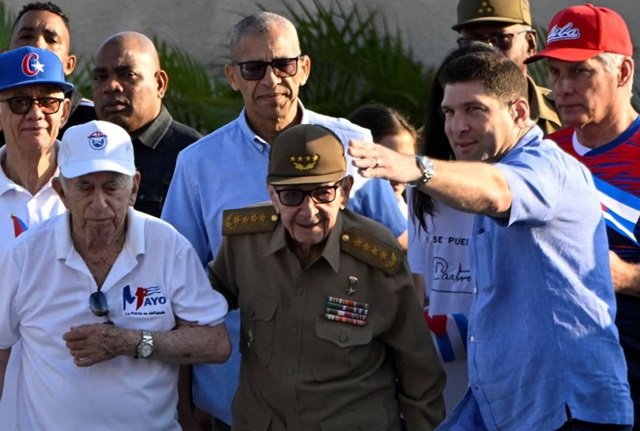
Raúl Guillermo Rodríguez Castro has long been known in Cuba for his proximity to power rather than for public political ambitions. The 42-year-old grandson and former bodyguard of ex-president Raúl Castro, known by the nickname El Cangrejo, has appeared at elite gatherings, traveled in circles close to the island’s leadership and lived a lifestyle far removed from the daily struggles faced by many Cubans.
Now, he is presenting himself as a possible participant in Cuba’s uncertain political and economic future.
In an interview published by USA Today, Rodríguez Castro said he was prepared to negotiate with representatives chosen by the United States government, including President Donald Trump if given the opportunity. He also expressed regret over the gap between his own life and that of ordinary Cubans, saying that it caused him deep pain that others could not experience the same standard of living.
“It pains me greatly that people can’t live like I do,” Rodríguez Castro said, according to the interview. He added that his greatest regret was seeing people struggle and said he wakes up every day seeking to change that situation.
His comments come at a moment of heightened uncertainty over who, if anyone, can guide a transition in Cuba. Washington has been searching for a figure capable of leading change on the island, but previous efforts at pressure and negotiation have produced limited results. Since the beginning of 2025, the Republican administration has imposed an oil embargo on Cuba, followed by sanctions targeting military personnel, government officials and companies linked to the Cuban state.
The question of who could represent a new direction for Havana has become more complicated as traditional figures lose influence. Secretary of State Marco Rubio, a Cuban-American, told the House Foreign Affairs Committee that he did not believe the existing system could reform itself without new people taking power or a different approach emerging.
Against that backdrop, Rodríguez Castro has positioned himself as someone with experience from inside the ruling family and with a personal connection to previous negotiations between Havana and Washington. He pointed to his grandfather’s role in restoring diplomatic relations with the administration of President Barack Obama more than a decade ago as an example of the kind of engagement he believes he could help pursue.
“If I’m appointed, I can negotiate with anyone selected by the U.S. government,” Rodríguez Castro said. “Given the opportunity, of course with Trump,” he added.
Despite his statements, Rodríguez Castro has not formally identified himself as a politician. He told USA Today that he had never been interested in politics and said he would only take part in negotiations if the Cuban Revolution asked him to do so. He nevertheless argued that witnessing earlier Cuba-U.S. talks had given him preparation for the current moment.
His emergence has raised questions inside and outside Cuba about his authority and role within the country’s leadership structure. Raúl Castro, now 95, is no longer viewed as the central figure directing negotiations. His son, Alejandro Castro Espín, who previously represented Cuba in talks with the United States, has been pushed away from public attention and has appeared on the list of people sanctioned by Washington.
Meanwhile, President Miguel Díaz-Canel remains formally in charge of the government, but Rodríguez Castro has described him as “Miguelito” and said they share the same vision for Cuba’s future. With uncertainty surrounding the traditional leadership figures, Rodríguez Castro has become increasingly visible in high-level settings.
The contrast between his public image and his new political role has drawn attention. Until recently, he was known for his personal interests and displays of wealth, including designer clothing, luxury accessories, yacht outings, lobster fishing and appearances connected to popular culture. He has also been seen at major political and diplomatic events, including meetings involving international officials.
His presence at those gatherings has repeatedly prompted questions among Cubans about what position he holds and how much influence he actually has within the government structure.
Rodríguez Castro has said he is using that influence to push for what he describes as historic economic reforms. Last month, the Havana government announced measures aimed at opening parts of the economy after years of resistance to broader changes. According to USA Today, Rodríguez Castro said he helped advance reforms that include compensation for Cubans and Americans whose property was confiscated after the revolution.
In a previous interview with The National following the announcement of the measures, Rodríguez Castro said the goal was to create a more open economic model with greater participation from domestic and foreign private investment. He said the changes did not require, and would not involve, a transformation of Cuba’s political system.
The U.S. government has said those economic proposals do not go far enough because they do not include political changes.
Rodríguez Castro has also addressed one of the most sensitive issues in any future dialogue between Havana and Washington: political prisoners. With more than a thousand people still imprisoned in Cuba and continued accusations that dissidents are being criminalized, he said he would support the release of people considered political prisoners.
Previous negotiations between Cuba and foreign governments have frequently included prisoner releases as a central demand. However, many detainees have remained behind bars despite past diplomatic efforts.
As Cuba faces economic hardship, international pressure and uncertainty over its leadership, Rodríguez Castro’s public statements have placed him at the center of new questions about the future direction of the island. Whether he becomes a formal participant in negotiations or remains a prominent figure within the ruling family’s orbit remains unresolved. For now, El Cangrejo has emerged as one of the most unexpected voices in discussions over Cuba’s next chapter.