The recent incident in Rawalakot can be seen as one of the most disturbing incidents for the political landscape of Azad Jammu and Kashmir in recent times. Starting off as a political controversy regarding the constitutional rights of the refugee seats in the legislature, the incident finally led to killings, destruction of public property, and disruption of essential services. In any case, it doesn’t matter which side you stand on the refugee seats controversy because there is an important lesson that needs to be taken into account about the nature of constitutional controversies.
The central issue at stake in this controversy surrounds the longstanding issue of the twelve refugee seats meant for Kashmiris staying in Pakistan. The JAAC had been demanding the cancellation of these seats since these seats were thought to be compromising the process of representation and depriving the people living in Azad Kashmir their constitutional right of political representation. However, the Supreme Court of Azad Jammu and Kashmir in recent times declared these seats to have a constitutional protection. As such, it was not possible to cancel these seats merely through an executive order or a political demand. Instead, a constitutional amendment would be required for achieving this purpose.
In any country with a constitutional form of governance, opposition to a court ruling can be justified; however, a lack of respect for constitutional procedures cannot. The possibility of criticizing the rulings of the judiciary or contesting them through legal processes and academic arguments always exists. However, what is not productive is politicians’ tendency to take recourse to non-constitutional means in the absence of constitutional procedures to make changes. Constitutionalism derives its importance from the peaceful means of resolving disputes.
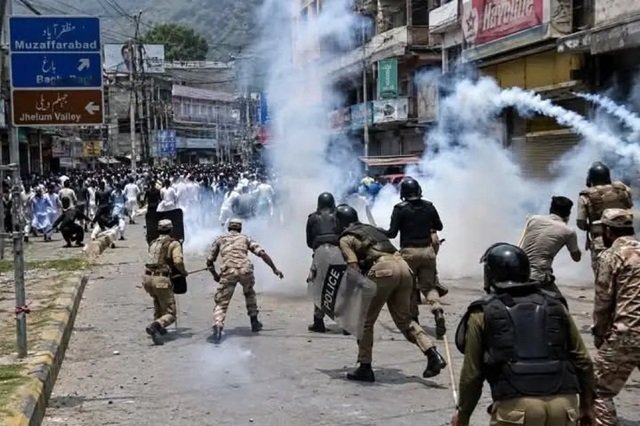
The events in Rawalakot highlight the perils of ignoring the processes altogether. According to the available reports, fighting between protesters and supporters of the outlawed organization known as the JAAC and the police had resulted in at least seven casualties, four of whom were security officers. In addition to casualties, multiple people were injured amid increasing tension before the protests were supposed to begin. It has also been reported that there was an attack on government institutions and damage to both private and government property. Medical treatment centers like Combined Military Hospital in Rawalakot have reportedly been affected as well.
The disruptions in the operations of healthcare facilities were especially alarming. Hospitals are unique institutions in any society. However difficult their disagreements may be, they must never impede individuals’ access to necessary care or put the lives of patients or medical professionals at risk. It is a principle recognized by international standards of humanitarian behavior and civic morality that hospitals cannot be places where political confrontations occur. If state institutions that deliver necessary services start becoming targets in case of political unrest, the implications can be dire indeed.
This case underscores one of the dilemmas faced by many democracies today – namely, the increasingly widespread perception of political compromise and constitutional constraints as weaknesses. Contemporary political movements usually benefit from mobilization tactics. However, the success of any democratic movement is measured by its commitment to accepted rules of the constitution, rather than to the number of slogans repeated and people participating in protests. Any movement that resorts to violence loses its moral appeal.
However, the preservation of democratic order is not only an obligation of the protesters but also that of the government. The authorities need to realize that persistent political issues cannot be resolved without political interaction. In fact, the authority of the state can only be effective when both law enforcement and politics go hand-in-hand. It is the double responsibility of the government, as such, to uphold social order while providing opportunities for political participation.
Rawalakot incident ought not to be recorded in history as a mere dispute between the two parties. What it should actually remind us of is that any constitutionally guaranteed system relies on mutual restraint from all involved parties, where activists have to follow the law, the government has to respond to people, and institutions should offer neutral mechanisms of conflict resolution.
With the electoral process in Azad Jammu and Kashmir on the horizon once again, it is imperative for the people involved to draw from the lessons learned in Rawalakot. Disputes are a part and parcel of any democratic polity. Violence, however, does not have to be a consequence of disputes in a democracy. Rather, the mark of a mature democracy is not necessarily its capacity to avoid disputes altogether, but rather its capacity to handle the ensuing differences without compromising on law, order, and the lives of people.
In light of the constitutional nature of politics in the region in question, there could be nothing more symbolic than a commitment to constitutionalism in response to this crisis.