


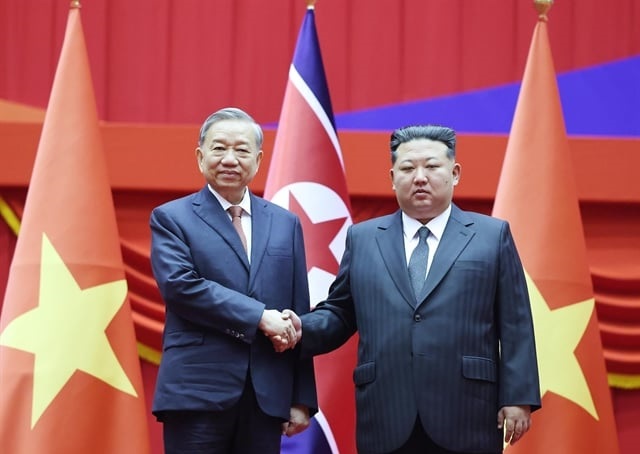
Four of the world’s five remaining communist leaders are convening in Pyongyang this week, a symbolic gathering that underscores both the endurance and evolution of the world’s few one-party regimes. Among them is Vietnam’s General Secretary To Lam, making his first visit to North Korea as party chief — and the first such trip by a Vietnamese leader in 18 years. The visit, reported by Nikkei Asia, highlights a moment of political theater designed to project unity among socialist states at a time of rising geopolitical tension.
Lam’s arrival at the invitation of North Korean leader Kim Jong Un comes as Pyongyang celebrates the 80th anniversary of the ruling Workers’ Party of Korea. The Vietnamese government has described the visit as a reciprocal gesture, following Kim’s state trip to Hanoi in 2019 for a high-profile summit with then–U.S. President Donald Trump. That visit, which famously ended without a deal, briefly placed Vietnam at the center of international diplomacy — a role Hanoi seems eager to reprise.
According to Nikkei Asia, Lam’s presence alongside Lao President Thongloun Sisoulith and Chinese Premier Li Qiang is seen as a demonstration of ideological solidarity among the remaining communist states. The meeting comes as the world grapples with trade wars, Russia’s ongoing invasion of Ukraine, and the turmoil in Gaza — conditions that have strained global alliances and underscored the resilience of authoritarian systems.
For North Korea, Vietnam represents more than a fellow ideological ally. Isolated by sanctions and dependent on limited trade partners, Pyongyang has long used its relationship with Hanoi to maintain economic channels. Vietnam hosts North Korean restaurants and tourists linked to the regime, providing rare sources of foreign currency. Analysts told Nikkei Asia that the North may also exploit these ties to bypass sanctions through covert coal or software sales. For Hanoi, meanwhile, the relationship offers a way to share lessons from its own transformation — from rigid socialism to a market-oriented success story.
Vietnam’s balancing act between communist comrades and Western democracies makes Lam’s visit especially significant. Hanoi has cultivated strong ties with the United States, Japan, and Europe, even as it maintains close relations with China and Russia. During Kim’s 2019 trip, Vietnam openly shared its experience of “socio-economic development and international integration,” signaling that reform, not isolation, was the path forward. This dual identity allows Vietnam to act as both bridge and buffer in Asia’s complex power dynamics.
Observers say Lam’s visit could also reignite discussion of denuclearization talks. With Donald Trump eyeing a political comeback, speculation has grown about a potential “Hanoi Summit 2.0.” “If there is another Trump-Kim meeting in the future, North Korea would possibly choose Vietnam as a neutral venue rather than China or Russia,” Sitthiphon Kruarattikan of Thammasat University told Nikkei Asia. For Vietnam, facilitating such talks would enhance its standing within ASEAN and reaffirm its role as a diplomatic intermediary.
Lam’s Pyongyang trip also carries weight for South Korea. Hanoi maintains deep economic and social ties with Seoul, where more than 300,000 Vietnamese live and where companies like Samsung are vital to Vietnam’s export economy. His recent meeting with South Korea’s new president, Lee Jae Myung, reflects Vietnam’s delicate balancing of interests between the two Koreas — one a key partner, the other a longstanding ideological ally.
Despite past tensions, including Vietnam’s 1978 intervention against North Korea’s ally, the Khmer Rouge, the two nations have gradually rebuilt trust. Today, they share mutual respect rooted in historical struggle and pragmatic politics. As Lam meets Kim in Pyongyang, the moment captures not only a symbolic convergence of old socialist comrades but also a new strategic dance — one that blends ideology, diplomacy, and economic survival in a rapidly changing world.










