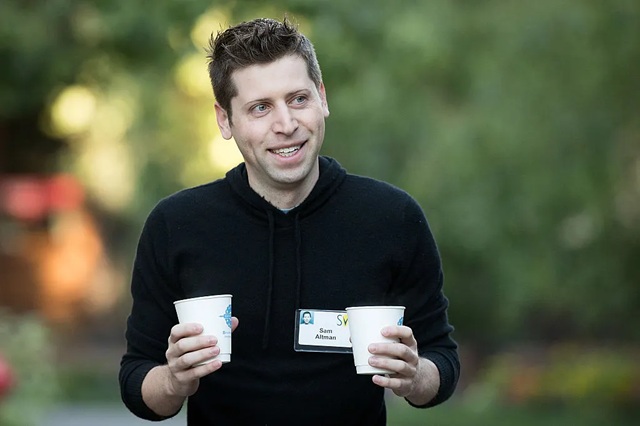
Editorial Note: The following excerpts are based on an interview with Sam Altman, CEO of OpenAI, conducted by Adam M. Grant, a renowned American popular science author and professor at the Wharton School of the University of Pennsylvania. In this engaging conversation, Altman shares insights on the future of artificial intelligence, its ethical implications, and the broader impact AI will have on society. Grant, known for his work on human behavior and organizational psychology, guides the discussion with thought-provoking questions that shed light on the evolving relationship between technology and humanity.
In a recent discussion about the future of artificial intelligence, Sam Altman, the CEO of OpenAI, shared some profound insights into the state of AI, its challenges, and its integration into the future. According to him, the journey of training AI models is a complex one. “We train these models to make predictions based off of all the words they’ve seen before,” he says. However, Altman acknowledges that the models sometimes generate inaccurate information due to the wrong data in the training set. He admits that AI’s ability to generalize is still evolving and that teaching models to confidently state when they don’t know something remains a key area of research.
Altman highlights that recent advancements in AI, particularly with reasoning models, are a big step forward. “I’ve prompted ChatGPT in various iterations. Like, is this true? Can you please make sure this is an accurate answer?” He emphasizes the importance of making this process an automatic part of AI development, as accuracy and reliability remain central to AI’s future.
The conversation then shifts to AI’s role in healthcare, with Altman revealing some surprising findings. “When you compare AI alone to doctors alone, of course, AI wins, but AI also beats doctor AI teams,” he says. His interpretation of this surprising result is that doctors sometimes override AI’s suggestions when they disagree, thereby preventing AI from performing at its full potential. This situation mirrors the history of AI in other fields, such as chess, where AI began as weaker than humans, then surpassed humans, only to be more effective when combined with human input. However, Altman believes there was a tipping point when AI surpassed even human-AI collaborations, due to humans overriding the AI’s judgment.
“We’re just early in figuring out how humans and AI should work together,” Altman observes. He suggests that AI will ultimately be a better diagnostician than human doctors. While this is undoubtedly a significant advancement, Altman is careful to note that humans will still be indispensable in many other aspects of care, particularly in providing the empathy and personal touch that patients desire.
As Altman reflects on the role of AI in everyday life, he shares a personal thought: “My kid is never going to grow up being smarter than AI.” He imagines a future where children grow up in a world where AI is simply a given—where they’re accustomed to its intelligence and capabilities. “The world that kids that are about to be born will, the only world they will know is a world with AI in it. And that’ll be natural.” He points out that while AI is smarter than humans in certain ways, the natural reaction to AI’s dominance should not be one of fear or discomfort. “Of course, it’s smarter than us. Of course, it can do things we can’t, but also who really cares?” In his view, it’s only the transitional period that feels strange, and ultimately, it will become just another part of daily life.
Altman also expresses concern about growing dependence on AI tools. “I can’t spell complicated words anymore because I just trust that autocorrect will save me,” he admits. He is mindful of the increasing reliance on AI for tasks that humans traditionally handled themselves. Yet, he recognizes that the future is inevitable, and we might just need to accept this shift. “Maybe that is just the way of the future,” he says, emphasizing that moral panics about the rise of AI tools might be misplaced.
But Altman also sees potential dangers. He observes a growing dependency, especially among students who find it difficult to start tasks like writing papers without ChatGPT’s assistance. “I’ve seen students who don’t want to write a paper without having ChatGPT handy because, you know, in front of a blank page or a blinking cursor.” He admits that this dependency is real, but he’s not sure whether it’s something that should be prevented. “For me, writing is outsourced thinking and very important,” he shares. Altman is open to the idea that this shift could be positive, as long as people are replacing their thinking with a new form of writing that enhances their creativity or thought processes.
In a more playful critique of modern workflows, Altman points out a phenomenon he finds particularly amusing: “A reasonably common workflow is that someone will write the bullet points of what they want to say to somebody else, have ChatGPT write it into a nice multi-paragraph email, send it over to somebody else. That person will then put that email in ChatGPT and say, ‘Tell me what the three key bullet points are.’” Altman humorously acknowledges that this approach might be an overcomplicated way of communicating, suggesting that the future could lead to a shift where people simply send bullet points back and forth.
One of the things Altman wishes for is some form of accountability when it comes to AI’s role in communication. “I really want a watermark or at least some internal memory where ChatGPT can say back, ‘Hey, this was already generated by me and you should go back and tell this person you wanted bullet points so that you all can communicate more clearly in the future.’” This, according to him, would improve communication clarity and prevent unnecessary back-and-forth that doesn’t add value.
As Altman reflects on his public persona and the challenges of being a high-profile figure in AI, he expresses the bittersweet reality of not always being able to express incomplete or evolving thoughts freely. “One of the sad things about getting more well-known is I don’t phrase everything perfectly for very little benefit to me or to OpenAI,” he says. “I just open up a ton of attacks or whatever. And that is a bummer.” He notes that there is a loss of privilege when one can no longer riff freely with ideas in public. The loss of this privilege, he acknowledges, is part of the price of being in the spotlight.
Despite this, Altman recognizes the value of thoughtful, careful communication. He advocates for more people to be intentional about their words and actions. “There’s also something about just being a thoughtful, somewhat careful person, which yes, I think more people should do.”
Discussing the broader societal implications of AI, Altman notes the slow adaptation of many people to the new technologies. But he is optimistic about human ingenuity. He refers to a study by Sharon Parker and her colleagues that demonstrated how employees in a robotics company were able to adapt to automation. Instead of fearing job loss, they found ways to outsmart the robots. “They study the robots, they figure out what they suck at, and then they’re like, ‘Okay, we are going to make that our core competence.’” In Altman’s eyes, this kind of adaptability will be crucial in the AI-driven world, where new skills and unique human contributions will continue to be valued.
However, he expresses concern that some of the skills that once differentiated humans are already becoming obsolete with advances in AI reasoning. “A lot of the skills that we thought would differentiate us last year are now already obsolete,” he says. This, he believes, is a sign of the rapidly changing nature of work and human interaction with technology.
The future of humanity in the age of AI remains a big unknown. “What are humans going to be for in 50 or 100 or 1,000 years? No one knows,” Altman admits. But he suggests that, at least for the present, humans will still find their value by being useful to others. “Be useful to other people. And I think that’ll keep being the case.”
Sam Altman also reflects on an intriguing concept shared with him by Paul Buchheit. According to Buchheit, there could one day be two separate types of currency—human money and machine money. While Altman doesn’t expect this to literally happen, he acknowledges it as a fascinating insight that hints at a future where humans and machines may live in parallel worlds.
Altman further considers how AI might change human priorities in the future. “But you will be thrilled that the AI has invented all of the science for you and cured disease and made fusion work and just impossible triumphs we can’t imagine. But will you care about what an AI does versus what some friend of yours does or some person running some company does?” He believes that, in the end, people will continue to focus on human connections, even in a world dominated by AI.
In a lightning round of questions, Altman gives some of his most direct answers yet. When asked what’s something he has rethought about AI, he admits, “I think a fast takeoff is more possible than I thought a couple of years ago.” He also critiques the common misconception that AI is “hitting a wall.” “AI is hitting a wall, which I think is the laziest way to try to not think about it and just, you know, put it out of sight, out of mind,” he argues.
As for advice on how to adapt to AI, Altman’s guidance is simple: “Just use the tools.” He emphasizes the importance of embracing the technology, making use of the powerful AI models available today. “The leading edge, the most capable person in the world and you can access the exact same frontier. And I think that’s awesome.”
In the end, Altman is realistic about the potential impact of AI, suggesting that while it may not be as world-changing in the short term as many believe, the long-term implications are profound. “Long term, everything changes,” he concludes. However, in the short term, he believes the world will continue to turn, with the general public largely unaffected by the rise of artificial general intelligence (AGI). “People in tech care and philosophers care,” he adds, “but even then, they care, but like 20 minutes later, they’re thinking about what they’re going to have for dinner that night.”