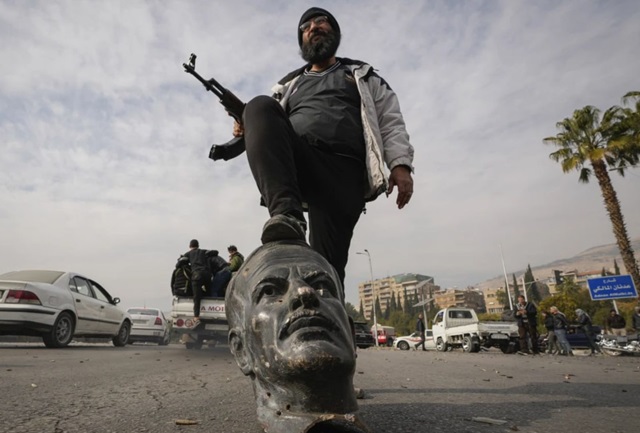
Syria is a fascinating country with an ancient civilisation whose history is as complex as it is interesting. The world has recently turned its attention to Syria again following the removal of the Assad regime on 7 December 2024. To understand the current situation in Syria, it’s important to revisit its history, but not in excessive detail.
Syria gained prominence in the 1940s, particularly in 1958, when President Gamal Abdel Nasser and the then President of Syria, Shoukry al-Kuatli, formed the United Arab Republic, a federation between Egypt and Syria. However, within a few years, in 1961, they dissolved the arrangement. A series of coups followed in Syria, and in 1966, Hafez al-Assad, then Defence Minister, participated in a coup that brought him to power in 1970.
The rise of Hafez al-Assad marked the beginning of the Assad regime and the cult of personality that sustained it for nearly 50 years. Crucially, Assad belonged to the Alawite sect, which some view as part of the Shia sect. His sectarian approach to governance alienated many mainstream Muslims, who did not accept the Alawites as legitimate members of the ummah. Assad employed family members and others loyal to him, clinging to power despite several attempts to remove him.
Assad viewed himself as a significant Arab leader. During his reign, particularly in the 1973 war with Israel, which resulted in the Israeli occupation of the Golan Heights (still held by Israel today), Assad adopted a pan-Arab stance. He supported what were seen as freedom-fighting organisations in the West, such as Hezbollah and Hamas, though the West labelled these groups as terrorists. Assad remained in power until his death in 2000, after which his son, Bashar al-Assad, succeeded him.
Bashar al-Assad, a trained doctor with international exposure, might have been expected to behave differently from his father. However, many commentators and historians view him as even worse than Hafez. Bashar continued his father’s personality cult and sectarian policies. He also maintained close ties with Iran, which, along with Russia, became one of his main backers. At this time, the world was divided between the Western bloc, led by the United States, and the Soviet Union, later replaced by the Russian Federation after its collapse. Assad aligned himself with both Russia and Iran, making Syria a hotbed for a range of militant groups, branded as terrorists by the West.
The Arab Spring, which began in Tunisia and spread through the region, triggered unrest in Syria. However, Bashar responded violently to the protests, resulting in bloody crackdowns in cities like Damascus. Despite maintaining control over key cities like Damascus, Aleppo, and Homs, Syria descended into civil war, plagued by insurgency and factionalism.
The fall of the Assad regime in December 2024, despite the support of Iran and Russia, reveals the extent of its rot. A regime that had been in power for 50 years collapsed within two weeks of the insurgency’s resurgence. This rapid downfall suggests that even with external support, the Assad regime could not withstand the internal decay.
The fall of the Assad regime is reminiscent of other personality-driven dictatorships. We saw similar patterns with figures like Jean-Claude Duvalier in Haiti (Papa Doc and Baby Doc), and while North Korea’s leadership endures, it too is based on a personality cult. The same decay led to the downfall of regimes like that of Bokassa in the Central African Republic. As seen in Syria, once a leadership is built around a single person, it often collapses from within.
Since the Arab Spring, Syria’s economy has been stagnant, and the country has been a refuge for various factions, including Hezbollah. The war economy kept the regime alive, but Bashar’s departure signals a troubled future for the region. In the short to medium term, the fall of the Assad regime may appear to benefit certain powers, but Syria remains a powder keg.
The question is: what can be learned from the Assad regime’s collapse? History teaches that those who gain power through violence often lose it in the same way. Assad sought asylum in Moscow after running a kleptocratic and plutocratic regime, and there are talks about the possibility of his extradition or prosecution by the International Criminal Court. However, the next few months will reveal how the situation unfolds.
In the short term, some may believe the Israelis, Turks, and Americans could benefit from Assad’s fall. The Israelis may see Hezbollah as weakened, while the Americans may view the collapse as a blow to Russian and Iranian influence in the region. However, the critical issue remains the fate of the long-suffering Syrian people. Syria is a deeply complex society, with a mix of sectarian groups such as the Alawites, Druze, Shia, and Sunni. If there is no attempt at unity, there is a risk of Syria descending into chaos, much like Lebanon did in the 1970s.
The challenge for Syria’s new leaders will be to ensure that all factions work together for the country’s greater good. I have heard them pledge to work on the economy and ensure lasting peace for the Syrian people. But these promises are easier said than done. There are still Assad loyalists who may try to maintain the regime’s ideology. The group that took control of Aleppo and Homs was a splinter faction of al-Qaeda, which, despite being labelled a terrorist group by the West, considers itself a freedom fighter.
As the West faces this complex situation, the US must decide whether to support the new Syrian leadership or attempt to change them. The next steps will depend on a variety of factors, including the actions of Russia and Turkey, which have significant influence in the region.
In terms of international response, the fall of Assad may create a new opportunity for dialogue. The Israelis, for example, may see this as an opportunity to weaken Hezbollah and diminish Iran’s influence in Syria. However, the future of Syria remains uncertain, and external players will continue to vie for influence.
If the Syrians can form an inclusive interim government and move away from the Ba’athist constitution, there is hope for a peaceful resolution. But if history is any guide, the road to peace in Syria will not be easy. Just look at the ongoing turmoil in Iraq, Somalia, the Democratic Republic of Congo, and Yemen, and you’ll see that rebuilding a nation is never simple.
Ultimately, the beneficiaries of Assad’s fall include Israel, the United States, and Europe, in that order. However, these powers will likely seek to shape the future of Syria in their favour. The Middle East remains a highly volatile region, where alliances shift quickly. What happens in Syria will have ripple effects across the region for years to come.