More than 3.6 million people pass through room number 12 of Madrid’s Prado Museum each year to admire Diego Velázquez’s La familia de Felipe IV, better known since the 19th century as Las meninas. Last summer, the painting acquired an unusual royal interpreter when Felipe VI, a direct descendant of Felipe IV, appeared in an Instagram video marking the 1,000th broadcast of the Prado’s channel. The video attracted more than five million views and, according to museum sources cited by El País, became one of the most watched in its history.
In the video, the King described the painting’s central figure, the Infanta Margarita, who appears illuminated by Velázquez and surrounded by her attendants. He also referred to the striking reddish-brown earthenware vessel that María Agustina Sarmiento offers the young princess on a silver tray.
“There are many interpretations of this work, about the messages its author intended to convey,” Felipe VI concluded.
Yet there was one detail he did not mention: the object itself was once something more than a prop in a celebrated painting. During Spain’s Golden Age, women of the royal and aristocratic courts were known to eat these vessels made from poorly fired clay. Art historian Natacha Seseña gave the practice the name bucarofagia.
The consumption of clay could cause iron-deficiency anaemia, producing the unhealthy pallor that was fashionable at the time. It was also consumed for supposedly medicinal and supernatural purposes, including regulating menstruation and contraception, and even as an intoxicating or narcotic substance intended to induce mystical states.
Journalist César Andrés Baciero devotes an entire chapter of his 2026 book Reyes que vivieron como reyes. Monarquía y lujo to the búcaro in Las meninas and its significance in 17th-century Spain. Speaking about the Prado video, he notes that he was not surprised Felipe VI did not discuss bucarofagia, although he believes the subject could have warranted a brief mention. The King, Baciero adds, did not record the video at the museum because of his schedule; it was filmed at the palace.
According to Baciero, Velázquez added the búcaro very late in the painting’s creation. There are various theories about why he did so, but one possibility is that it was intended to demonstrate the economic power of Felipe IV. The finest búcaros were produced in Extremadura, Portugal and Mexico and were expensive luxuries. Nuns traded them and sold them among aristocratic women.
The practice, however, could have serious consequences. Baciero points to María Luisa de Orleans, wife of Carlos II, who was reportedly given large quantities of clay in the hope that it would help her become pregnant. She died at the age of 26 after suffering severe gastrointestinal problems and acute pain. Baciero says it is believed that consuming so much clay caused a cólico miserere, or probable peritonitis, which ultimately killed her.
These episodes form part of Baciero’s broader examination of the luxuries, excesses and whims of European monarchies. His book moves from the legendary equestrian ballets organised by Leopoldo I of the Holy Roman Empire to the nouvelle cuisine of Luis XV, the spectacular jewellery collection of Catalina II of Russia and the gilded carriages of Guillermina of the Netherlands.
But some of the most striking stories concern something more intimate: the beauty rituals of crowned heads.
One of Baciero’s favourite chapters concerns the alleged pubic-hair wig of Carlos II of England. The king was an enthusiastic wearer of elaborate wigs, not because he lacked sufficient hair of his own, but because he wanted to conceal his greying hair. According to the legend recounted by Baciero, he commissioned a wig made from carefully selected pubic hair shaved from his female favourites. The wooden box with a mahogany head in which the supposed curiosity was displayed is preserved at the St Andrews Museum in Scotland.
Carlos II was not alone in turning hair into an instrument of royal status. His cousin Luis XIV became one of the great promoters of extravagant wigs. According to Baciero, having an impressive head of hair became a symbol of status, and because the Sun King himself did not possess much hair, wigs became fashionable at his court. He is said to have accumulated around a thousand models and even maintained a Cabinet of Wigs at Versailles, where busts displayed different full-sized hairstyles for different occasions.
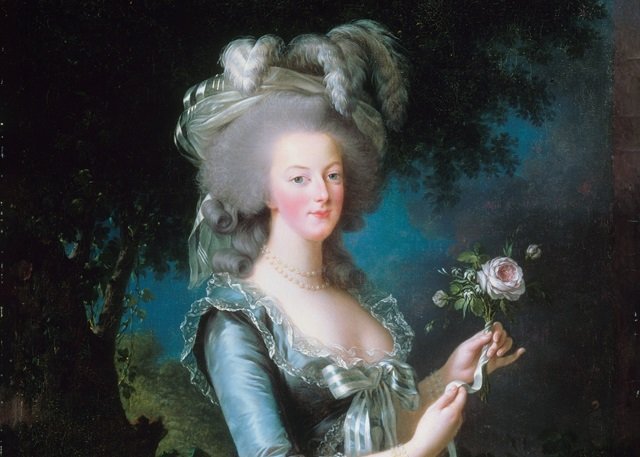
Then there was María Antonieta, consort of Luis XVI, whose elaborate bathing habits occupy another memorable section of Baciero’s account. She reportedly spent four hours in the bath, eating breakfast and even receiving language lessons while there. According to the stories cited by the journalist, the revolution caught up with her while she was in the bathroom. Long baths were not exclusively her indulgence. Luis XV reportedly took lengthy baths using water from the Seine and Marseille soap.
Perfume offered another avenue for royal extravagance. María Antonieta had an official perfumer, Jean-Louis Fargeon, while Catalina de Médicis was among the early royal devotees of fragrance. The wife of Enrique II of France reportedly liked to perfume even her gloves. A darker legend claims that she impregnated a pair with poison in an attempt to kill her daughter-in-law, Juana III of Navarra.
Catalina took perfume sufficiently seriously to travel to the French court with her personal perfumer, Renato Bianco, who had been raised by Dominican monks at Santa Maria Novella in Florence. In 1533, Bianco created Acqua di S.M. Novella, or Acqua della regina, for his patron. Five centuries later, Baciero notes, the fragrance is still sold.
The most disturbing cosmetics belonged to another queen. Isabel I of England suffered facial marks and scars after contracting smallpox in 1562. To conceal them, she used cerusa veneciana, or albayalde, a thick white cosmetic whose mineral active ingredient was cerussite — lead. Solimán, or mercuric chloride, was also used against freckles and blemishes. The Queen dyed her hair with a mixture containing lead sulphide, quicklime and water.
By the end of her life, Isabel I displayed symptoms associated with poisoning, including memory loss, nausea, fatigue, irritated skin and hair loss. She was buried without an autopsy, but continued use of layers of Venetian ceruse is considered one possible cause of her death.
For Baciero, these seemingly frivolous details reveal something more consequential about monarchy. Royal habits did not exist in isolation from society. For centuries, kings and queens devoted enormous sums and effort to their personal tastes, often using luxury to demonstrate economic, geopolitical and cultural power. Their excesses therefore became part of the language through which monarchy presented itself.
The modern royal household operates under different expectations. European monarchies now exercise greater restraint over their extravagances, carefully limiting the use of tiaras, haute couture, palaces and gilded carriages. Baciero attributes this change partly to the decline of the ancien régime and the rise of the bourgeois ideal of work and domestic respectability.
Queen Victoria, he notes, preferred to be portrayed as a mother and wife rather than as a monarch, reflecting that new ideal. Austerity, Baciero argues, became more a matter of appearance than ethics.
Spain’s Bourbon monarchy has gone particularly far in presenting itself as an ordinary middle-class family. The Spanish monarchy is described as Europe’s cheapest, with an official annual budget of about €8.4 million. When Juan Carlos and Sofía came to the throne, they deliberately adopted an austere presentation, shaped both by the political circumstances following Franco’s death and by a desire to appear Spanish and ordinary after more than 40 years without a monarchy.
Felipe VI has continued that approach. Yet Baciero questions whether restraint necessarily makes luxury less attractive to the public. In an age when social media displays the lives of the extremely wealthy, he argues that conspicuous luxury has not disappeared. Instead, it has acquired new audiences and new forms.
The paradox is striking. The monarchs of earlier centuries displayed their power through wigs, perfumes, palaces, jewels, extravagant baths and even clay-eating rituals. Their modern descendants are expected to appear restrained and ordinary. Yet the fascination with royal excess has survived.
What has changed is not necessarily the appetite for spectacle, but the way it is presented. The strange beauty rituals preserved in portraits, museums and historical accounts offer a reminder that behind the carefully constructed image of monarchy have always been individuals with insecurities, weaknesses, obsessions and desires — sometimes concealed beneath layers of powder, perfume, clay and hair.