by Our Correspondent in Colombo
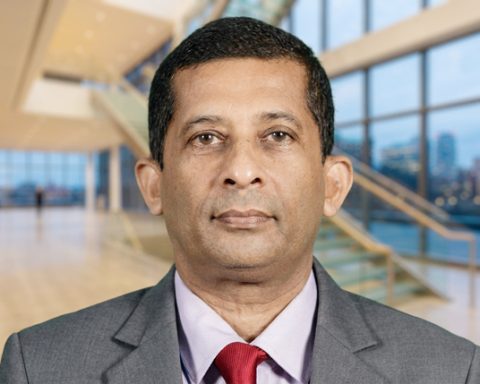
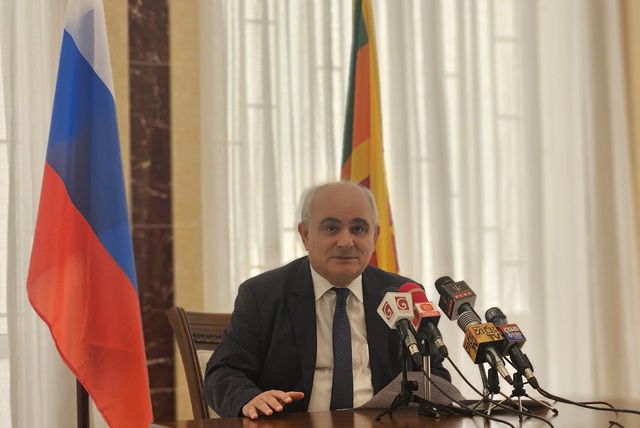
Speaking at a press conference today morning in Colombo to mark the third anniversary of Russia’s Special Military Operation in Ukraine, Russian Ambassador to Sri Lanka and the Maldives, Levan S. Dzhagaryan, delivered a strong defense of Moscow’s actions while condemning Western interference and outlining conditions for ending the war. He reiterated Russia’s position that Ukraine is an “artificially created state,” tracing its origins to the Soviet era and accusing its post-Soviet leaders of promoting aggressive nationalism that marginalized ethnic Russians. The ambassador accused Western countries, particularly the United States, of supporting these policies and pushing Ukraine toward a military confrontation with Russia.
According to Dzhagaryan, Ukraine was created as a state following the Russian Revolution, with Soviet leader Vladimir Lenin playing a key role in its formation. He stated that the country’s borders included “originally Russian lands,” specifically Novorossiya, and that the 1954 transfer of Crimea to Ukraine by Soviet leader Nikita Khrushchev was carried out without consulting the local population. After Ukraine gained independence in 1991, he claimed, its leadership undertook a campaign of forced Ukrainization, suppressing the rights of ethnic Russians. He argued that this process was actively encouraged by Western nations, with the United States leading efforts to weaken Russia’s influence in the region.
Dzhagaryan further pointed to NATO’s 2008 summit in Bucharest, where member states assured Ukraine that it would eventually be granted NATO membership. He described this as an unacceptable provocation, stating that Russia would not tolerate Western military structures and missiles near its borders, just as the United States would reject Russian military installations close to its own. He argued that NATO’s expansionism directly contributed to the deterioration of relations between Russia and Ukraine, culminating in the events of 2014.
Referring to the Maidan protests of 2014, which led to the ousting of pro-Russian President Viktor Yanukovych, Dzhagaryan called the movement an unconstitutional coup backed by nationalist forces. He accused the new Ukrainian leadership of launching a war against the Russian-speaking population in Donbas, which he said forced Moscow to take action to protect the region’s residents and Crimea. He argued that Russia’s intervention in both regions was a defensive response to what he characterized as Ukraine’s aggressive actions against its own people, with particular emphasis on the rights of ethnic Russians.
Further, Dzhagaryan pointed to Russia’s efforts to resolve the conflict through diplomacy. He referenced the Minsk agreements, which Russia had agreed to in an attempt to settle the dispute peacefully with Ukraine, Germany, and France. However, the ambassador accused former French President François Hollande and former German Chancellor Angela Merkel of having no intention of implementing the agreements, accusing them of using the process to buy time and strengthen Ukraine militarily. He claimed that despite repeated calls from Russia to negotiate, particularly concerning the interests of the Russian-speaking population in Donbas and Russia’s security concerns, the West arrogantly rejected all such efforts.
The ambassador also revisited the launch of the Special Military Operation in February 2024, stating that it was an unavoidable response after diplomatic channels failed. He mentioned a brief period of negotiations in Istanbul that resulted in an agreement which was initially supported by Ukraine. However, according to Dzhagaryan, the deal was undermined by British Prime Minister Boris Johnson, who urged Ukraine to reject the agreement and continue fighting. Dzhagaryan claimed that the West had encouraged Ukraine to prolong the conflict, even at the expense of its own people.
In September 2022, Dzhagaryan noted, Ukrainian President Volodymyr Zelensky signed a decree prohibiting any further negotiations with Russia, further complicating the prospect of peace. He also labeled Zelensky as an “expired” president, arguing that according to the Ukrainian Constitution, Zelensky lost legitimacy in May 2024.
The ambassador’s comments turned to the recent U.S. political landscape, suggesting that the arrival of Donald Trump on the political scene might open new doors for diplomacy. Dzhagaryan characterized Trump as a pragmatic leader and welcomed the possibility of renewed dialogue under his leadership. However, he also noted that no concrete proposals had yet been made by the U.S., stating that any negotiations must be based on principles of equality, mutual respect, and a genuine consideration of the situation on the frontlines.
Dzhagaryan further outlined Russia’s conditions for a peaceful resolution to the conflict. In June 2024, President Putin had articulated four key demands: the demilitarization and denazification of Ukraine, Ukraine’s neutral status (excluding any nuclear weapons or military alliances), the recognition of Crimea, Sevastopol, Donetsk, Luhansk, Kherson, and Zaporizhia as integral parts of Russia, and the lifting of all Western sanctions imposed on Russia. Dzhagaryan stressed that these were non-negotiable and that Russia was willing to engage in talks with Ukraine despite Zelensky’s alleged illegitimacy, although he questioned the validity of any agreements signed by him.
The ambassador also criticized the European Union’s stance on the conflict, pointing to the lack of unity among EU member states regarding a peaceful resolution. He acknowledged that some countries, such as Slovakia, were in favor of negotiations, but he highlighted the opposition from others, particularly Great Britain, France, Poland, and the Baltic states, who he claimed were prolonging the war by refusing to support peace efforts. Drawing parallels to past Western interventions, Dzhagaryan warned that the West’s promises of support to Ukraine would end the same way as their involvement in Afghanistan—marked by a hasty and humiliating retreat.
The ambassador concluded by emphasizing that Russia would not accept any form of ceasefire or a frozen conflict. For Russia, he stressed, the goal was not a temporary resolution but a lasting peace that ensures the security of both Russia and Ukraine. He reiterated that Moscow would not tolerate any ultimatums and that the West needed to engage in honest negotiations, taking into account the realities on the ground.