Using observations from NASA’s James Webb Space Telescope, scientists have produced the most detailed map yet of dark matter, the invisible substance that makes up the majority of matter in the universe and shapes its large-scale structure.
The new map, created from a patch of sky nearly three times the size of the full moon, traces the distribution of dark matter by analyzing how its gravity subtly bends light from about 250,000 distant galaxies. This phenomenon, known as gravitational lensing, causes slight distortions in galaxy shapes that allow researchers to infer the presence and concentration of otherwise unseen matter along the line of sight.
Dark matter does not emit or reflect light, making it impossible to observe directly with telescopes. While ordinary matter forms stars, planets and people, it accounts for only about 15% of all matter in the cosmos. Scientists deduce the existence of dark matter from its gravitational influence on galaxy rotation, the stability of galaxy clusters, and the way light travels through the universe.
The new Webb-based map significantly improves on an earlier effort using the Hubble Space Telescope. Thanks to Webb’s greater sensitivity and resolution, the latest map offers roughly double the detail, covers a larger region of space, and probes much further back in time—looking some 8 to 10 billion years into the past, a crucial era for galaxy formation.
“This allows us to resolve finer dark matter structures, detect mass concentrations that were previously unseen, and extend dark-matter mapping into earlier epochs of the universe,” said Diana Scognamiglio of NASA’s Jet Propulsion Laboratory, lead author of the study published on Monday in the journal Nature Astronomy.
The map reveals the universe’s “cosmic web” with unprecedented clarity, showing massive galaxy clusters, vast filaments of dark matter along which galaxies and gas are distributed, and large, sparsely populated regions with relatively little mass.
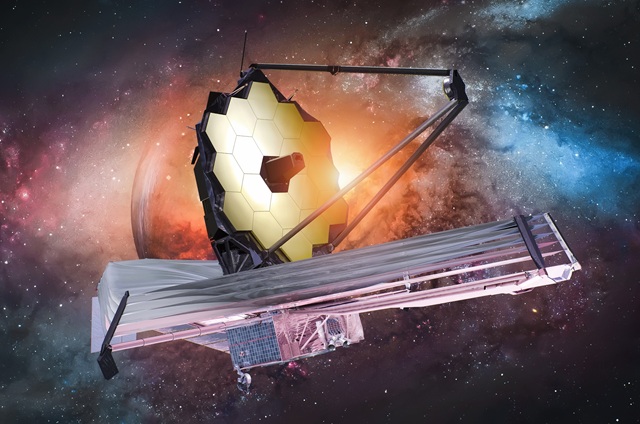
Launched in 2021 and operational since 2022, the James Webb Space Telescope is an infrared observatory with about six times the light-gathering power of Hubble. That capability allows it to detect much fainter and more distant galaxies, providing researchers with a denser background of reference points for mapping dark matter.
“The James Webb Space Telescope is like putting on a new pair of glasses for the universe,” Scognamiglio said. “More galaxies and sharper images translate directly into a sharper map of dark matter.”
The observations focus on the Cosmic Evolution Survey, or COSMOS, a well-studied region of the sky in the direction of the constellation Sextans. Researchers said the map will support a wide range of future studies, particularly those exploring how galaxies form and evolve over cosmic time.
“Dark matter halos are the nurseries of galaxies,” said Jacqueline McCleary of Northeastern University, a co-author of the study. “Knowing where the dark matter is and how it connects to the galaxies embedded within it places important constraints on our models of galaxy formation and evolution.”
The findings are consistent with the leading cosmological theory known as Lambda-CDM, which describes a universe dominated by dark matter and dark energy, the mysterious force driving the universe’s accelerating expansion.
“In this framework, dark matter provides the gravitational backbone on which galaxies, groups and clusters form,” Scognamiglio said. “Our map offers a much sharper observational view of this dark-matter scaffolding.”