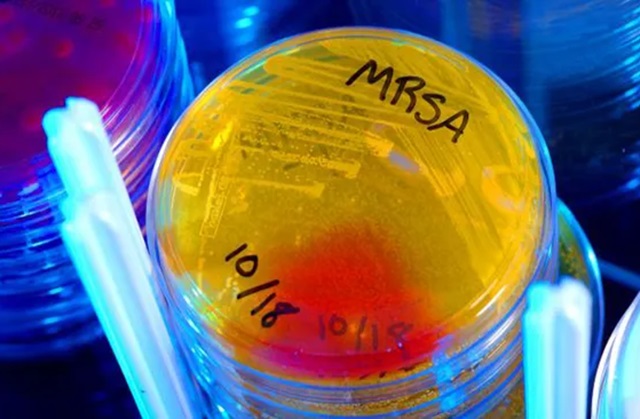
Scientists have uncovered the first member of a promising new class of antibiotics, and the discovery came as a surprise. The compound, called pre-methylenomycin C lactone, demonstrates strong activity against drug-resistant bacteria, including methicillin-resistant Staphylococcus aureus (MRSA) and multidrug-resistant Enterococcus faecium, both of which are notorious for causing infections in hospitalized patients. The findings were reported Oct. 27 in the Journal of the American Chemical Society, with lead authors Lona Alkhalaf and Greg Challis describing the molecule as “the first in a new class” of antibiotics in correspondence with Live Science.
Interestingly, the researchers were not initially searching for new drugs. Their original goal was to study how a known antibiotic, methylenomycin A, is produced by the soil bacterium Streptomyces coelicolor. Many microorganisms generate secondary metabolites — complex compounds that often have medicinal properties in humans. By understanding how these molecules are synthesized, scientists can identify new drug candidates. Alkhalaf and Challis used a methodical approach, deleting specific genes from the bacterium’s biosynthetic gene clusters to halt methylenomycin A production at key steps. This allowed them to isolate previously unseen intermediate compounds, which they named pre-methylenomycin C and pre-methylenomycin C lactone.
Subsequent testing revealed that pre-methylenomycin C lactone was particularly effective. “[It] is active against a range of Gram-positive bacteria, including MRSA and multidrug-resistant E. faecium,” the researchers told Live Science. Remarkably, the compound was roughly 100 times more potent than the original antibiotic and, in a 28-day experiment, did not induce resistance in bacteria, a common problem with repeated antibiotic exposure.
The team plans to expand their research to study the compound against additional bacterial strains and over longer periods. They are also collaborating with synthetic chemist David Lupton at Monash University in Australia to develop a method to chemically produce pre-methylenomycin C lactone. This would allow larger-scale studies to explore how the molecule works in bacterial cells and how its structure can be optimized for even greater effectiveness.
Medicinal chemist Stephen Cochrane, who was not involved in the study, cautioned that many compounds with antibacterial activity do not always translate into viable drugs. “The big challenge is creating something that persists long enough in the body, isn’t toxic to humans, and isn’t prone to resistance,” he said. Still, the discovery offers a promising new direction in the fight against antibiotic-resistant infections, highlighting the potential of studying microbial natural products for novel therapeutics.
By systematically analyzing bacterial metabolic pathways, Alkhalaf and Challis have revealed not just a new molecule but a potential avenue for next-generation antibiotics, providing hope against some of the most challenging drug-resistant pathogens in modern medicine.