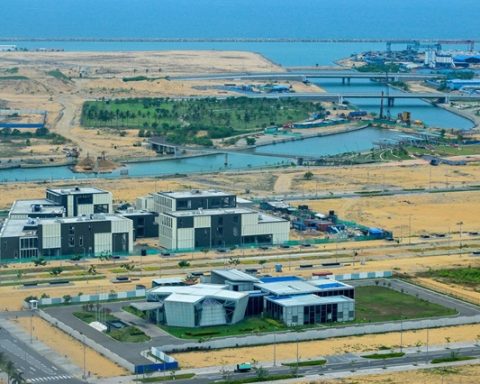

On the morning of November 18, 1995, an event unfolded in the skies above Sri Lanka that starkly illuminated the harsh realities of conflict and the critical importance of inter-service communication. This was the tragic downing of the Sri Lanka Air Force Shaanxi Y-8 transport aircraft, tail number CR-871, by the Liberation Tigers of Tamil Eelam (LTTE) near the sea off Palaly Air Force Runway in Northern Sri Lanka, now known as Jaffna International Airport, bustling with activity.
The Fateful Day
CR-871 departed from Ratmalana Air Base at 6:50 AM, carrying urgent cargo essential for ongoing military operations. The crew included some of the Air Force’s finest officers: Wing Commander Thejananda Thibbotumunuwe as the captain, Squadron Leader Bandu Kumbalathara as co-pilot, and a team comprising Wing Commander Lalith Nanayakkara, Squadron Leader Prasanna Balasooriya, Flight Lieutenant Sanjeewa Goonewardane, and Sergeant P.A.S.T. Jayasinghe.
The Y-8 flew at an altitude of 13,000 feet, navigating a precarious sea route to avoid missile threats. As the aircraft descended for its final approach to Palaly, it came under attack. LTTE boats, equipped with anti-aircraft weaponry, opened fire. A 12.7 mm shell struck the Y-8, causing catastrophic damage. The aircraft belly-landed into the sea, three kilometers from the coastline.
Out of the six crew members, only Squadron Leader Kumbalathara survived, rescued heroically by a Bell-212 helicopter piloted by Squadron Leader Dushantha Edirisinghe and Flying Officer Bandu Edirisinghe amid intense enemy fire. The remaining crew members, including Wing Commander Thibbotumunuwe, lost their lives, with some bodies never recovered.
The Naval Perspective
I was the Officer-in-Charge (OIC) of P 485, tasked with guarding the sea corridor, which meant monitoring the approach path of aircraft to Palaly Air Force Base. Using my small Fast Attack Craft (FAC), one of only two such craft available to the Northern Naval Area (NNA), I carried out this duty daily. Additional FACs from Trincomalee would often be attached to the NNA for specific tasks.
Based on directives from the Commander of the Northern Naval Area, one FAC was deployed along the aircraft’s approach path during landings and take-offs. Military personnel traveling on leave or returning to duty, along with lightweight cargo, were typically transported by various Air Force aircraft.
On this particular day, I cleared the approach of fishing vessels and began monitoring the airspace for incoming aircraft. I had basic VHF, non-secure communication with the Kankesanthurai (KKS) Naval Operations Room but no direct communication with the Army or Air Force. All coordination was handled through the KKS Operations Room.
Early in the morning, two passenger aircraft successfully landed and departed without incident. However, I suddenly noticed five to six fast boats approaching from the uncleared areas of Velvettithurai and Thondaimanaru toward the aircraft’s descent path. I immediately alerted the NNA Operations Room to suspend air operations and advanced toward the enemy boats with full firepower. Unfortunately, it was too late—the Y-8 had already approached from my rear and entered the crossfire zone.
I vividly recall witnessing an enemy boat, fitted with an anti-aircraft 12.7 mm gun, firing toward the sky. The Y-8’s left wing began smoking as it took multiple hits. Within minutes, the aircraft belly-landed on the water, drifted briefly, and partially sank. Under heavy enemy fire, I maneuvered my FAC close to the sinking aircraft, preventing the enemy from approaching and requesting backup from the NNA. Additional FACs and a Dockyard craft arrived shortly after, supporting me in keeping the enemy at bay.
Aftermath and Revelations
The final analysis of this incident exposed significant operational shortcomings, particularly in inter-service communication. Earlier that morning, the Army had fired artillery at LTTE boats in the Thondimannar and Velvettithurai areas. However, this critical information was not relayed to either the Air Force or the Navy due to incompatible communication systems and siloed operations. Furthermore, the Air Force’s decision to withhold aircraft arrival times for security reasons left the Navy reliant on visual identification of overflying aircraft.
The LTTE exploited these gaps, timing their attack precisely to ambush the Y-8. Intelligence suggested the LTTE had relayed the Y-8’s departure time from Ratmalana using land-based telephones. The Navy’s lack of real-time information further compounded the tragedy.
Strategic Lessons Learned
This incident marked a pivotal moment in Sri Lanka’s military history, prompting immediate reforms. The Ministry of Defense mandated the deployment of Air Force liaison officers to Naval Operations Rooms, ensuring direct communication. Over time, secure, unified communication systems were introduced, enhancing inter-service coordination and operational efficiency.
Beyond technological upgrades, the Y-8 tragedy underscores the enduring importance of collaboration, trust, and shared intelligence in military operations. It serves as a stark reminder that success in modern warfare demands cohesive, integrated strategies.
A Tribute and a Call to Remember
The sacrifices of Wing Commander Thibbotumunuwe, his crew, and countless others who served during the conflict must never be forgotten. Their courage under fire reflects the resilience of those who dedicate their lives to national security. However, the lessons learned from their tragedy must also endure, guiding future strategies to prevent similar losses.
As we reflect on this event, let us honor their memory by fostering a culture of unity and preparedness. The Y-8 incident is not just a story of loss but a testament to the need for continuous improvement and collaboration in the face of adversity.