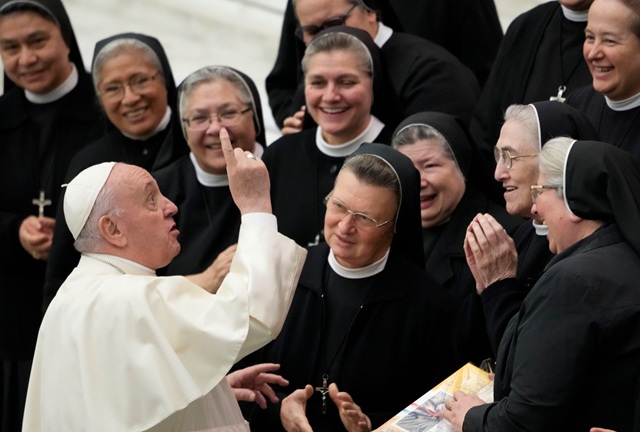
Pope Francis has made several key appointments that suggest a shift in the Catholic Church’s power dynamics, particularly concerning women’s roles. These appointments, including the appointment of Raffaella Petrini as the first woman to head the Vatican governorate and Sister Simona Brambilla as the first female head of a dicastery, are seen as groundbreaking. However, despite these strides, Pope Francis’ stance on women’s ordination remains unchanged, with the Pope still holding that women cannot be priests. His position has led to debates about whether he can truly be considered a feminist.
While the Pope has made strides in appointing women to high positions within the Vatican, his opposition to female priests has drawn significant criticism. The Pope has previously spoken about the need for the Catholic Church to be “demasculinised,” advocating for women to shift from “servitude” to “service.” His praise for women as better managers than men highlights his belief that women should play a stronger role in decision-making processes within the Church. Despite these progressive moves, the Pope continues to hold firm on the issue of female ordination, repeatedly stating that the “door is closed” for women priests, which has led to mixed reactions from various Catholic factions.
Women like Nathalie Becquart, who serves as the undersecretary of the Synod of Bishops, acknowledge that while visible roles in liturgical ceremonies are still predominantly male, behind the scenes, many significant roles within the Vatican are now occupied by women. This includes women in influential positions such as Barbara Jatta, director of the Vatican Museums, and Maria Lia Zervino, head of the World Union of Catholic Women’s Organisations. These appointments align with Pope Francis’ push for “declericalisation,” a process by which lay people, including women, are given leadership roles, even in areas traditionally dominated by clergy.
Some women in the Vatican have been surprised by their new roles, like Zervino, who found out she had been appointed to the Dicastery for Bishops in 2022, an entirely male body. Despite this progress, many feel there is still a long way to go for women to achieve full equality within the Church, particularly when it comes to ordination. The question of whether women should be ordained remains a divisive issue, and Pope Francis continues to resist calls to allow women to become priests, though he has allowed for a commission to study the possibility of women becoming deacons, a position that could lead to a more significant role in church functions like baptisms, weddings, and funerals.
There is also a growing conversation around how the Church’s attitudes toward women should evolve, with some calling for a more progressive stance on ordination, while others are content with the changes already made. Critics of the Pope’s position argue that while his moves toward empowering women are a step in the right direction, they are not enough to address the underlying issues of gender inequality within the Church. Pope Francis’ emphasis on shifting power from the priesthood to lay members has been seen as an important part of his approach to change, although for many, this is not enough to counterbalance his refusal to allow women to become priests.
While some see the Pope’s actions as sincere and progressive, others remain skeptical about whether his approach is truly feminist, or merely an incremental shift that does not challenge the Church’s patriarchal structure. The debate over women’s roles in the Catholic Church continues, and for many, the glass ceiling remains firmly in place.