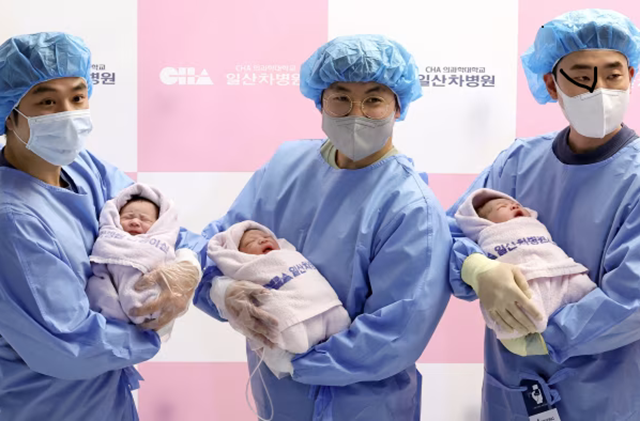
South Korea’s fertility rate has increased for the first time since 2015, offering a rare glimmer of hope for a country struggling with the world’s lowest birth rate. According to new data from the national statistics office, the fertility rate rose from 0.72 in 2023 to 0.75 last year, a small but significant uptick driven largely by a post-pandemic surge in marriages.
Officials have attributed the rise to changing social attitudes, a higher number of people in their early 30s, and delays in marriage and childbirth caused by the pandemic. The number of marriages jumped to 222,422 in 2023, the highest since 2019. “There was a change in social values, with more positive views about marriage and childbirth,” said Park Hyun-jung, an official at Statistics Korea.
Despite this modest increase, the fertility rate remains far below the 2.1 needed to sustain a stable population. South Korea continues to face a deepening demographic crisis, which threatens economic growth and increases pressure on the country’s pension and healthcare systems.
The government has spent more than ₩380 trillion ($270 billion) since 2006 on policies aimed at boosting birth rates, including expanded parental leave, increased childcare subsidies, and workplace flexibility for working mothers. Recently, it even launched a pilot program allowing 100 Filipino workers to assist with domestic tasks in Seoul, a move aimed at easing the burden on families.
Large corporations have also stepped in with incentives. Construction company Booyoung, for example, has offered employees a $75,000 bonus for each child they have—a striking attempt to encourage higher birth rates.
However, experts remain skeptical about whether this upward trend will continue. According to the Financial Times, sociologist Shin Kyung-ah from Hallym University cautioned that the increase could be a short-term effect of the post-pandemic recovery rather than a lasting shift. “I am not sure if the fertility rate has turned the corner. Things can get worse if the economy deteriorates,” she said. “Young people’s perception towards marriage and childbirth has not improved much, given the structural economic and cultural problems.”
While the recent rise in births is a positive sign, South Korea still faces significant hurdles in reversing its long-term population decline. Whether government incentives and shifting attitudes will be enough to sustain this momentum remains an open question.