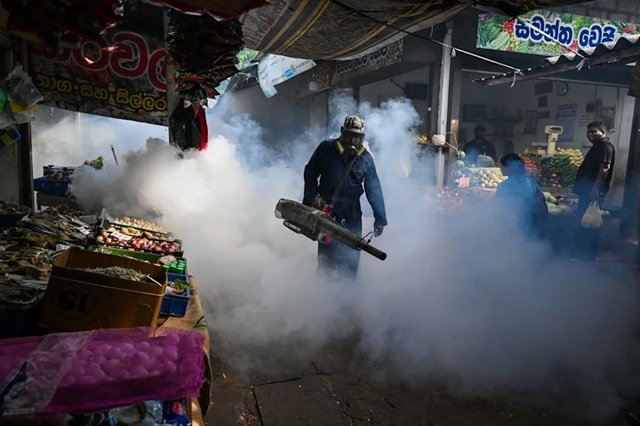
Sri Lanka has deployed military drones and expanded armed forces support in an intensified campaign to combat the country’s worst dengue outbreak in almost a decade after infections surpassed 77,000 and the death toll reached 56. The government of President Anura Kumara Dissanayake has established a military-led monitoring unit as health authorities seek to contain the rapid spread of the mosquito-borne disease and prevent a repeat of the devastating 2017 epidemic.
The National Dengue Control Unit has identified 162 administrative divisions as high-risk transmission areas, with cases reported across the island. Colombo has recorded the highest number of infections. Health officials have attributed the outbreak largely to the spread of the more virulent DENV-2 strain, which Acting Director General of the National Dengue Control Unit Kapila Kannangara said accounts for nearly 75 per cent of reported cases and has a tendency to spread rapidly.
The Health Ministry has enlisted the armed forces to strengthen surveillance and eliminate mosquito breeding sites. Air Force drones are being used to detect stagnant water collected on rooftops following monsoon rains, while police officers have been assigned to inspect homes, schools and construction sites. Authorities said the measures are intended to reduce mosquito breeding and avoid a recurrence of the country’s 2017 outbreak, when more than 186,000 infections and at least 450 deaths were recorded.
Hospitals have responded to the escalating crisis by adding beds, opening special wards and extending duty hours for doctors and nurses after more than 18,000 cases were reported during the first two weeks of July alone. Public health officials said medical services are under increasing pressure as patient numbers continue to rise. Kannangara said public health workers were “stretched to their limit”, adding that both the number of patients and the severity of cases had increased sharply.
Health authorities linked the surge in infections to the aftermath of Cyclone Ditwah, which struck Sri Lanka in December and damaged infrastructure and health facilities. Consultant community physician Prashila Samaraweera of the National Dengue Control Unit said large amounts of debris left in the environment created extensive mosquito breeding grounds, resulting in elevated entomological indicators that persisted in the months that followed.
The outbreak has further strained resources in the country of 22 million people, which has been recovering from years of economic decline. Health officials expect infection rates to ease as monsoon rains weaken in August but warned that cases could rise again from November when rainfall returns.
Authorities last week launched an island-wide clean-up campaign targeting the hardest-hit areas. Homes, shops and religious establishments were inspected to remove mosquito breeding sites. The Health Ministry said around 11,000 breeding locations had been cleared this month, while fines were imposed on more than 4,000 premises found to harbour breeding grounds.
Doctors in heavily affected districts reported a sharp increase in admissions. Lalindra Dias, a consultant in Negombo, said the district hospital had treated nearly 1,800 dengue patients in less than two months since June, compared with about 1,050 during the same period last year. According to Ada Derana, Sri Lanka recorded 8,590 cases in May, 21,537 in June and 21,650 cases during the first 20 days of July.
To ease pressure on hospitals, health authorities are advising patients with mild symptoms to recover at home where appropriate. Officials are also considering the use of a dengue vaccine as part of the response, although public health experts have cautioned that its effectiveness may be limited because several strains of the virus are circulating simultaneously.