Editorial
The plaintive bleats of Sri Lanka’s opposition parties, predicting the imminent collapse of President Anura Kumara Dissanayake’s government, ring more of desperate fantasy than grounded political calculus. The notion that this administration, flawed as it may be, will crumble by September is not merely premature but verges on delusional. Opposition politicians, flailing for relevance, have begun to indulge in a collective hallucination, casting themselves as saviours without the moral, intellectual, or organisational gravitas to lead.
Let us be clear: Ranil Wickremesinghe, with all the political acumen he has cultivated over decades, would do well not to re-emerge as the nation’s helmsman under the current tainted alliance. Rather, he ought to focus on forging a worthy successor who can dismantle the culture of corruption that festers not only within his own party but throughout the opposition establishment. A decaying tree cannot yield sound fruit.
The opposition, for its part, remains fractured, directionless, and devoid of authentic ideological cohesion. Their criticism of Dissanayake’s regime as deceitful is often justified, yet they offer no compelling alternative. If they are to be believed, a mere reshuffling of names will yield national redemption. The reality, however, is that they suffer from what French sociologist Pierre Bourdieu termed a “habitus of defeat“—a behavioural inertia rooted in years of systemic failure and opportunistic politicking.
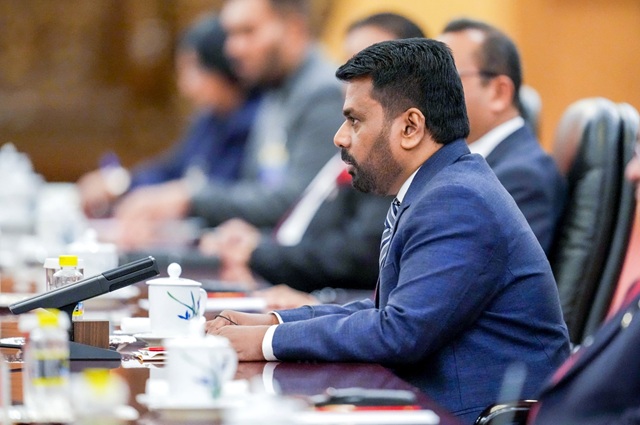
Despite Dissanayake’s apparent psychological strain—his conspicuous hyperactivity betrays a man under immense internal and external pressures—he remains, for now, unassailable by the current political opposition. His relentless grassroots engagement, though occasionally haphazard and histrionic, has earned him a rare commodity in Sri Lankan politics: trust. In an era defined by the erosion of institutional legitimacy, that trust is his strongest bulwark.
The president’s tenuous hold on the public’s patience is sustained not by the virtue of his policies but by the opposition’s inability to present a coherent counter-narrative. Their incompetence is illustrated by the vacuity of their leaders, many of whom display staggering immaturity and a woeful misunderstanding of modern governance.
As Machiavelli noted in The Prince, “It is not titles that honour men, but men that honour titles.” Many opposition leaders today, though adorned with lofty designations, possess neither the wisdom nor the disposition to steward a nation teetering on the edge of socioeconomic precipice. Their infantile tantrums and internecine feuds serve only to alienate the citizenry.
It is not that Dissanayake’s administration is impervious to collapse. Indeed, the internal fissures within the National People’s Power (NPP) and the Janatha Vimukthi Peramuna (JVP) are beginning to show. The Prime Minister, in particular, has acted with an alarming degree of political naivety. With rare exceptions—such as Bimal Rathnayake and Nalinda Jayatissa, who exude a modicum of integrity and strategic sensibility—the remainder resemble proverbial bulls in a china shop, wreaking havoc with rhetoric devoid of substance. The cabinet, peopled by courtiers and yes-men, lacks the intellectual rigour and ethical backbone to guide national policy. A recalibration is urgently needed—not as a cosmetic exercise but as a foundational rethinking of governance ethos.
This is a time that calls for what Antonio Gramsci termed “pessimism of the intellect, optimism of the will.” Dissanayake must confront his government’s deficiencies with brutal honesty. He must reassert control by discarding those who masquerade as loyalists but are in fact political parasites. His team must be rebuilt on meritocratic foundations, with continuous performance evaluations and a readiness to excise the deadwood.
The opposition, meanwhile, clings to the fantasy that the government will suffer a Gotabaya-style implosion. But history seldom repeats with such symmetry. The upheaval that unseated Gotabaya Rajapaksa was sui generis, fuelled by an economic apocalypse and decades of dynastic decadence. Unless the present government commits a similarly spectacular act of self-destruction, it will not be dislodged by mere rhetorical vitriol.
At present, the opposition’s main tactical gambit lies in weaponising the government’s contradictions and unfulfilled promises. They aim to frame Dissanayake’s administration as purveyors of “noble lies” in the Platonic sense—crafted myths masquerading as truth to preserve political order. But even if this is partially accurate, the opposition has failed to articulate its own truth. What is their economic doctrine? How will they navigate the geopolitical quagmire engulfing Sri Lanka, especially with mounting tensions between China and India? The silence is deafening.
It is also pertinent to consider the regional parallels. In Pakistan, Imran Khan rode a populist wave to power only to be undone by his lack of institutional support. In Brazil, Lula da Silva returned with renewed credibility, not just because of Bolsonaro’s failures but because he offered a compelling alternative vision. The Sri Lankan opposition, by contrast, offers neither structural reform nor charismatic leadership. Instead, it harps on the failures of the government while embodying many of the same pathologies.
Sri Lanka needs more than regime change; it requires epistemic rupture—a break from the cognitive and cultural structures that have perpetuated decades of misgovernance. This involves transforming not merely the faces in parliament, but the very way political legitimacy is conceptualised and exercised. As Michel Foucault argued, “Power is not an institution, and not a structure; neither is it a certain strength we are endowed with; it is the name that one attributes to a complex strategic situation.”
Thus, for the opposition to truly challenge Anura Kumara Dissanayake, it must understand the strategic complexity of the moment. They must cease being reactive and start being visionary. They must move beyond ephemeral populism and cultivate a political grammar that speaks to the structural anxieties of the Sri Lankan people: inflation, corruption, youth unemployment, education reform, and climate resilience.
Let it be clear: we are no sycophantic paean to the current regime. Dissanayake must urgently manage his insecurities, stabilise his psyche, and rid himself of sycophantic advisers who, in the words of Shakespeare’s King Lear, “…will say anything to gain their ends, though they mean nothing.” If he fails to do so, his government may become a theatre of tragic irony—a revolution betrayed from within.
Sri Lanka is entering uncharted territory. The geopolitical chessboard is shifting rapidly, and crises loom that lie beyond the nation’s immediate control. The challenge is not merely to survive these trials but to develop resilience. Should Dissanayake’s government maintain focus on the main issues and prepare for unforeseen global shocks, it can plausibly complete its term.
Politics is not a morality play. It is a contest of visions, capabilities, and coalitions. For now, the opposition offers neither. Until that changes, Anura Kumara Dissanayake remains the default choice—not because he is flawless, but because the alternative is, quite simply, far worse.