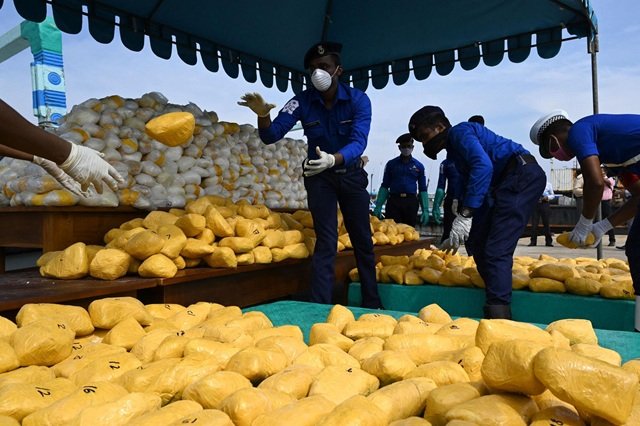
- Is the Sri Lankan coastline becoming a paradise for international drug traffickers?
- 705 individuals engaged in drug trafficking in the country’s maritime zone arrested from 2021 to 2026
- 46 Iranian and Pakistani nationals among those arrested
By Rahul Samantha Hettiarachchi
With fisheries as its core, the blue oceans and picturesque coastline surrounding Sri Lanka are today rapidly turning into a major transit hub for international drug traffickers. Studying official data reports obtained from the Police Narcotics Bureau and the Sri Lanka Coast Guard under the Right to Information Act reveals the threat posed to the country’s national security, as demonstrated by the quantities of drugs and information on suspects arrested solely by the Police Narcotics Bureau from January 01, 2021, to July 31, 2026, within the country’s coastal and maritime zones.
Five Years of Drug Landings
According to official data reports provided by the Police Narcotics Bureau, 705 individuals bringing heroin, cannabis/Kerala cannabis, cocaine, methamphetamine, and narcotic pills into the country through the maritime zone and at the coastline over the past six years have been arrested. Among them were 654 Sri Lankans, 21 Pakistanis, 25 Iranians, and 5 other nationals.
In the year 2021, 32 suspects were arrested with 795.81 kg of heroin, 15 suspects with 1452.625 kg of cannabis and Kerala cannabis, and 4 suspects with 126.78 kg of methamphetamine (ice). Similarly, in 2022, 151 suspects were arrested with 1363.76 kg of heroin, 100 suspects with 6190.013 kg of cannabis and Kerala cannabis, 84 suspects with 148.15 kg of methamphetamine, and 1 suspect with 32 narcotic pills.
In the year 2023, 64 suspects with 715.516 kg of heroin and 68 suspects with 3762.405 kg of cannabis and Kerala cannabis were found. In 2024, 46 suspects were arrested with 365.386 kg of heroin, 34 suspects with 1210.472 kg of cannabis and Kerala cannabis, and 36 suspects with 867.51 kg of methamphetamine. Considering the year 2025, 11 suspects were found with 1006.42 kg of heroin, 14 suspects with 3214.2 kg of cannabis and Kerala cannabis, alongside 1888.1 kg of methamphetamine.
Furthermore, in the first seven months of the year 2026 (up to July 31), 33 suspects with 919.682 kg of heroin, 1 suspect with 368 kg of cannabis and Kerala cannabis, 6 suspects with 256.2 kg of cocaine, and 5 suspects with 478.33 kg of methamphetamine have been arrested.
(Note: The corresponding bar chart illustrating the amounts and numbers of arrests related to drugs from 2021 to 2026.07.31 is presented in the original document).
Who are the Masterminds of the Network?
An analysis of the data mentioned in the Police Narcotics Bureau reports clarifies that both Sri Lankans and foreign nationals are heavily involved in drug trafficking conducted via sea routes.
According to that data, domestic Sri Lankans are the ones most frequently arrested during drug transportation. Local fishermen, falling prey to traffickers driven by economic difficulties and the goal of making money, have been directly utilized for this. However, data from 2021, 2022, and 2023 confirms that Pakistani and Iranian nationals act as the main suppliers of these large-scale traffickings. Particularly, the arrest of 21 Pakistani nationals and 25 Iranian nationals solely for the heroin trade during those three years shows that Sri Lanka’s coastal waters are being utilized as a primary exchange center of the regional drug network, and that international orchestration and support exist for it.
(Note: The bar chart depicting heroin arrests in the maritime zone from 2021 to 2026.07.31 categorized by Sri Lanka, Pakistan, and Iran is presented in the original document).
Vessel Owners Disabling VMS Systems for Illegal Trafficking
Reports obtained through the Right to Information Act from the Coast Conservation Department (CCD) reveal that illegal methods such as intentionally deactivating, disconnecting, or tampering with Vessel Monitoring Systems (VMS and AIS) are used to continuously carry out illegal drug transportation and various trafficking in the maritime zone. These destructive measures are followed with the objective of keeping the vessels’ routes and locations confidential while conducting trafficking.
According to Sri Lanka Coast Guard reports, Coast Guard officers have arrested 7 multi-day fishing trawlers that deactivated VMS systems for illegal activities in this manner during the year 2026 alone. These vessels were arrested in areas associated with the Mirissa fisheries harbor and Gandara fisheries harbor. Coast guard reports confirm that vessel operators have managed these traffickings by rendering VMS units inactive, removing power supply fuses, or connecting and burning wires together.
The Net of the Law and Progress of Trials
Cases filed for individuals engaged in drug trafficking in this manner for the year 2020 are 3, with 1 case currently on trial. The number of convicts from cases that completed trials is 7. Similarly, in the year 2021, 5 cases were filed, with 1 case on trial. The number of convicts is 6. In the year 2022, 7 cases were filed, with 1 case on trial. The number of convicts is 16. In the year 2023, 6 cases were filed, with 1 case on trial. The number of convicts is 8. Likewise, although cases filed in the years 2024, 2025, and 2026 were 8, 11, and 9 respectively, data regarding their trial statuses and the number of convicts has not been presented.
Data regarding cases filed against arrested suspects and their current progress is shown below:
| Year | Number of Cases | Number on Trial | Number of Completed Trials | Number of Convicts |
| 2020 | 3 | 1 | 1 | 7 |
| 2021 | 5 | — | 1 | 6 |
| 2022 | 7 | — | 1 | 16 |
| 2023 | 6 | 1 | 1 | 8 |
| 2024 | 8 | — | — | — |
| 2025 | 11 | — | — | — |
| 2026 | 9 | — | — | — |
The ‘Golden Crescent’ and International Sea Routes
Studying international drug reports reveals that the primary drug threat facing Sri Lanka originates from the region known as the ‘Golden Crescent’, comprising Pakistan, Afghanistan, and Iran. Traffickers bring drug stocks to the high seas via mother vessels from the Persian Gulf or the Makran Coast. Thereafter, multi-day fishing trawlers sailing from the southern and western coasts of Sri Lanka disable their VMS systems and exchange these drug stocks in the middle of the sea. These toxic drugs, subsequently brought to shore via small boats, are channeled into distribution networks across the island.
What Should Be Done to Control Coastal Security and the Drug Disaster?
Immediate action must be taken to curb maritime drug trafficking and the illegal trend of deactivating VMS systems. While the heightened security measures currently taken by Sri Lankan security forces are commendable, it is essential to expand surveillance vessels, drones, and modern radar systems belonging to the Sri Lanka Navy and Coast Guard to accelerate deep-sea searches. Introducing strict laws and technical monitoring methods to prevent vessels from intentionally disconnecting or tampering with VMS systems; capturing mother vessels in the sea itself by directly sharing intelligence with neighboring countries including India, Maldives, and Pakistan as well as international anti-narcotics agencies; enforcing strict laws by expediting trials through a special judicial system for drug traffickers and vessel law-violators; and educating fishermen who become pawns of drug traffickers while establishing a mechanism to instantly report suspicious exchanges at sea are imperative.
It must be pointed out that the time has arrived for both security forces and society as a whole to remain intensely vigilant in order to save the country and future generations from this national catastrophe.