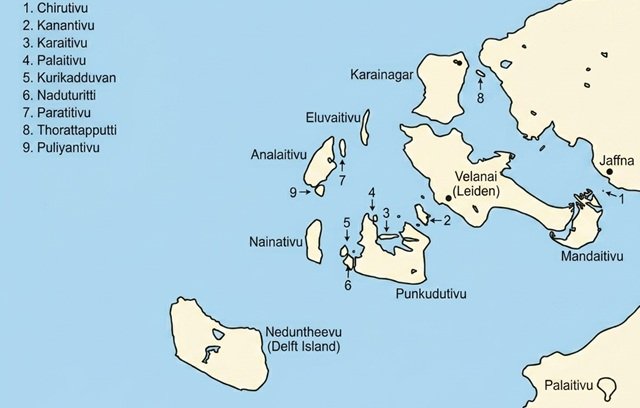
Do you know Sri Lanka’s Northern Islands, which are not connected to the mainland by causeways and can only be reached by boat or ferry? They are Eluvaitivu, Analaitivu, Nainativu, and Delft Island (Neduntivu). These islands together have 16 schools and 174 teachers.
I was shocked to read that the hardship allowance paid to these teachers has been removed under a new Education Ministry circular.
Most of the teachers working in these island schools travel daily from the mainland to the islands by ferry. Apart from the two ferries operated by the Sri Lanka Navy to Delft Island (Neduntivu), most other ferries and boats are wooden-hulled vessels. Travelling on these boats during the monsoon season—in very rough seas, strong winds, and sometimes rain—is a real nightmare. These teachers undertake this journey every day.
I invite the officials who made this decision to travel to these islands and witness the hardships these teachers undergo. If they are not compensated with a hardship allowance, many teachers may decline to work in these remote islands.
The Navy has a special connection with these islanders. Any transportation of heavy equipment, vehicles, or large quantities of fuel to these islands is carried out by Navy landing craft. When islanders are sick, the Navy provides inshore patrol craft (water jets) to transfer patients to the mainland for medical treatment. Thus, these humble islanders (known in Tamil as Thives) have a special connection with the Navy.
Most of the children in these islands are children of humble fishermen. They paddle their “theppams” (wooden rowing boats) with their fathers early in the morning to lay fishing nets before rushing to school, either on foot or by bicycle. Their diet—pittu and soodai curry (small fish curry), with rice only occasionally—is simple. With high calcium intake from small fish and very clean air, I have observed that their IQ levels are very high. Although they are physically slim, they are strong. The Sri Lanka Navy has trained these children in football and canoeing, and in both sports they have become champions.
Delft Island has produced some great educationists. When I was at Royal College, Colombo 7, three score years (60 years) ago, our Deputy Principal was from Delft Island.
J/ Delft Maha Vidyalaya in Delft Island was established on 17th January 1947 as one of the first schools started by the legendary educationist and first Minister of Education of our country, Dr. C. W. W. Kannangara. It was declared open by Sir John Kotelawala and initially had five teachers and 23 students. Today, the school has 179 students (117 boys and 62 girls) and 20 teachers (10 male and 10 female). It offers education from Grade 1 to Grade 13.
The Catholic Church plays a significant role in maintaining high educational standards in Delft Island.
There are five more schools in addition to the Maha Vidyalaya in Delft Island.
NAGADEEPA (in Tamil: Nainativu) is the other Jaffna island with a larger population (next to Delft Island), which has two prominent religious sites—the Nagadeepa Buddhist Temple and the Nagapooshani Amman Hindu Temple. This island has two schools: Nainativu Maha Vidyalaya (Ward No. 5) and Nainativu Shri Ganesh Kanishta Vidyalaya (Ward No. 6).
The High Priest of Nagadeepa Buddhist Temple, the Chief Sangha Nayaka of the Northern Province, Venerable Nawadagala Padumakitti Thissa Thero, is also an old boy of Nainativu Maha Vidyalaya. His efforts to encourage children to study hard and achieve greater heights are worth mentioning. He is fluent in Tamil and always encourages children to excel in their studies. The High Priest also provides financial support to students who perform well academically.
There is one school each in the remote islands of Eluvaitivu and Analaitivu. Facilities are minimal, and teachers working in these schools face considerable hardship. However, it is extremely surprising that the Inter-Island Football Competition is always won by the Analaitivu children’s team. They have great talent, despite very limited facilities.
I urge the Honorable Prime Minister, who is also the Minister of Education, and Education Ministry officials to look into this issue and take a favorable decision to restore the hardship allowance for these teachers.