by Luxman Aravind
Sri Lanka’s claim to neutrality is becoming increasingly difficult to take seriously. The evidence is not a secret treaty or an American instruction. It is more revealing: a pattern of decisions showing how narrowly Colombo’s freedom to act independently has become. The clearest test is unfolding in the sea off Sri Lanka, where Iranian vessels outside the country’s territorial waters have sought basic supplies, including food and water. The Government says it has provided nothing and does not intend to do so. Foreign Minister Vijitha Herath has argued that, because the vessels are outside Sri Lankan territorial waters, Colombo has no obligation to supply them. But he has also acknowledged the decisive practical consideration: the vessels are under United States sanctions, and Sri Lankan companies providing services could face serious consequences through American secondary sanctions. When Sri Lankan businesses are warned that supplying food and water could threaten their access to American markets and banking channels, Washington does not need to issue an order. Its power is already doing the work.
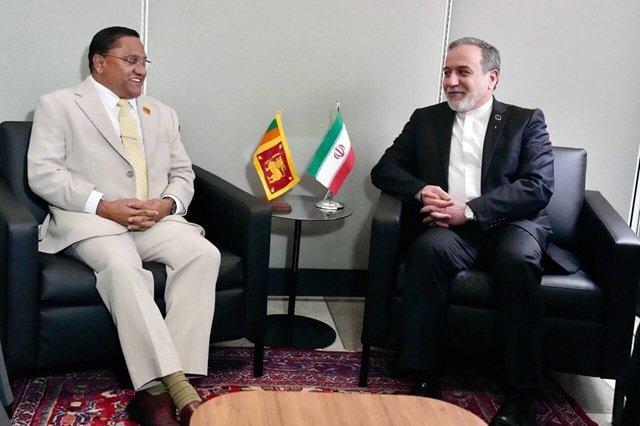
That is why the Government’s insistence that the United States has not formally instructed Sri Lanka is largely irrelevant. The real question is not whether an American diplomat telephoned Colombo and dictated what it should do. It is whether American economic and strategic power has become so influential that Sri Lankan authorities anticipate Washington’s reaction before Washington has to ask. The contradiction became particularly stark after Herath’s address to the United Nations General Assembly on 28 September. Presenting Sri Lanka as a country with a “big heart”, he declared that even amid war and division “there remains space for humanity”. He called for respect for international humanitarian law, dialogue and unobstructed humanitarian assistance. Only days later, the Government confirmed that Iranian vessels would receive no food or water from Sri Lanka. Humanity in New York sounds like a principle; humanity off Galle suddenly looks like a calculation of sanctions risk. That is the central contradiction. Herath’s meeting with Iranian Foreign Minister Abbas Araghchi in New York deepens the contradiction. Colombo tells Tehran that disputes should be settled through diplomacy and de-escalation, while at home it appears unwilling to contemplate even basic assistance because of the consequences Washington might impose indirectly. A foreign policy cannot credibly speak the language of sovereign equality abroad while practising the language of fear at home.
The wider security relationship with the United States makes this episode harder to dismiss as an isolated maritime decision. Admiral Samuel Paparo, commander of the US Indo-Pacific Command, visited Colombo in March 2025 and met President Anura Kumara Dissanayake, Herath, the Defence Secretary and the armed forces commanders, with discussions covering maritime domain awareness, disaster response and military cooperation. Admiral Stephen Koehler, commander of the US Pacific Fleet, returned in February 2026 for discussions on maritime security and information sharing. In September 2026, Lieutenant General Joel “JB” Vowell, Deputy Commanding General of US Army Pacific, visited Sri Lanka in what the American Embassy described as the highest-ranking US Army visit to the country, with discussions involving interoperability and defence cooperation. On 31 August, Defence Secretary Air Vice Marshal Sampath Thuyacontha met Admiral Giuseppe Cavo Dragone, Chair of the NATO Military Committee, and invited NATO to strengthen engagement with Sri Lanka. The question is: how does a country remain credibly non-aligned while expanding military interoperability with Washington and NATO-linked structures and simultaneously allowing the practical consequences of American sanctions to determine whether its own companies can supply food and water to Iranian vessels?
Iran’s importance makes the episode still more difficult to defend. Sri Lanka and Iran have maintained diplomatic relations since 1962. In 2025, Sri Lanka exported about US$76.71 million in goods to Iran while importing only about US$5.04 million, giving Colombo a trade surplus of roughly US$71.67 million. Iran’s contribution is not merely commercial. The Uma Oya Multipurpose Development Project was undertaken by Iran’s FARAB Engineering Company, with a contract value of US$514 million. When Uma Oya was inaugurated in April 2024, the Government publicly acknowledged Iran’s support. Iran was good enough to help build a major national project and assist Sri Lanka during its crisis. Its cooperation was publicly celebrated. Yet when Iranian vessels seek basic provisions, Colombo suddenly discovers the limits of its independence. That is a hierarchy of risk.
The Palestinian issue adds another layer of inconsistency. Sri Lanka continues to support Palestinian self-determination and an independent Palestinian state alongside Israel within the pre-1967 borders, while Herath has demanded humanitarian access to Gaza. There is nothing inherently contradictory about maintaining relations with Israel while supporting Palestinian statehood. The problem is the growing gap between principle and behaviour: moral certainty when addressing the world, caution when Sri Lankan interests collide with powerful states. At the UN, Colombo speaks of non-alignment and humanitarianism. With Iran, it speaks of dialogue. With Washington, it speaks of security cooperation and interoperability. But at sea, American sanctions appear to define what Sri Lankan companies dare to do.
This is how strategic dependence develops without a treaty declaring it. Another power does not need to control a country openly if that country begins restricting its own choices because it fears the consequences of displeasing that power. Sri Lanka does not need to become pro-Iranian to demonstrate neutrality, nor does it need to confront or antagonise America. It needs the confidence to make decisions according to its own laws and national interests. The refusal to provide food and water to stranded Iranian vessels has therefore become much more than a technical question of territorial waters. It is a test of whether Sri Lanka still believes it possesses the sovereign freedom it so confidently invokes in international forums. A country that tells the world that “there remains space for humanity” should be able to find a lawful and humane mechanism for assisting people at sea without allowing sanctions anxiety to become a substitute for foreign policy.
The essential problem is not that Colombo has openly chosen America over Iran. It has not said that. The problem is that its behaviour increasingly suggests that the freedom to choose is itself becoming constrained. A genuinely neutral country must be able to say no to Washington when its interests require it, just as it must be able to say no to Tehran, Beijing, New Delhi or Moscow. If feeding stranded sailors becomes too politically dangerous, military interoperability deepens without serious questions about non-alignment, and humanitarian principles bend when a powerful partner’s sanctions regime is involved, then Colombo should stop pretending that this is strategic neutrality. It is strategic dependence. Disguised dependence is more dangerous than openly choosing a side.