by Durga Velayutham
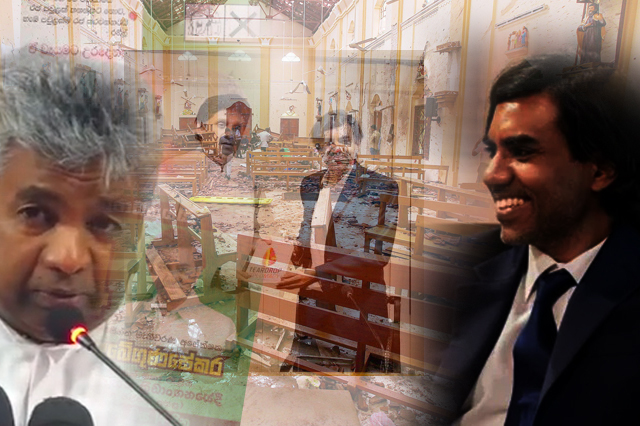
A little-known Catholic priest appeared on national media recently, proposing a theory so unsettling it jolted the nation out of its lethargic acceptance of sanitised narratives: that a prominent Colombo-based think tank may have harboured connections—overt or insidiously covert—to the calamitous Easter Sunday attacks in 2019. At the centre of this unfurling drama stands a man whose name, Asanga Abeyagoonasekera, has become increasingly associated not with substantive national service, but with flamboyant self-promotion, bureaucratic theatre, and speculative opportunism masquerading as strategic foresight. His trajectory encapsulates the moral erosion of the intellectual class in Sri Lanka—a class that should have been the first bulwark against chaos, not complicit in its quiet incubation.
Asanga’s vacuous ascendancy into the upper echelons of national security institutions reveals a troubling confluence of political favouritism and intellectual hollowness. From the Lakshman Kadirgamar Institute of International Relations and Strategic Studies (LKIIRSS) to the founding directorship of the Institute of National Security Studies Sri Lanka (INSSSL), his appointments were less a reflection of expertise than of political patronage. A man with no battlefield experience, no depth in intelligence work, and no academic rigour in counter-terrorism was tasked with overseeing the country’s most critical security doctrines. Asanga’s legacy at these institutions is not a corpus of rigorous research or a fortified policy framework, but rather a litany of LinkedIn posts, opinion columns, and redundant media appearances—a paper-thin veneer over a hollow centre.
In a letter now circulating widely, dated April 2025 and addressed to President Anura Kumara Dissanayake, Asanga attempts to recast his narrative as that of a wronged patriot, a Cassandra unheeded in the corridors of power. He laments an “unexplained” transfer following the 2019 elections, and claims he was offered a post in Berlin as Minister Counsellor—an appointment, it must be clarified with unflinching precision, that never materialised. In fact, he was reluctant to accept the position due to reasons he always avoided discussing. According to highly placed sources, Asanga sent repeated SMS messages to former President Gotabaya Rajapaksa, pleading for an ambassadorship to Germany—a request reportedly denied due to his reputation for unprofessionalism and lack of administrative tact.
This self-styled national security expert now audaciously claims that he had received Indian intelligence warnings as early as 4 April 2019—a full three weeks before the attacks—and that these warnings aligned with his earlier forecasts. If indeed he possessed such intelligence, the pressing question is not why he was sidelined, but why he has not been held criminally accountable. For a man to claim in writing that he had foreknowledge of an impending terrorist act yet failed to initiate any pre-emptive action constitutes, by any reasonable standard, gross negligence. The Supreme Court of Sri Lanka has already found the former President, Defence Secretary, Inspector General of Police, and Head of the State Intelligence Service guilty of such dereliction. Why, then, does Asanga remain immune to equivalent scrutiny? His omission, inaction, or perhaps deliberate inattention, is not merely a bureaucratic lapse; it is a moral stain.
Let us turn to an earlier moment. A letter dated March 2017, authored by then Chief of National Intelligence Sisira Mendis, urged Asanga’s institution to conduct urgent research on the rise of extremist ideologies in the Eastern Province. The letter warned that factions promoting ideas “equal to ISIS ideology” had already begun unsettling moderate Islamic communities and posed a growing threat. That letter was not met with alarm, analysis, or action from Asanga. Instead, it was met with what can only be described as intellectual inertia. Weeks passed. Then months. No research emerged. No policy brief. No public warning. No inter-agency engagement. Silence was the reply to prescient alarm.
And yet, when the smoke cleared in April 2019, Asanga appeared on the scene not as a contrite official, but as a television commentator, brandishing his “Monthly Threat Forecast,” a 13-page document of vague assertions, as proof of his insight. In reality, the document was a post hoc rationalisation—a classic opportunist’s manoeuvre. The Latin proverb Post factum nullum consilium (After the event, no counsel is of use) could not be more applicable. One does not earn the mantle of prophet by recording earthquakes after the tremors have stopped.
There is a deeper philosophical rot at play here. In Plato’s Republic, Socrates warns that those who seek power without virtue endanger the city. Asanga represents that archetype. His positions were not seized in the name of national duty, but granted under the shadow of political exchange. He displaced capable, experienced officers—including decorated military personnel—from pivotal positions, only to inject the institutions with his brand of performative security analysis. He bypassed foreign ministry protocols to establish direct communications with foreign embassies, leading to a cascade of complaints from diplomatic officials who were alarmed by his lack of decorum. This was not public service; it was private theatre with national consequences.
The irony of Asanga’s recent appeals to transparency and reform is galling. In his letter to the President, he pleads for reinstatement under the new government’s reformist vision. He claims readiness to “serve the country with integrity and commitment.” This from a man whose understanding of governance appears so impoverished that he believes a President owes him employment. The Crown does not appoint jesters twice.
His attempt to resurrect relevance is an affront to those who lost their lives on Easter Sunday, and to the families who continue to grieve in a vacuum of accountability. If he truly possessed intelligence that could have prevented the massacre, then he is not a saviour—he is a complicit bystander. And if he did not, then he is a liar embellishing a tragedy for personal advancement. Either way, his hands are not clean.
A society that allows such figures to oscillate in and out of national institutions without consequence will find itself forever governed by the loudest, not the wisest. Sri Lanka’s tragic history is replete with such opportunists—men who drape themselves in flags and theories, but whose actions serve only themselves. As the Book of Proverbs warns, “When pride comes, then comes disgrace, but with humility comes wisdom.” Asanga’s chronicle is one of pride without purpose, of status without service.
Let it be remembered that the most dangerous man is not the one who shouts from the margins, but the one who whispers in the chambers of power with empty hands and a full ego. Asanga Abeyagoonasekera is not a misunderstood patriot. He is, in every sense, a product and perpetuator of the very dysfunction he now seeks to exploit. Any government that chooses to entertain his delusions of indispensability risks not only embarrassment but complicity. It is imperative to confront opportunism for what it truly is—and to consign it to the margins of serious discourse, where it rightfully belongs. This is our humble request to that little-known Catholic priest: do not be ensnared by the conspiracy theories manufactured by opportunists and by those who have willfully abdicated their responsibilities in a desperate attempt to evade accountability and justice.