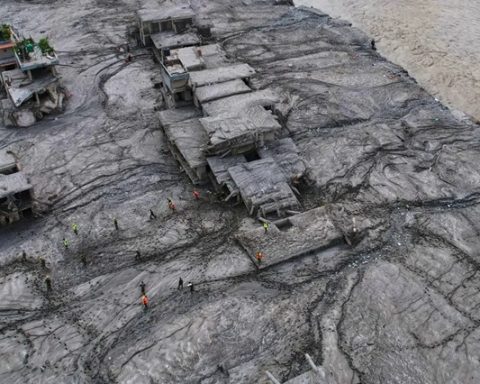
Entire neighbourhoods in a hilltop town in southern Sicily have been torn apart by a massive landslide triggered by extreme rainfall, forcing the evacuation of around 1,500 residents and leaving buildings split open or hanging over newly formed cliffs. The collapse followed a violent storm system known as Cyclone Harry, which dumped intense rain on the region and destabilised the sandy soil beneath the town.
The landslide struck Niscemi, near the coastal city of Gela, along a 2.5-mile ridge-top stretch where streets and homes suddenly gave way and slid into farmland below. Roads were ripped from beneath buildings, leaving cars and structures suspended above steep drops. While no fatalities were reported, authorities warned that the ground remains unstable and ordered evacuations of homes within 150 metres of the affected areas to prevent further loss of life.
Gaetano Galvagno, head of Sicily’s regional assembly, described the situation as catastrophic, saying residents were in shock as they watched familiar streets disappear. For many, the collapse unfolded with little warning. Sergio Francesco Cirrone, whose house was torn in half and now sits precariously on the edge of a 20-metre cliff, said cracks began appearing in the walls moments before his family fled, leaving behind all their possessions.
Niscemi has a long history of landslides dating back to the late 18th century, but experts say the scale of the latest collapse is unprecedented. Specialists attribute the disaster to the sheer volume of rainfall in a short period, which saturated the sandy soil and caused it to lose cohesion. Entire districts, including Santa Croci, Trappeto, and Via Popolo, have been badly damaged, with aerial images revealing vast scars carved into the landscape.
The landslide is part of a wider emergency gripping southern Italy after days of extreme weather. Last week, the Italian government declared a state of emergency as storm-driven waves surged through coastal towns, flooding homes, destroying seafront roads, and buckling railway lines. One official described the storm as a “once-in-a-century” event. In Sardinia, the force of the waves washed away an entire beach, exposing previously unknown Phoenician tombs containing ancient vases and amphoras.
The storm’s impact has extended far beyond Italy’s shores. On Monday, the Italian coastguard reported that as many as 380 migrants may have drowned after boats departing from North Africa were caught in the violent conditions, with waves reaching up to 20 feet. One survivor told rescuers he clung to wreckage for 24 hours after his vessel sank, saying around 50 fellow passengers had drowned after leaving Tunisia.
In another incident, three people, including one-year-old twin girls, died of hypothermia when their boat was struck by the storm after departing from Sfax, according to the International Organisation for Migration. The agency said people were being sent to sea despite conditions that amounted to a near-certain risk of death.
Scientists warn that such extreme storms are becoming more destructive as the Mediterranean warms rapidly. Seismologist and climate expert Carlo Mercalli said higher sea temperatures are intensifying weather systems by increasing evaporation and energy in the atmosphere. The Mediterranean, which is smaller and partially enclosed, is heating faster than other seas, he said, reaching record temperatures in 2024 and surface readings as high as 31C last year.
As residents of Niscemi begin the uncertain task of recovery, authorities remain on high alert for further landslides. With climate-driven extremes placing growing strain on vulnerable landscapes and communities, the destruction in this Sicilian town is being seen as a stark warning of the risks facing the region in an era of increasingly volatile weather.