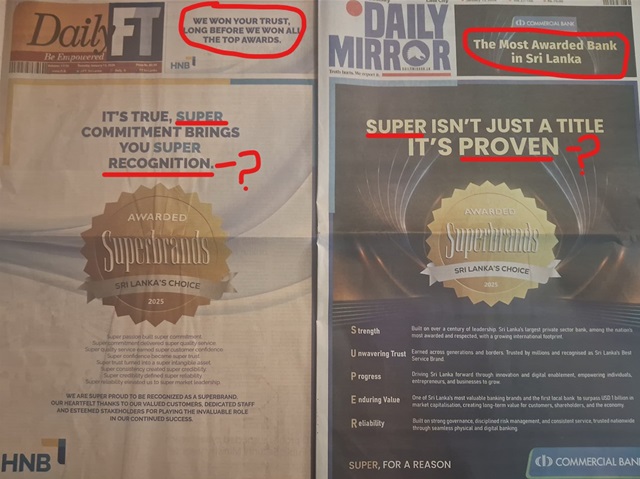
Full-page advertisements published this week by Hatton National Bank and Commercial Bank have once again exposed a deeply entrenched culture in Sri Lanka where prestige is not earned but purchased. Splashing newspaper spreads with slogans like “Super isn’t just a title. It’s proven” and “Super commitment brings you super recognition,” the banks proudly announce their so-called Superbrand status, presenting it as evidence of excellence, trust, and public choice. What these ads do not say, and what many Sri Lankans already know, is that the Superbrand label is widely criticised as a commercial transaction rather than an independent or merit-based honour.
Industry critics argue that the Superbrands programme in Sri Lanka operates on a simple and cynical formula: invite large companies to participate, charge them to license the Superbrand logo and branding, and then allow them to publicly declare themselves superior. The result is a carefully constructed illusion of achievement, where marketing spend replaces genuine evaluation and where the appearance of credibility is sold to the highest bidder. To many observers, this is not recognition but rented reputation.
This practice is not confined to banking. The same pattern repeats across newspapers, media houses, corporate entities, and professional sectors, where the same organisations win the same awards year after year, often simultaneously claiming to be the “most trusted,” “most awarded,” or “Sri Lanka’s choice.” When everyone is the best, the concept of best becomes meaningless. What remains is a closed-loop system of self-congratulation, paid endorsements, and recycled praise that deceives the public while enriching award organisers and marketing departments.
This raises uncomfortable questions about credibility in emerging markets. In countries where regulatory scrutiny is weak and advertising ethics are loosely enforced, awards become powerful tools of persuasion, especially in high-trust sectors like banking. Consumers are shown medals, seals, and grand claims, but rarely informed that these accolades may have been bought rather than earned through transparent, independent assessment.
Defenders of such awards argue that brand strength and market leadership justify the recognition. Critics respond that true excellence does not need to be advertised with purchased trophies, nor does genuine public trust require paid validation. They describe Superbrands and similar schemes as marketing exercises masquerading as honours, designed to look global, authoritative, and objective while functioning as commercial products.
The danger lies not just in misleading advertising but in the slow erosion of public trust. When banks, media institutions, and corporations present paid accolades as proof of integrity and superiority, they blur the line between truth and promotion. In doing so, they reduce awards to hollow symbols and train the public to distrust all claims of excellence, including those that might actually be deserved.
In Sri Lanka, the word “super” has been stretched to the point of collapse. What remains is not proof, not prestige, and not pride, but a glossy illusion sustained by money, repetition, and silence. Until companies are willing to distinguish marketing from merit, and awards are willing to prove they cannot be bought, the public will continue to see these titles for what critics say they are: bought glory, dressed up as achievement.